B12 Blood Test Explained: Results, Ranges and Next Steps
A B12 blood test measures circulating vitamin B12. Learn what low, borderline and normal results mean and when to ask a clinician about testing.
The most repeated advice is also the least useful. Feel tired, book a B12 blood test, and treat the number as the answer. That shortcut turns a screening measurement into a diagnosis, and it sends people toward supplements before anyone has asked why the level looks the way it does.
A B12 blood test is a starting point, not a verdict. It shows vitamin B12 circulating in the blood at the time of the draw. It doesn't, on its own, prove deficiency, clear you, or decide whether a tablet is the right next step. In Australia, clinicians read that figure beside folate, the full blood count, symptoms, and sometimes methylmalonic acid or homocysteine.
If you've been told that tiredness alone justifies the test, or that a result inside the range ends the question, both ideas leave out the part that changes care.
What a B12 Blood Test Actually Measures
Say you've been flat for weeks and you book a blood test expecting a yes or no. The draw is simple. What the laboratory reports is narrower than many patients anticipate.
Vitamin B12 is needed for red blood cell production and for normal nerve function. Your body can't make it, so it has to come from food or from a supplement. A standard test measures serum B12, the amount in circulation when the sample is taken. It doesn't measure the store in the liver, and it doesn't show what your cells can use that day.
Picture a bank account. The serum figure is the balance on the statement. Active B12, the fraction bound for delivery to cells, is closer to cash you can spend. A healthy balance doesn't prove money is moving where it's needed. That's why a result inside the printed range can still sit next to tingling, a sore tongue, or a blood film that looks wrong.
What the visit covers
A collector takes blood from a vein in your arm. Folate is often measured on the same sample, because the two shortfalls can occur together and both can affect red cells. You get a number, a unit, and a reference range set by that laboratory's assay. Fasting isn't usually required for B12 alone. If the request also covers lipids or glucose, follow the instructions printed for those tests.
Intake and blood level aren't the same thing. Healthdirect's guide to the vitamin B12 test reports Australian Bureau of Statistics estimates that 9.7% of Australians aged 2 years and over, about 2.4 million people, had inadequate vitamin B12 intake from food and beverages in 2023, up from 2.8% in 2011–12. That rise explains why testing comes up. It doesn't prove anyone in that group has a low blood result. Absorption, liver stores, supplements, medicines, and other conditions all move the concentration.
Practical rule: Match the result to symptoms, diet, medicines, and the blood count. Don't match it to a national intake figure.
Australian guidance treats anaemia or an abnormal blood count, tiredness with weakness or dizziness, neuropathy, a restricted diet such as vegan eating, gut disease that limits absorption, pregnancy or breastfeeding, and mental-health changes as reasons a clinician may test. The test covers circulating B12 that morning. It leaves out the cause, the size of body stores, and whether nerves are already involved. One number is one part of the picture, and a clinician should interpret it.
Reading Your Result Against the Reference Range
Open the report and look for three things before you react: the number, the unit, and the reference interval printed beside it. Consumer sites often collapse that into a single cutoff. Laboratories don't work that way, and a general band is only a guide.
| Serum B12 band | Typical interpretation | What usually follows |
|---|---|---|
| Below 150 pmol/L | Low, and usually consistent with deficiency | Clinician review, often with MMA or homocysteine, before any treatment decision |
| 150 to 200 pmol/L | Borderline grey zone | Symptoms, the blood count, and folate decide the next step |
| Above 200 pmol/L | Generally within many working ranges | Doesn't rule deficiency out if symptoms persist |
| Printed laboratory reference range | Set by each laboratory and assay | Use the range on your own report, not a figure from a website |
How the bands get misread
A result below 150 pmol/L is the band clinicians usually treat as low, and it still needs a person to confirm the pattern before treatment starts. 150 to 200 pmol/L is the grey zone. The same number can be reassuring in someone well, with a normal blood count, and concerning in someone with new numbness. Above 200 pmol/L often sits inside a laboratory's interval, yet it isn't a clearance certificate if gait, memory, or a sore tongue are changing.
Population figures show how wide "typical" is, and they aren't cutoffs. Australia's 2022–24 National Health Measures Survey reported a mean serum vitamin B12 of 395 pmol/L and a median of 355 pmol/L among measured Australians, with the middle half between 267 and 468 pmol/L. Subgroup means ran from 368 to 409 pmol/L, and subgroup medians from 336 to 364 pmol/L. People don't cluster on one universal value.
A result near the population median can still be the wrong result for you if the assay range, the blood count, or the symptoms point elsewhere.
Reading the flag on your page
Find the interval the laboratory printed, check the unit is pmol/L, and note whether the flag says low, borderline, or within range. Assays differ, so a number that one lab flags can sit inside another lab's interval. Compare your result with the range on that report. A range copied from a website, or from an overseas article that uses pg/mL, will send you to the wrong conclusion.
Serum B12 is commonly read with folate, because the two deficiencies can coexist, and the B12 figure alone doesn't show cause, severity, or how much B12 is available to cells rather than stored. A borderline or unexpected result needs clinical correlation, not a supplement started from the PDF.
Symptoms and Risk Factors That Justify Testing
Tiredness on its own isn't a reason for this test in Australia. The Medicare Benefits Schedule states that tiredness alone isn't an appropriate indication. Testing becomes relevant when fatigue sits with something else: anaemia or macrocytosis on the full blood count, cognitive change, visual symptoms, glossitis, paraesthesia, an impaired gait, balance trouble, or other neurological signs.
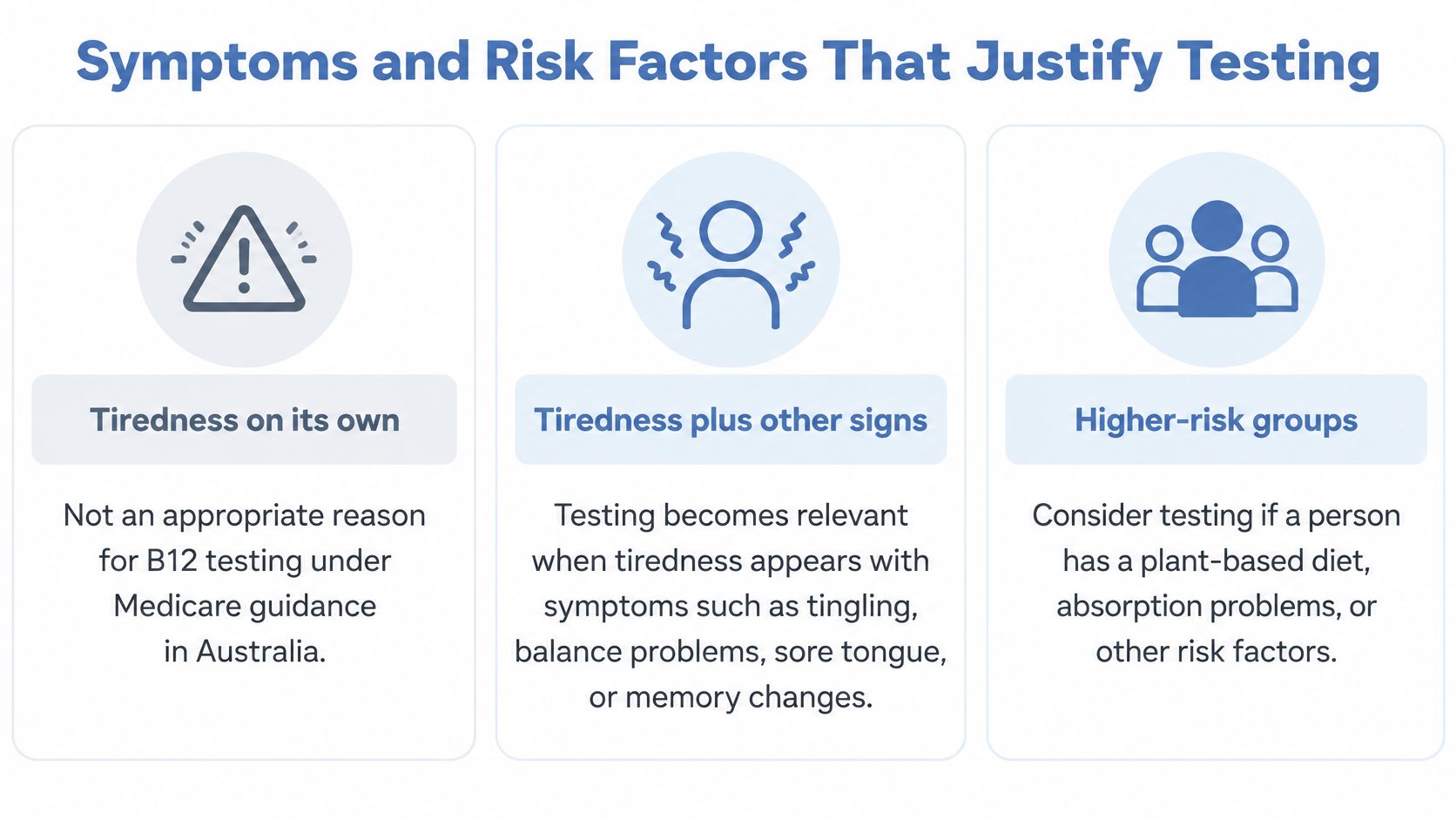
That rule matches the biology. When B12 is too low for DNA synthesis, the marrow releases large, immature red cells, the megaloblastic pattern a full blood count can pick up. When myelin and nerve cells are short of B12, people notice numbness, poor balance, or spinal-cord features. Those two consequences don't always arrive together.
What belongs on the checklist
Bring a specific list, not "I feel off."
- Blood count changes: Anaemia, or red cells that are larger than expected, is a stronger prompt than fatigue by itself.
- Nerve symptoms: Tingling, pins and needles, an unsteady walk, or balance problems justify a conversation even when energy is only slightly down.
- Thinking and vision: Memory or concentration changes, and visual symptoms, belong in the same discussion as the blood result.
- Mouth and tongue: A sore, smooth tongue, glossitis, is easy to dismiss and worth mentioning.
- A normal haemoglobin: Neurological problems can show up with little or no anaemia, so a normal haemoglobin doesn't exclude a clinically important deficiency.
Who is more likely to need the test
Risk isn't the same as a diagnosis. It tells you when a low or borderline result deserves a proper look rather than a supplement chosen online.
| Risk factor | Why it lowers B12 | When testing is relevant |
|---|---|---|
| Coeliac disease | Reduces absorption of B12 from the gut | Symptoms, anaemia, or an abnormal blood count, read with diet history |
| Atrophic gastritis | Reduces stomach acid and intrinsic factor | Gastrointestinal history reviewed with the full blood count |
| Type 1 diabetes | Autoimmune association raises deficiency risk | Autoimmune risk reviewed when a low or borderline result appears |
| Vegan or restricted diet | Low dietary intake of B12 | Neurological symptoms or a large-cell blood pattern |
| Pregnancy or breastfeeding | Higher demand for B12 | Clinician review, usually with folate |
A borderline result should trigger a review of the blood count, diet, gut history, medicines, autoimmune risk, and nerve symptoms. Supplementation without that review can mask the cause, including coeliac disease or atrophic gastritis, and it can confuse the next blood test.
Why a Normal or Borderline Result Needs Context
A result stamped "normal" feels like permission to stop. It often isn't. Total serum B12 measures what is circulating. It doesn't always reflect whether cells have enough usable vitamin. Someone can sit inside the reference interval and still have symptoms that fit deficiency, or a blood count that doesn't match the cheerful flag.

Clinical Labs' explanation of revised Medicare items for vitamin B12 describes the practical gap. Many explanations stop at low versus normal. From 1 July 2025, the Medicare Benefits Schedule supports first-line total B12 or holotranscobalamin testing, then methylmalonic acid (MMA) or homocysteine when that first result is inconclusive or abnormal.
What the extra markers add, and where they mislead
MMA tends to rise when cells lack functional B12, so it can help when the serum result and the symptoms disagree. Homocysteine can rise with low B12 or low folate. Neither marker is a verdict.
- Homocysteine isn't specific. Reduced kidney function, folate deficiency, and vitamin B6 deficiency can lift it too.
- MMA needs context. It can also rise when kidney function is reduced, and it isn't automatic for every borderline result.
- An abnormal extra marker doesn't prove deficiency any more than a normal serum result clears it.
| Marker | What it reflects | Limitation to know |
|---|---|---|
| Total serum B12 | Circulating B12 at the time of the draw | Doesn't always reflect usable B12 inside cells |
| Holotranscobalamin | Active B12 bound to its transport protein | Read with total B12, not on its own |
| Methylmalonic acid (MMA) | Rises when cells lack functional B12 | Can also rise with reduced kidney function |
| Homocysteine | Rises with low B12 or folate | Kidney impairment and vitamin B6 deficiency also raise it |
Symptoms, blood-count changes, diet, malabsorption risk, medicines, kidney function, and any treatment already started have to be read together. That's especially true if you arranged a private test and received an isolated number without a pathway for what comes next.
A short clinical walk-through of why the first number sometimes isn't enough:
Take that isolated result to a clinician. Don't decide from the flag alone that you're fine, or that you're deficient.
Reading Results Together
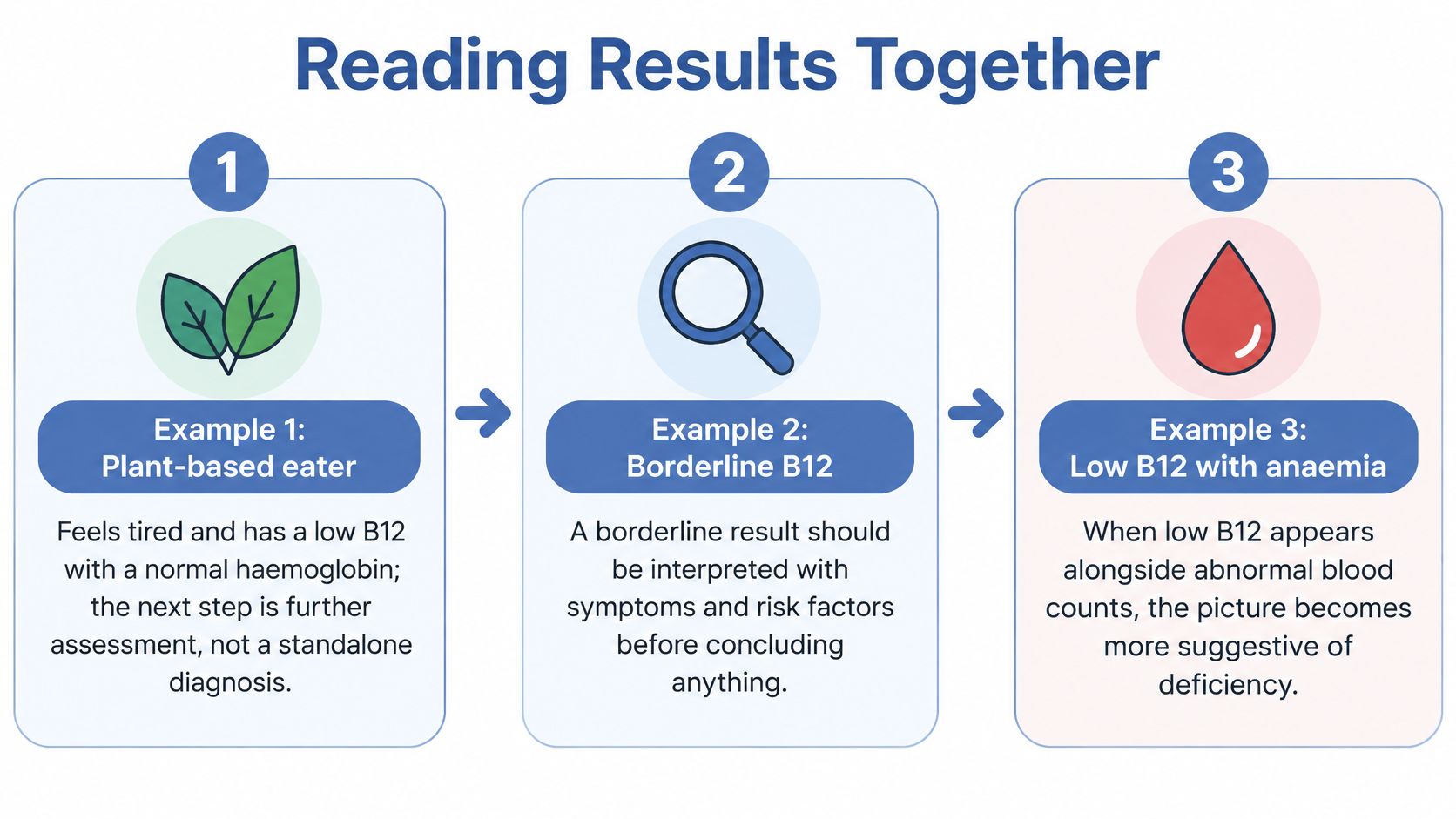
The same serum figure means different things once folate, the blood count, diet, and nerves are on the page. These three sketches are examples, not case records.
A plant-based eater, tired, with a low result and a normal haemoglobin. Intake is the obvious clue, and a normal haemoglobin doesn't retire the question. The useful next step is a clinician reviewing diet, the full blood count, and, if the picture is unclear, MMA. Starting a high-dose supplement the same afternoon can fix the number and hide whether absorption was ever the problem.
New tingling in the feet, with a borderline result around 180 pmol/L. That value sits in the grey zone in this example. Numbness means deficiency isn't excluded. Second-line markers, plus a proper look at gait and sensation, matter more than repeating the same serum test next week and hoping the flag changes.
A normal result, persistent numbness, and known coeliac disease. Here the serum figure is the least interesting line. Gut disease that limits absorption keeps the question open, and the next investigation follows the bowel history rather than a website cutoff.
Patterns, not single lines
| Result pattern | What it can suggest | Usual next step |
|---|---|---|
| Low B12, low folate, large-cell pattern on the blood count | Combined deficiency is likely | Clinician confirms the cause, plans treatment, and arranges a recheck |
| Low B12, normal blood count, no neurological symptoms | Early or mild deficiency is possible | Clinician decides on repeat testing and a dietary review |
| Borderline B12 with tingling or a gait change | Deficiency isn't excluded | Second-line markers such as MMA, plus neurological review |
| Normal B12 with persistent neurological symptoms | Deficiency is less likely, not excluded | Clinician reviews other causes and considers MMA |
| Low B12 with coeliac disease or gastritis | An absorption problem is likely | Clinician investigates the gut cause before relying on supplements |
Each row ends on the same two questions. What else is being measured, and who is interpreting the set together? A low result with a large-cell film and low folate points toward combined deficiency and a planned recheck. A low result with a quiet blood count and no nerve symptoms can be early and mild, so repeat testing and diet may be enough. A normal result with numbness that won't settle still needs someone to consider other causes, not a shrug.
Confirm Your Next Step With a Clinician
Decide from the pattern, not from the urge to start a bottle.
If the result is low or borderline, or any feature on the symptom checklist is present, book a GP or another clinician before you start or stop a supplement. The cause has to be found, and the plan has to fit the result, including whether injections, oral replacement, diet, or investigation of the gut comes first. If the result sits in range and symptoms persist, ask whether MMA or homocysteine, folate, and a full blood count should be added rather than repeating serum B12 in isolation.
Questions worth taking to the appointment
- Range and units. What reference range does this laboratory use for B12, and is the unit pmol/L?
- Folate. Was folate measured on the same sample?
- Second-line tests. Are MMA or homocysteine needed to clarify an inconclusive or mismatched result?
- Timing. Which symptoms should prompt a repeat, and when should that be?
Private testing in Australia doesn't require a GP referral. At Vital iQ Health you can order online, choose from 41 pathology panels, attend a NATA-accredited collection centre, and receive results within 24 to 72 hours. Our laboratories and collection centres are NATA accredited. That speed supports the conversation with a clinician. It doesn't replace the person who can weigh symptoms, the blood count, diet, and medicines against the number.
A private PDF without that conversation is still an incomplete test.
If you want a B12 result you can discuss, Vital iQ Health offers private vitamin and pathology testing across Australia, including B12 within broader panels, ordered online and collected through NATA-accredited centres. Pair the result with a clinician, including our telehealth GP consultations, so a borderline or unexpected figure gets a proper next step. Visit Vital iQ Health to arrange the test and plan that review.
Published via the Outrank app