Sperm Count Test Near Me: Results, Costs and Next Steps
Looking for a sperm count test near me in Australia? Learn what the test measures, how to prepare, how to choose a service and what to ask your doctor.

If you find the closest place for a sperm count test, have you also found the right test? Not necessarily. Preparation, laboratory scope and referral status can matter more than the distance to the collection centre.
When you search for a sperm count test near me, look for a service that can explain what it measures, how to collect a valid sample and who'll review the result. A semen analysis is a snapshot, not a verdict on your ability to have children.
Sperm Count Reference Values at a Glance
| Parameter | WHO 2021 lower reference limit | Unit |
|---|---|---|
| Semen volume | 1.4 | mL per ejaculate |
| Sperm concentration | 16 | million per mL |
| Total sperm count | 39 | million per ejaculate |
| Progressive motility | 30 | % of sperm |
| Total motility | 42 | % of sperm |
| Normal morphology | 4 | % of sperm |
| Vitality | Laboratory-specific reference interval | % |
| pH | Laboratory-specific reference interval | pH units |
| Viscosity | Laboratory assessment of sample consistency | qualitative |
The RCPA semen analysis guidance lists a sperm concentration reference value above 15 million per millilitre. The WHO 2021 lower reference limits shown here are fifth-centile benchmarks: they describe the lower end of results among a reference population of recently fertile men, not a line that separates fertile from infertile people.
A result just below a benchmark calls for interpretation, not an automatic diagnosis. The values are reference points, rather than a fertility scorecard.
Check the label beside the number
Concentration describes the number of sperm in a measured amount of semen. Total count describes the number in the whole ejaculate. The distinction is like comparing the number of cars on one block with the number across an entire city: the figures answer different questions.
Motility also has two labels. Progressive motility counts sperm moving forwards; total motility includes all moving sperm, whether or not they move forwards. Compare each result with the matching row, rather than treating the percentages as interchangeable.
Morphology is the proportion of sperm with a typical shape under the laboratory's assessment criteria. Vitality measures whether sperm are alive, which is different from whether they move. Volume, pH and viscosity add further information about the sample.
Practical rule: Read total count and motility alongside concentration. Don't interpret concentration alone.
A result within the reference limits does not guarantee fertility. A result outside them does not identify the cause on its own, so the laboratory's comments and clinical interpretation matter too.
What a Semen Analysis Measures and Why One Number Is Not Enough
A semen analysis is closer to a full car inspection than a speedometer reading. Concentration is a gauge, but a reassuring reading there can't tell you whether every other part is working as expected.
The laboratory looks at quantity and sperm characteristics separately. Your clinician then considers how those findings fit together, rather than choosing the most reassuring or most alarming line.
A report review can help turn unfamiliar laboratory terms into questions you can act on.

How volume and concentration fit together
The calculation is straightforward:
Total sperm count = semen volume × sperm concentration.
For a hypothetical sample, multiplying its volume by its concentration gives the total number of sperm in the collected ejaculate. That explains why a concentration result can't tell you the total count unless you also know the sample volume.
A small volume with a reasonable concentration may still contain relatively few sperm overall. A larger volume can contain more sperm in total even when its concentration looks less impressive. Neither description tells you how well those sperm move.
Consider these contrasting reports:
- Adequate numbers, limited movement: The total count may look reassuring, but reduced motility still needs attention.
- Good movement, very low numbers: A high proportion of moving sperm doesn't erase a low total count.
- Movement and vitality don't match: Some sperm may be alive without moving, so these measurements answer different questions.
Read the report as a set of findings
Morphology adds another dimension by describing sperm appearance. It doesn't measure swimming ability, and it shouldn't be treated as a substitute for motility. Similarly, semen volume describes the amount of fluid collected, not a direct measure of sperm production.
When you open your report, identify the parameter, the unit, the laboratory's reference interval and any collection comments. Then look for patterns across the findings.
A reassuring value in one row doesn't cancel an abnormal value in another.
Avoid turning the report into a self-diagnosis. Its most useful role is to guide a focused clinical conversation about what needs checking, whether the sample was suitable and what investigation comes next.
Choosing a Local Service by Referral, Accreditation and Cost
| Route | Referral needed | Test scope | Typical cost | Best for |
|---|---|---|---|---|
| GP-referred pathology | Yes, GP request | Semen analysis through a pathology laboratory | Obtain a quote; Medicare rebate may apply | Men wanting a clinician-led plan |
| Direct private order | No preliminary GP referral where offered | Confirm formal semen analysis is available | Obtain the full private fee before paying | People seeking direct access |
| Fertility clinic or andrology laboratory | Usually arranged through the clinic | Specialist analysis; confirm review arrangements | Request testing and consultation fees separately | Couples planning conception or arranging further assessment |
| Home test kit | No | Basic sperm estimate; check the product's actual scope | Check purchase price and included services | Preliminary screening, not diagnosis |
Compare the service before comparing the price. A nearby blood collection centre isn't automatically equipped to receive a semen sample, and a private pathology catalogue doesn't necessarily include semen analysis.
Healthy Male's clinical guidance describes formal assessment of concentration, total sperm number, motility, vitality, morphology and semen volume, with additional measurements when indicated. It also advises repeating an abnormal analysis at least six weeks later, preferably through a specialised andrology laboratory.
Ask what the quoted fee includes
An Australian example from IVF Australia's semen analysis information lists an approximate $150 fee and a rebate of about $43.75 with an appropriate GP or specialist request; self-referred testing may not attract that rebate. Treat this as a provider example, not a national price.
Ask whether the quote covers collection, analysis, medical interpretation and any follow-up consultation. Don't assume a pathology request generated through private ordering has the same rebate arrangements as a GP-requested test.
Use this phone checklist:
- Accreditation: Confirm the laboratory and collection arrangements are NATA accredited for the service being offered.
- Test scope: Ask for formal semen analysis, not a sperm count estimate.
- Sample handling: Establish whether collection happens on site and what delivery conditions apply.
- Reporting: Ask when the report is expected and who receives it.
- Clinical review: Identify who'll explain abnormal findings and organise further assessment.
Distinguish network access from test availability
At Vital iQ Health, we use NATA-accredited laboratories, and all our collection centres are NATA accredited. Customers can find their nearest collection centre by selecting their lab network.
Our private blood testing service provides direct access to blood pathology, but that doesn't establish that semen analysis is available through a particular site. Confirm the specific test and collection arrangements before paying or travelling. Blood tests and semen analysis answer different questions, even when both form part of a clinician's assessment.
Book and Collect Your Sample Step by Step
Collection instructions aren't administrative details. They help the laboratory assess a sample that reflects your biology rather than avoidable collection or transport problems.
Use this visual overview to organise the booking and collection process.
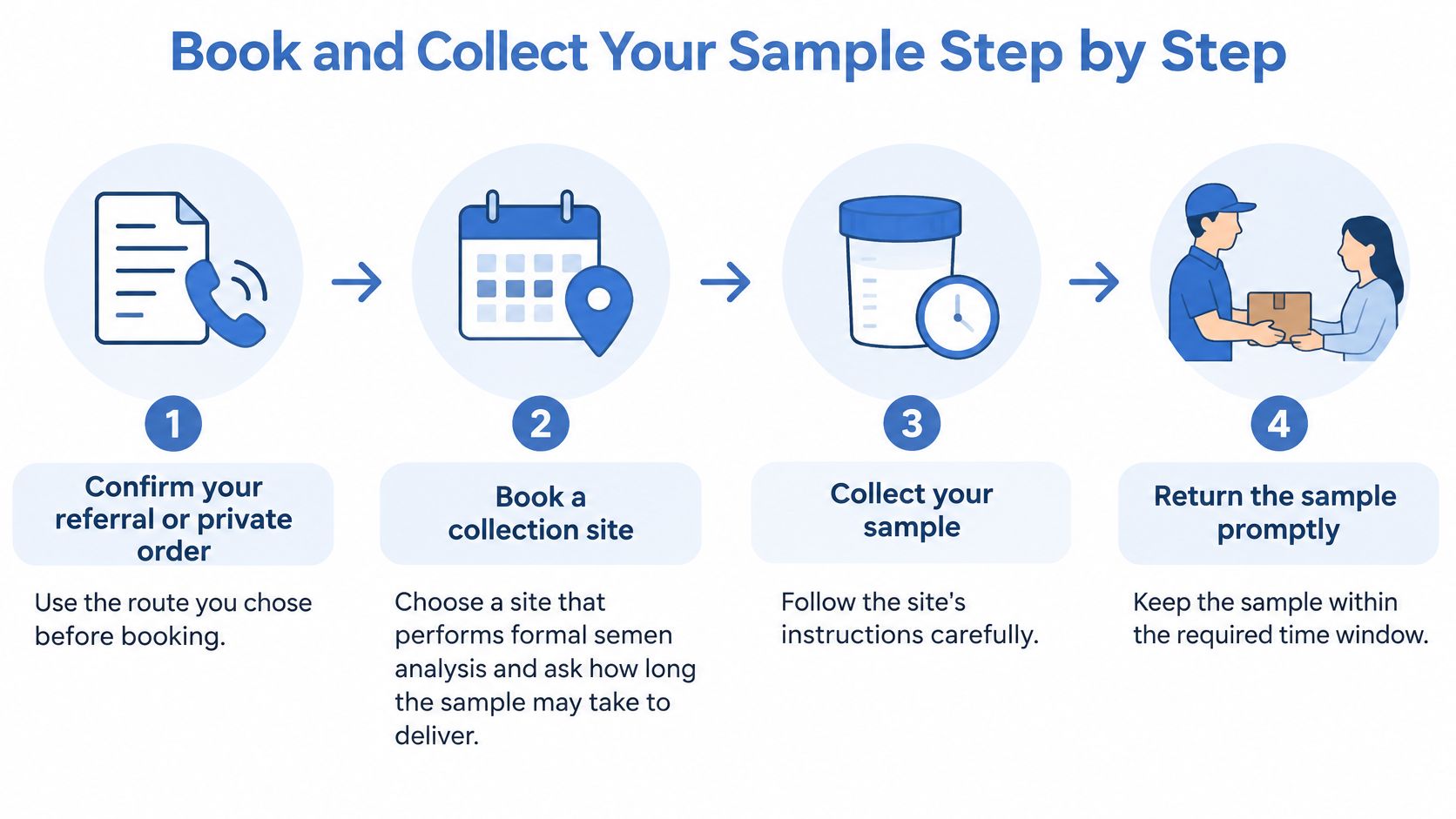
Prepare before collection day
Confirm your order and book the right site. Have your GP request or private order ready, then book a site that performs formal semen analysis. Ask whether it has a collection room and accepts samples collected elsewhere. A common mistake is arriving at a general collection centre without checking whether it handles this test.
Plan the abstinence interval. The Australian male-infertility recommendations specify 2–7 days without ejaculation before collection and prefer on-site collection, with delivery within one hour when on-site collection isn't possible. Choose a suitable date and report any departure from the instructed interval rather than keeping it to yourself.
Collect directly into the supplied sterile container. Collection is generally by masturbation, without lubricants or condoms. Capture the entire ejaculate because losing the first fraction can lower the measured sperm concentration. If you spill any, tell the laboratory which part was lost if you know.
Protect the sample during transport. Keep the closed container close to body temperature and follow the laboratory's delivery instructions. Don't chill it or expose it to excessive heat. Cooling and delays can reduce apparent motility, so tell staff if transport didn't go to plan.
Make the handover and follow-up clear
Provide the collection details. Record the collection time and disclose an incomplete sample, unsuitable abstinence interval or transport problem. The laboratory will assess the requested parameters and may comment on limitations. Don't assume a printed numerical result means the sample was collected under ideal conditions.
Book a named clinician to review the report. Arrange this before collection where possible, especially if you're ordering privately. Ask how you'll receive the result and what happens if the laboratory flags a significant finding. Access to a report isn't the same as having someone responsible for explaining it.
Keep the instructions for any repeat collection. If your clinician requests another sample, use comparable preparation and transport arrangements. Save the laboratory's written instructions and set a reminder once the repeat date is agreed. Changing collection conditions can make comparison harder.
The accompanying video offers another way to familiarise yourself with the process; your laboratory's specific instructions should guide your collection.
What to Discuss With Your Doctor After Results
Bring the full report, including reference intervals and laboratory comments, rather than a screenshot of the flagged count. Add the collection date, your abstinence period and any notes about spillage or transport.
A low count doesn't settle the question of why conception hasn't occurred. It identifies something to investigate within a broader assessment, not a complete explanation on its own.
The first Australian evidence-based male-infertility guidelines report that male factors alone explain about 20–30% of infertility cases and recommend an initial evaluation combining reproductive and medical history, physical examination, including the scrotum, and semen analysis.
Questions to take into the appointment
- Which findings matter most? Ask which parameters are outside the laboratory's reference intervals and whether the pattern is mild, marked or difficult to interpret.
- Was the sample suitable? Check whether incomplete collection, transport or another laboratory flag limits confidence in the result.
- What history could change the interpretation? Discuss your reproductive history, previous relevant treatment, current medicines, hormone use and supplements.
- Do I need an examination? Ask whether the report needs to be considered alongside a physical assessment rather than managed through repeat pathology alone.
- Should my partner be assessed too? Where relevant, fertility evaluation should consider both partners rather than assuming the semen result identifies the whole problem.
- Who owns the next step? Establish whether your GP will arrange further testing or refer you to an andrology, urology or fertility specialist.
Separate a flagged result from a significant finding
No sperm detected, often described as azoospermia, and complete immotility deserve prompt clinical discussion. Don't interpret either finding yourself, but don't leave the report unread until a distant routine appointment either.
Other abnormalities still need attention, although the appropriate response may be a planned repeat collection rather than an immediate conclusion. Your clinician needs to judge the report alongside your circumstances and fertility goals.
Leave with an action, an owner and a review point, not simply a reassurance that someone will be in touch.
Before the appointment ends, write down the clinician's interpretation in plain language. Record which test or referral is being arranged, who will organise it and how you'll hear about the outcome. If the plan is observation or repeat testing, ask what would justify earlier contact.
You don't need to memorise every laboratory term. You do need to understand what the result changes about your next decision.
Repeat Testing and When to Escalate
An abnormal sample usually needs confirmation because semen parameters can change between collections. Repeating the test isn't about trying until you get a reassuring result. It helps your clinician judge whether the finding persists under suitable conditions.
Use the interval your clinician recommends and request a specialised andrology laboratory where appropriate. Keep the abstinence and transport arrangements comparable so that you're not comparing a carefully collected sample with one affected by avoidable handling problems.
Keep a useful comparison record
A short log is enough:
- Collection details: Record the date, abstinence period and whether the whole sample was captured.
- Transport details: Note collection and delivery times, plus any temperature or handling concerns.
- Laboratory comments: Save flags about sample suitability and the reference intervals used.
- Clinical decisions: Record the reviewer's name, interpretation and agreed next action.
Compare matching measures, not just whichever number is highlighted. If the laboratory uses a different motility category or reference interval, ask your clinician to explain the distinction before deciding that the result improved or worsened.
Escalate according to the finding
Contact the requesting clinician promptly if no sperm are detected or the report shows complete immotility. Don't assume the routine repeat pathway is the only action required.
Persistent abnormalities, or ongoing difficulty conceiving despite apparently reassuring results, also warrant a broader clinical plan. Your GP can determine whether an andrology, urology or fertility referral is appropriate.
A normal repeat result doesn't guarantee conception, and a persistently low result doesn't by itself establish sterility. The useful endpoint is a named clinician and a written next step, whether that means further investigation, specialist assessment or a planned review.
We offer private blood testing through NATA-accredited laboratories and telehealth GP consultations to help explain results and discuss next steps. Visit Vital iQ Health to explore these services, and confirm semen analysis availability separately before arranging a collection for fertility assessment.
Refined using Outrank tool