How to Test Hormone Levels in Australia
Learn how to test hormone levels in Australia: match the analyte, time the draw, prepare for collection and review results with a clinician.

The popular advice to order a hormone panel and test on day 21 misses the most important step: deciding what you're trying to find out. A useful blood test answers a named clinical question. More measurements won't necessarily explain your symptoms, and a result collected at the wrong time can create confusion rather than clarity.
If you're working out how to test hormone levels in Australia, start with your symptoms, menstrual pattern where relevant, medicines and a clinician conversation. Then choose the test, arrange the right collection conditions and plan how you'll use the result.
Match the Hormone Test to the Question
Hormone tests matched to the clinical question
| Clinical question | Test to request | Collection note |
|---|---|---|
| Thyroid symptoms or screening | TSH first; free T4, and free T3 only if indicated | Any menstrual cycle day; record biotin, thyroid medicine, pregnancy and illness |
| Possible missed ovulation | Serum progesterone | Mid-luteal, about seven days before the expected period |
| Irregular or absent periods | FSH, LH, oestradiol, TSH and prolactin | Document cycle length and bleeding pattern |
| Suspected high androgens | Calculated free testosterone, free androgen index or calculated bioavailable testosterone | Prefer a validated LC-MS/MS testosterone method |
| Typical menopause symptoms at 45 or older | Usually no routine FSH or oestradiol | Symptom history guides care unless the diagnosis is uncertain |
| Amenorrhoea or oligomenorrhoea under 40 | FSH with the amenorrhoea panel | Premature ovarian insufficiency must be considered |
The RACGP's menopause consultation guidance supports question-led investigation, including mid-luteal progesterone approximately seven days before the expected period, usually avoiding routine menopause hormone testing in typical cases aged 45 or older, and considering premature ovarian insufficiency with absent or infrequent periods under 40.
There's no single blood test called a hormone level. The laboratory measures a particular analyte, meaning the substance being tested, and each analyte answers a different question. A progesterone result used to investigate ovulation can't substitute for a thyroid assessment or establish why someone feels tired.
Choose a pathway rather than a bundle
For possible thyroid dysfunction, thyroid-stimulating hormone, or TSH, is usually the starting marker. Free T4 helps interpret thyroid function; free T3 is added when clinically indicated rather than automatically. The clinician reads the combination, not just whichever number has a flag beside it.
Absent periods are a different problem. Amenorrhoea means absent periods, while oligomenorrhoea means infrequent periods. Assessing FSH, LH, oestradiol, TSH and prolactin together can help a clinician investigate reproductive, pituitary and thyroid pathways rather than assuming the ovaries alone explain the change.
Androgen testing needs attention to the measurement method. Liquid chromatography–tandem mass spectrometry, abbreviated LC-MS/MS, is a laboratory technique used for testosterone assessment. Calculated free testosterone and the free androgen index also help answer questions that total testosterone alone may leave unresolved.
Keep the investigation specific
Cortisol and DHEAS belong in an investigation with a named adrenal question, not a default collection of tests for feeling stressed or run-down. Ask what condition the clinician is investigating and what a result would change.
Likewise, fertility assessment isn't interchangeable with a reproductive hormone panel. If sperm production is the concern, understanding a sperm count test helps distinguish that investigation from measuring hormones in blood.
Before ordering: Write the question in a sentence, such as whether you're ovulating or whether thyroid dysfunction could explain your symptoms.
That sentence gives you and your clinician a practical way to remove tests that don't contribute to the decision.
Skip the Panel When Perimenopause Symptoms Are Typical
For someone with typical perimenopausal symptoms in the usual age group, ordering hormone levels may add a laboratory report without adding a treatment decision. Irregular bleeding, hot flushes and disrupted sleep deserve attention, but proving each symptom with a hormone measurement isn't necessarily useful.
During this transition, hormone concentrations fluctuate. A result can describe the moment the sample was collected without reliably explaining the person's broader experience. That's why a detailed symptom history may be more useful than routine FSH, oestradiol, AMH, progesterone or testosterone testing.
Skipping an unnecessary test doesn't mean dismissing symptoms. It means spending the consultation on what's happening, how much it affects you and what can help.
Use a decision filter
Before adding an analyte, work through these questions with your clinician:
- Describe the problem clearly. Record your bleeding pattern, hot flushes, sleep disruption and changes affecting mood, relationships or work. Include what's new and what's getting worse.
- Name the decision. Would the result change treatment, referral or follow-up? Ask for a concrete answer rather than a general promise of insight.
- Remove measurements that won't help. If a high or low result wouldn't change the next step, there may be little reason to order it.
Say your main difficulty is waking repeatedly with hot flushes and struggling at work the following day. A careful discussion about those symptoms can be useful even without a biochemical label. Buying a larger panel doesn't make that conversation more valid.
A laboratory flag isn't a diagnosis
A reference interval describes results in a reference population. It isn't a personalised boundary separating health from disease, and a result outside it isn't automatically evidence of a disorder.
Age, sex, medicines, supplements and health status affect interpretation. Menstrual context matters too, so a value shouldn't be judged against an interval that doesn't fit the collection circumstances.
There are still reasons to investigate rather than assume perimenopause. An uncertain diagnosis or unexpectedly early menstrual change needs clinical assessment, and FSH may have a role in that investigation.
More biomarkers can create more uncertainty when nobody has defined the decision they're meant to support.
A surprising result is therefore a reason to talk with a clinician, not an instruction to buy another panel. Don't start hormones, supplements or other treatment solely to move a flagged number into the printed interval.
Time Progesterone to the Cycle Not Day 21
When to collect mid-luteal progesterone
| Cycle pattern | When to collect | Why |
|---|---|---|
| Regular 28-day cycle | About day 21 | Approximately seven days before the expected period |
| Regular 30-day cycle | About day 23 | Approximately seven days before the expected period |
| Regular 32-day cycle | About day 25 | Approximately seven days before the expected period |
| Short, long, infrequent or absent cycles | Estimate from the expected bleed where possible; a clinician may arrange serial tests | A fixed calendar day may miss the intended phase |
| Hormonal contraception, postpartum change or typical perimenopause | Clarify whether testing is useful before choosing a cycle day | A calendar-based draw may not answer the intended question |
These are calendar examples of the mid-luteal timing rule, not a universal schedule for every reproductive hormone. The relevant target for progesterone is the phase after ovulation, not a date chosen because it's familiar.
Use the timeline to connect the collection date to your expected next period.
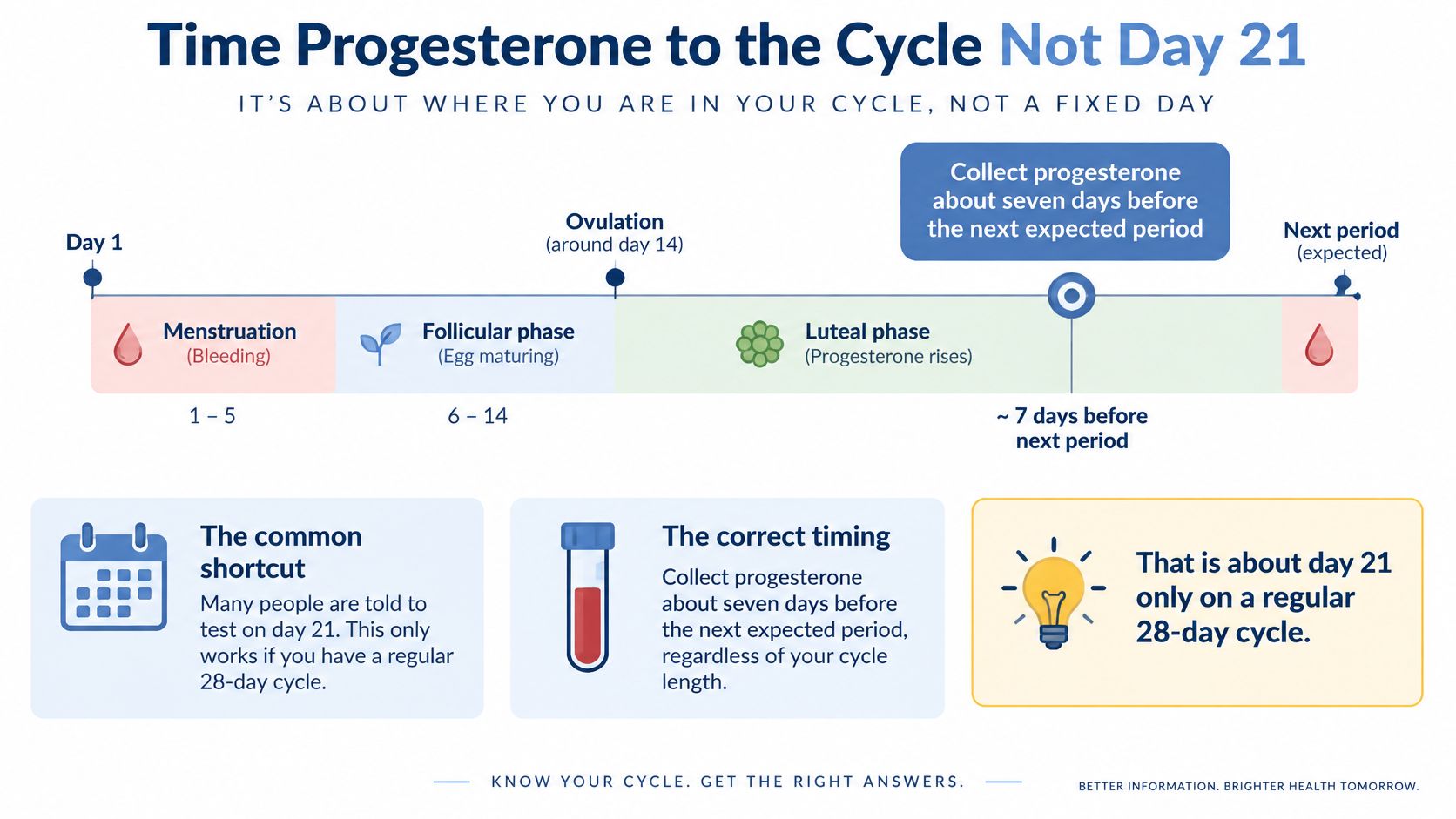
Make the calendar useful
Record the first day of full menstrual bleeding, rather than a day of light spotting, as the start of your cycle. Add your usual cycle length and the expected date of your next period so the clinician can work backwards to an appropriate collection date.
If your cycles aren't predictable, don't guess a standard booking day and assume the result will settle the question. Your clinician may need a revised collection date or serial progesterone measurements. If you aren't having periods, ask how ovulation should be investigated instead of trying to calculate an expected bleed.
Also record hormonal contraception, recent childbirth and relevant medicines. These details can change whether a naturally cycling interpretation is appropriate at all. Don't stop contraception or prescribed treatment just to make a blood test easier to interpret.
A video explanation can help you discuss the timing with your clinician.
Don't confuse ovulation testing with menopause testing
Progesterone collected to investigate ovulation has a specific purpose. It isn't a general score for reproductive health, and it doesn't turn a broader hormone panel into a reliable menopause assessment.
The same restraint applies when ordering directly. Healthdirect's guidance on understanding pathology tests emphasises interpreting pathology in context and recognising that not every test is useful. Access to a request form doesn't remove the need to decide what a result would mean.
Before collection, give the clinician or collector a concise note containing:
- Last period: The date full bleeding started.
- Cycle context: Your usual cycle length and whether the current cycle is unusual.
- Expected next period: The date used to plan collection.
- Relevant treatment: Contraception and other medicines.
Keep that note with the report. Without the collection context, a seemingly low progesterone result may be much harder to interpret.
How to Arrange the Draw and Prepare
Preparation starts before venepuncture, the collection of blood from a vein. The aim is to collect the right sample under conditions that make the answer usable, not merely to get to the collection chair.
This process shows the path from a clinical question to the blood draw.
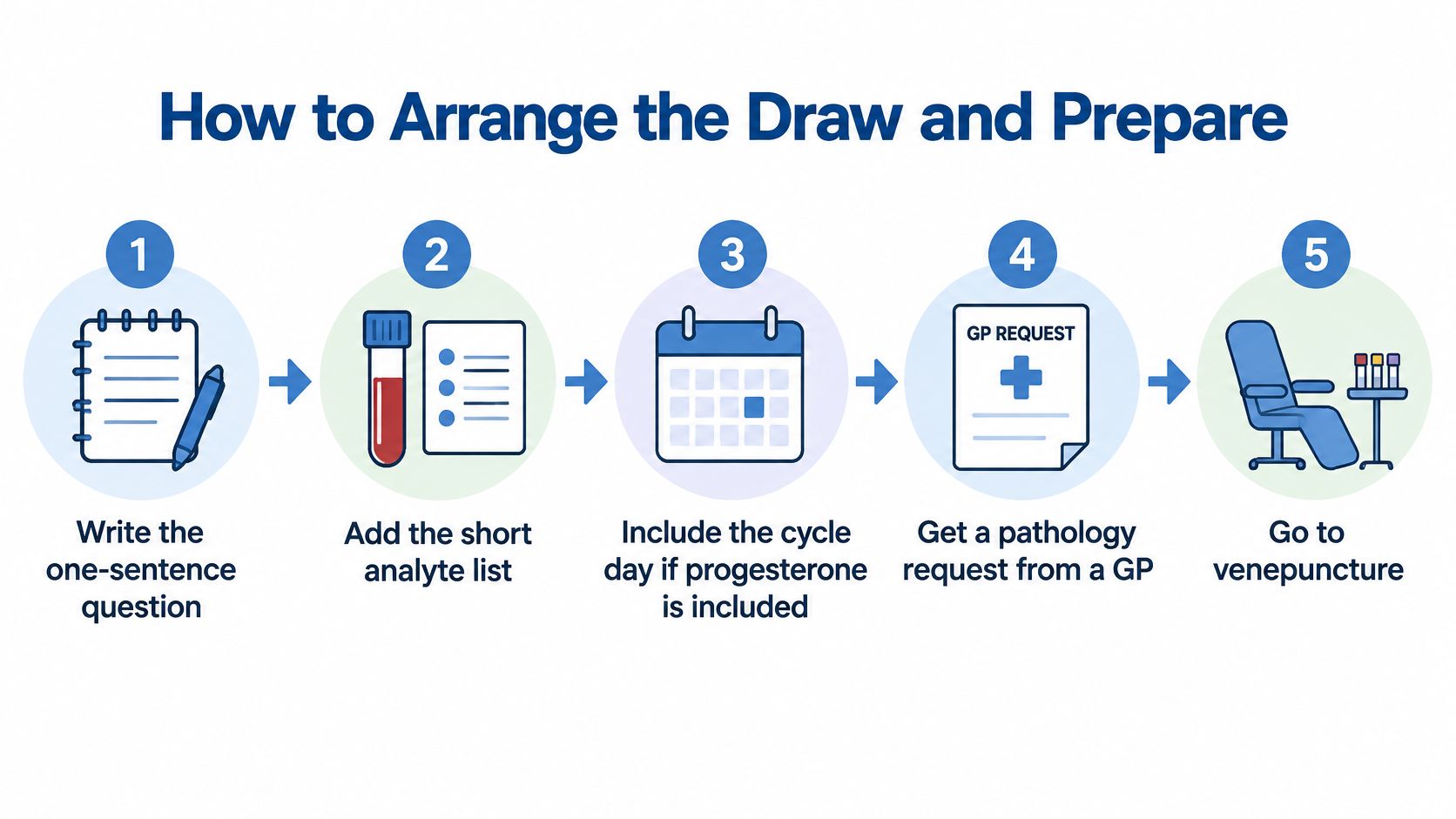
Arrange access and the appointment
Write down the question and agreed analytes. Include the intended cycle phase if progesterone is being measured. This helps prevent an appointment being arranged for convenience rather than clinical usefulness.
Obtain a pathology request. A GP can organise testing after assessment. Through our private blood testing process, you can also order online without a prior GP referral and receive an emailed pathology request after payment. That form provides access to testing, not a diagnosis.
Choose the collection centre and confirm its arrangements. We use NATA-accredited laboratories and collection centres, and you can find a nearby centre by selecting the laboratory network. Check whether the centre requires a booking and whether its opening hours suit the intended collection date.
Check the date against the clinical purpose. For example, suppose someone with a longer regular cycle is booked on the familiar calendar day without anyone checking the expected next period. Recalculate the booking from the expected bleed with the requesting clinician rather than treating the existing appointment as fixed.
Document anything that can affect the sample
List medicines and supplements by name and dose. Include thyroid medicine and when you take it. Don't omit hair, skin or nail supplements just because you don't consider them medicines.
Resolve high-dose biotin before thyroid collection. NSW Health Pathology's thyroid testing guidance advises withholding biotin exceeding 5 mg per day and delaying thyroid blood collection for at least three days after the last dose, because interference with the assay can produce misleading results. If biotin is prescribed, confirm the plan with the treating clinician rather than stopping it independently.
Record pregnancy, acute illness and hormonal treatment. These details can alter interpretation. Tell the requesting clinician if your circumstances change between receiving the form and attending collection.
Follow the request's fasting instructions. Don't invent a fast for reproductive hormone testing. If other tests on the request require fasting, follow those instructions, and clarify anything unclear before the appointment.
Ask for relevant collection details to be documented. Include cycle information and medication timing where appropriate. Keep a copy yourself so you can provide it when discussing results.
Keep the laboratory consistent when monitoring. Using the same laboratory can reduce avoidable differences between reports. If interference is suspected, however, the clinician may deliberately request a validated alternative assay rather than repeat the same method.
Bring the pathology request, identification if required by the collection service, and your cycle and medication note. Don't change prescribed thyroid treatment or other medicines to improve the appearance of the result.
Read a Discordant Result Before Adding Tests
If TSH and free T4 don't fit together physiologically, adding unrelated hormones won't explain the mismatch. A discordant result is a reason to check the sample context and measurement method before drawing a conclusion.
Start with the practical details. Did you take thyroid treatment as prescribed, and when was the dose taken relative to collection? Was a supplement omitted from the request history, or was the sample collected during an illness?
Check the result before expanding the investigation
- Confirm treatment use. Tell the clinician about missed doses, recent changes and the collection-day dose timing. Don't retrospectively adjust your account to match what you think should have happened.
- Review supplement exposure. Bring the actual label or a photograph so the clinician can identify ingredients and doses.
- Check the laboratory method. Different assay platforms may produce results that aren't directly comparable. The clinician can ask the laboratory about suspected interference.
- Plan a purposeful repeat. Repeat testing may use the same laboratory for consistency or an alternative validated assay to investigate a measurement problem.
Laboratory error isn't the only explanation, and persistent inconsistency needs clinician review. The point is to test an explanation, not assume that an unexpected result is either definitely disease or definitely harmless.
Avoid the single-androgen PCOS diagnosis
An abnormal testosterone result alone doesn't diagnose polycystic ovary syndrome. According to Australian Prescriber's PCOS guidance, adult diagnosis requires two qualifying features, ovulatory dysfunction, clinical or biochemical hyperandrogenism, or polycystic ovaries/high AMH, after other causes have been excluded.
The clinician may consider androstenedione, DHEAS and 17-hydroxyprogesterone when testosterone is normal but clinical suspicion persists. Those tests investigate specific possibilities, including non-classical congenital adrenal hyperplasia, rather than just expanding the panel.
Regular bleeding also doesn't guarantee ovulation. Conversely, an isolated result collected at an unsuitable point in the cycle can't reliably settle whether ovulation occurred.
The Australian Prescriber fertility testing guidance places progesterone collection approximately seven days before the next expected period, explaining why a regular 28-day cycle suggests about day 21, a 30-day cycle about day 23, and a 32-day cycle about day 25. It also explains that pulsatile secretion, particularly of LH, can cause substantial differences between samples.
A useful repeat tests an explanation. It isn't simply another attempt to obtain a reassuring number.
Keep a short record of bleeding, energy, sleep and medicines for the consultation. If symptoms raise a separate question about nutritional deficiency, discuss a targeted investigation such as a B12 blood test on its own merits, rather than automatically adding it to a hormone request.
Talk Through the Report With a Clinician
When the report arrives, start with the original question rather than scrolling straight to the red flags. A useful interpretation connects the measured result to your symptoms, collection circumstances and the decision you're trying to make.
Bring the request, report, symptom record and medicine and supplement list. If menstrual timing matters, include the date full bleeding started, your expected cycle length, contraception and the collection date.
Ask these questions in order
Which result answers the original question? Ask the clinician to explain which measurement matters most and what the other results contribute. A report can contain many values without each one being equally relevant.
Does a flagged value change a decision? Discuss whether it supports further investigation, a treatment change or monitoring. Ask whether medication, supplement exposure or collection timing offers another explanation.
Should the same test be repeated, and under what conditions? Get a clear plan covering timing, preparation and laboratory choice. A repeat without those details may reproduce the same uncertainty.
Would a symptom or treatment step help more than another panel? The next useful action might be managing symptoms, reviewing a medicine or arranging a targeted referral rather than collecting more biomarkers.
Ask for the conclusion in plain language. You should leave knowing what the clinician thinks the result means, what remains uncertain and what happens next.
Keep a record you can use later
Save the full report, including the laboratory name, units and printed reference intervals. A screenshot containing only the flagged number can leave out information needed to interpret a future comparison.
Record any agreed treatment changes and the reason for them. If no treatment is needed, note why and what symptoms or changes should prompt another appointment.
Privately ordered results belong in the same clinical conversation. Our partnered telehealth GPs can review findings, answer questions and recommend next steps from home. Direct access to pathology changes how you obtain the test; it doesn't replace clinical interpretation.
If a clinician requests follow-up, confirm who will review the next report rather than assuming someone else will contact you. Seek prompt clinical advice if the laboratory or treating practitioner identifies an urgent result, and don't wait for a routine review if you're acutely unwell.
Book the review when your report arrives, choosing the next available appointment if a same-day discussion isn't possible. Bring your original question so the consultation ends with a decision rather than another unexplained list of numbers.
We offer private blood testing through accredited collection networks, with partnered telehealth GPs available to explain results and discuss next steps. Visit Vital iQ Health to explore testing options that match your clinical question and arrange a plan for reviewing the findings.