PSA Screening Australia: Ages, Benefits and Limits
PSA screening Australia is a personal choice, not a national program. See the age bands, the 3.0 ng/mL repeat rule, benefits, harms and next steps.

The advice to get a PSA test and catch prostate cancer early leaves out an important question: what happens after the result? A straightforward blood test can lead to reassurance, repeat testing, specialist assessment or investigations you might never have needed. The decision to test belongs with you and a clinician, not an automatic checklist.
For PSA screening in Australia, the useful starting point is your age, family history and overall health. Just as important is having someone responsible for interpreting the result and arranging follow-up.
Who Is Offered PSA Testing in Australia
PSA testing is common, but Australia doesn't have a government-sponsored prostate cancer screening invitation program comparable with organised breast, bowel or cervical screening. You shouldn't expect a letter telling you it's time, and you shouldn't assume that everyone without symptoms needs testing.
Screening means testing someone who doesn't have symptoms. If you're having urinary problems or other concerning changes, you need a clinical assessment rather than adding PSA to a blood-test order.
Match the offer to your risk
The RACGP prostate cancer prevention guidance recommends testing every 2 years for average-risk men aged 50–69 who choose it after discussion, with earlier conversations at about 45 for a first-degree family history or 40 when three first-degree relatives are affected. The same guidance recommends repeating a total PSA above 3.0 ng/mL within 1–3 months, and advises against testing when life expectancy is under approximately 7 years.
The following table brings those recommendations together.
| Situation | When to start the talk | If he chooses testing | First action on the number |
|---|---|---|---|
| Average risk | 50 to 69 years | Every 2 years | Above 3.0 ng/mL: repeat in 1 to 3 months |
| One affected first-degree relative | About 45 years | Earlier start, then clinician-set interval | Do not treat one high result as cancer |
| Three affected first-degree relatives | About 40 years | Earlier start after a risk discussion | Same repeat-before-diagnosis rule |
| Life expectancy under about 7 years | Testing generally not recommended | No routine screen | Early detection unlikely to change mortality in time |
A first-degree relative means your father, brother or son. Tell your clinician who was affected, their age at diagnosis if you know it, and whether other relatives have also had prostate cancer.
Family history isn't a box to tick and forget. If another relative receives a diagnosis, bring that information to your next appointment because it may change the assessment.
Why age alone isn't enough
A clinician also considers your health, existing illnesses and whether finding a cancer would lead to treatment likely to help you. Life expectancy isn't a judgement about someone's worth or a precise prediction of their remaining years. It's a way of asking whether a delayed benefit is likely to arrive while the person can still gain from it.
Routine screening of boys and young men sits outside the usual offer. Continuing automatically into advanced age also needs a specific clinical reason, rather than the assumption that more testing must be better.
Find the row that most closely describes you, then take it into a conversation. Being eligible for a discussion isn't the same as being obliged to have the test. Choosing to test, or choosing not to test for now, should follow an explanation you understand.
What a PSA Result Actually Measures
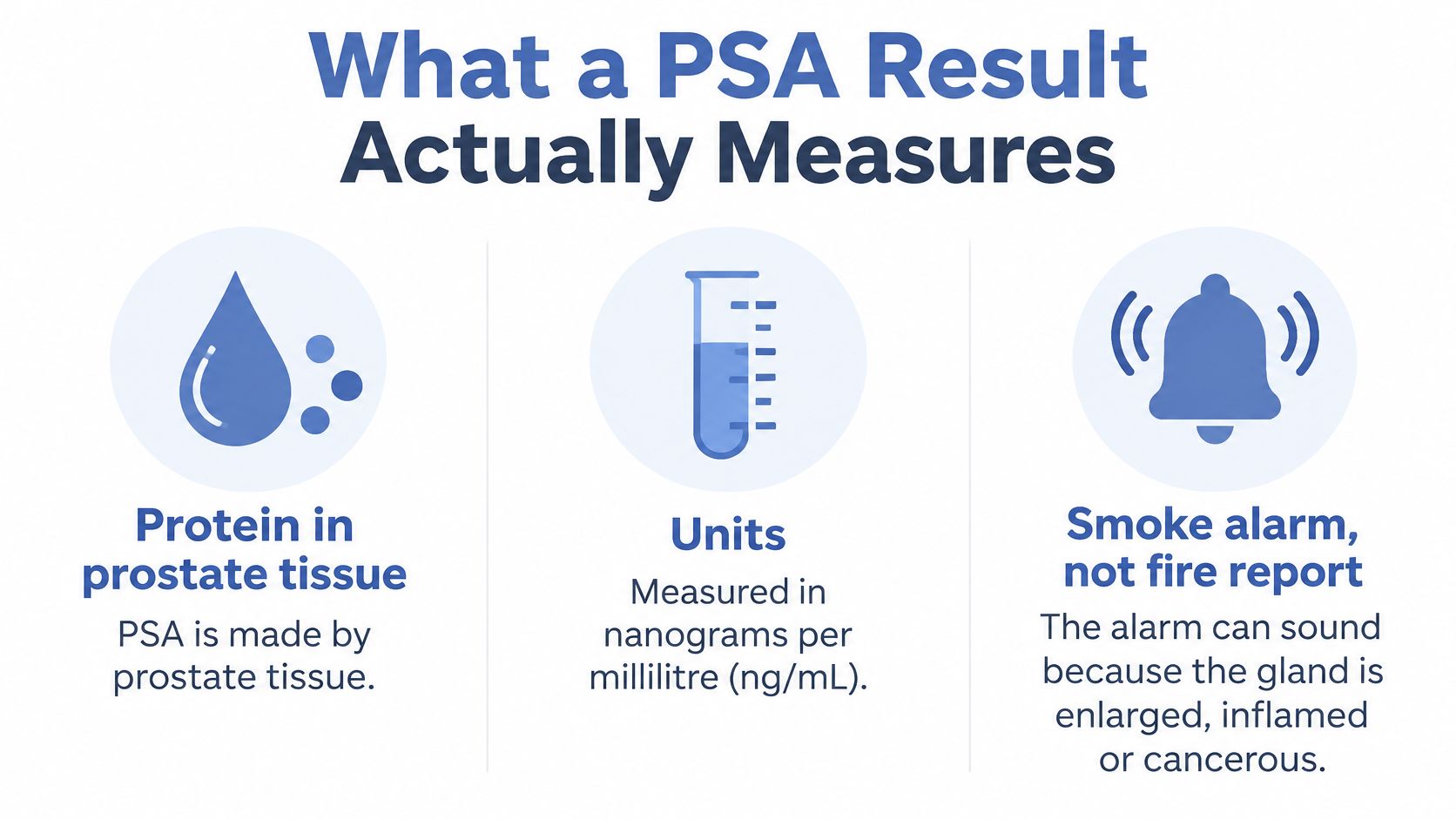
Prostate-specific antigen, or PSA, is a protein made by prostate tissue. The blood test measures how much of that protein is circulating, usually reported in nanograms per millilitre, written as ng/mL. It doesn't directly measure cancer cells.
Think of PSA as a smoke alarm, not a fire report. An alarm tells you something needs checking, but it can't tell you whether there's a dangerous fire, burnt toast or another explanation. PSA can rise when the prostate is enlarged, inflamed or affected by cancer.
The distinction between measuring a protein and diagnosing a disease is central to interpreting the test.
Why clinicians discuss it
Prostate cancer is a substantial health concern. According to the Urological Society of Australia and New Zealand, more than 26,000 Australian men were expected to be newly diagnosed in 2025, and nearly 4,000 were expected to die from it.
Those estimates explain why early detection matters, but they don't establish that testing every man is the right policy. Screening decisions must also account for what happens to men whose results lead to investigations without finding a harmful cancer.
Say a man receives a result marked above the laboratory's reference range. That flag means the result needs interpretation. It doesn't show that a tumour has been found, whether a cancer is aggressive, or whether treatment would improve his health.
A PSA number is a prompt for a clinical conversation, not a verdict.
What the result can't tell you
A single total PSA can't establish whether a cancer is confined to the gland or has spread. It also can't distinguish, by itself, a slow-growing cancer suitable for monitoring from one that needs treatment.
This is a broader lesson in blood-test interpretation. Whether you're reading about PSA or a B12 blood test, understanding what the test measures is different from knowing why your result has changed.
Your clinician combines the number with symptoms, family history, medicines and previous results. A change may deserve attention, but it still needs an explanation rather than a diagnosis made from the laboratory flag alone.
Everyday Factors That Shift a PSA Reading
Say a man has a PSA blood test while recovering from a feverish urinary infection. His result comes back raised, and he assumes the infection has revealed a cancer. The more sensible response is to tell his clinician about the illness, have the infection assessed and agree on an appropriate time for reassessment.
A PSA reading is a snapshot, and events around the blood draw can blur the picture. Context doesn't make the result irrelevant. It makes accurate interpretation possible.
What to mention before the blood draw
Give the ordering clinician and collector information that could affect the result, rather than trying to decide for yourself which detail matters.
- Recent ejaculation: Mention it and ask what preparation instructions apply before testing.
- Infection or inflammation: Report a recent urinary infection, fever, suspected prostate inflammation and any antibiotics you're taking.
- Urinary symptoms: Describe burning, difficulty passing urine, an unusually weak stream or a recent change in your usual pattern.
- Procedures: Mention recent catheterisation, prostate investigations or procedures involving the urinary tract.
- Prostate medicines: Bring the names of medicines used for prostate enlargement, particularly medicines that shrink the gland.
- Recent examination or vigorous cycling: Say if either happened shortly before the test, without assuming it explains an abnormal result.
Some medicines for prostate enlargement can lower PSA, making the number look more reassuring than it otherwise would. Don't stop prescribed treatment to prepare for a test. Tell the clinician what you take so they can interpret the result appropriately.
Explain a possible influence, don't dismiss the result
A benignly enlarged prostate can raise the baseline PSA. Infection and inflammation can also increase it, which is why a clinician may postpone testing while an acute problem settles.
The size of a change still matters in context. A recent bike ride or examination shouldn't become a convenient explanation for a substantial, persistent elevation without proper review.
Practical rule: Tell the clinician what happened before the test. Don't use that information to clear an abnormal result yourself.
Keep a brief record of symptoms, medicine changes and recent procedures alongside your results. That gives the clinician something more useful than a number remembered from a phone notification.
If symptoms are severe, particularly fever with difficulty passing urine, seek prompt medical care rather than waiting for a planned screening appointment. Sorting out an acute illness takes priority over obtaining a screening baseline.
Benefits and Harms Worth Weighing First
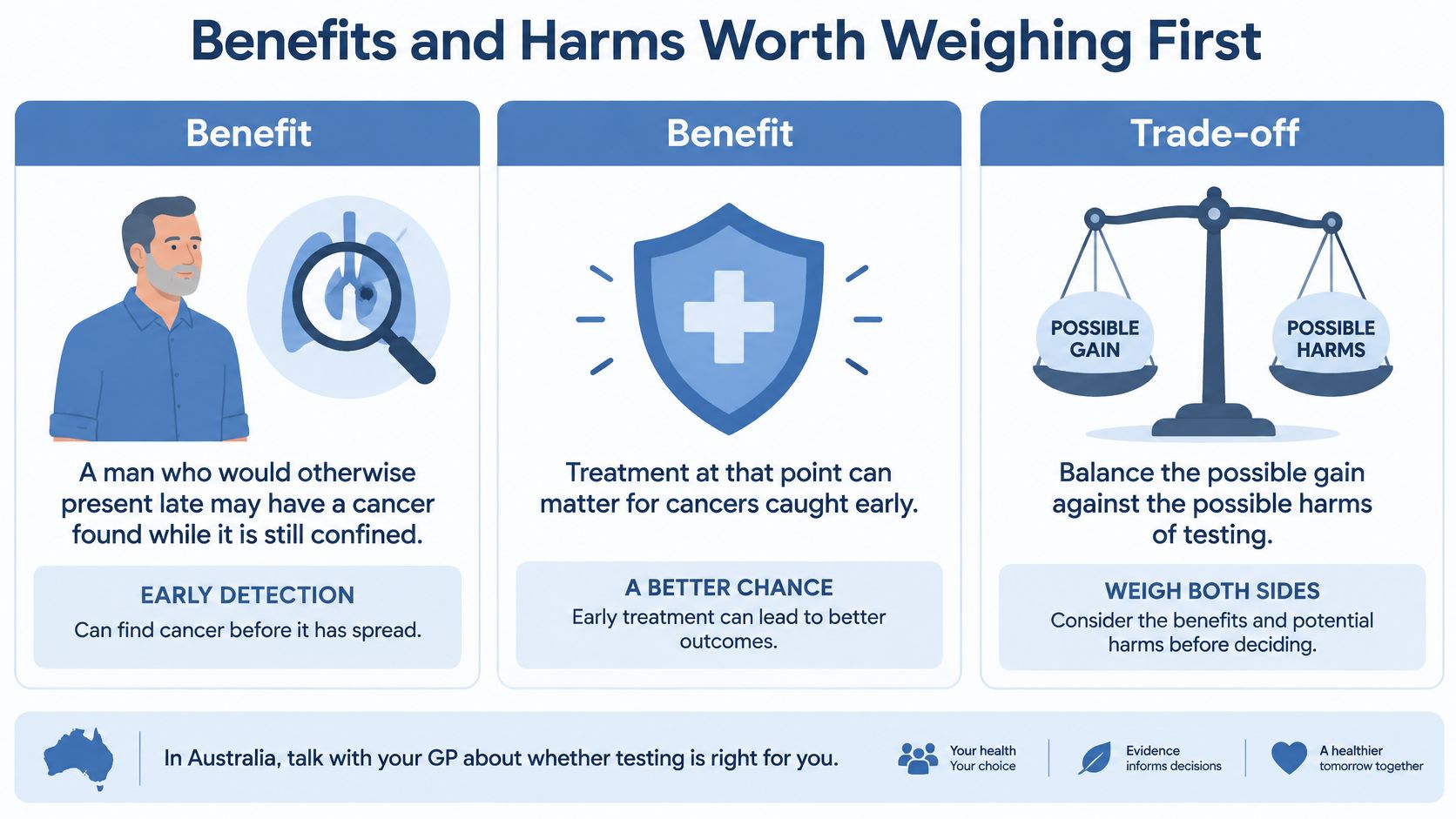
The strongest reason to consider PSA testing is the possibility of finding a consequential cancer before it causes symptoms. For a cancer capable of spreading, detection while it's still confined may create an opportunity for useful treatment.
The trade-off is that testing can also start investigations that don't improve a man's health. The blood draw is easy. The decisions it can trigger are sometimes difficult.
This balance concerns the whole pathway, not just the convenience of collecting a sample.
Separate false alarms from overdiagnosis
A false-positive result raises concern but doesn't lead to a cancer diagnosis. Getting to that conclusion may involve more blood tests, appointments, imaging and sometimes biopsy, along with worry while you wait.
Overdiagnosis is different. A cancer really is present, but it grows so slowly that it would never have caused symptoms or shortened that man's life. Finding it can still change how he feels about his health and expose him to decisions about monitoring or treatment.
| Possible gain | Possible cost |
|---|---|
| Finding a harmful cancer before symptoms develop | Investigating a raised result that isn't cancer |
| Having the opportunity to treat clinically significant disease earlier | Finding a cancer that would never have caused harm |
| Making an informed management plan | Living with uncertainty, repeat appointments or treatment effects |
Treatment can affect urinary control, sexual function and bowel function. Those possibilities don't mean treatment should be avoided when it's needed. They mean a man should understand the consequences before entering a testing pathway that could eventually lead there.
Reasonable men can choose differently
A healthy man with no known family history might prefer testing because he values the chance of earlier detection. Another man in a similar position might decline for now because he places greater weight on avoiding unnecessary investigation. Both decisions can be informed.
A man whose father and several brothers have had prostate cancer has a different starting point. He needs a family-risk assessment rather than assuming the average-risk approach fits him.
Useful questions include:
- What am I hoping to gain? Earlier detection of a harmful cancer is a clearer goal than testing to feel certain.
- How would I handle uncertainty? Consider whether you're prepared for repeat testing and potentially further assessment.
- Would I consider treatment? Your health and preferences matter if an investigation finds clinically significant disease.
Informed consent isn't a signature obtained after the decision has already been made. It's the discussion that helps you make the decision.
The Pathway After a Raised PSA
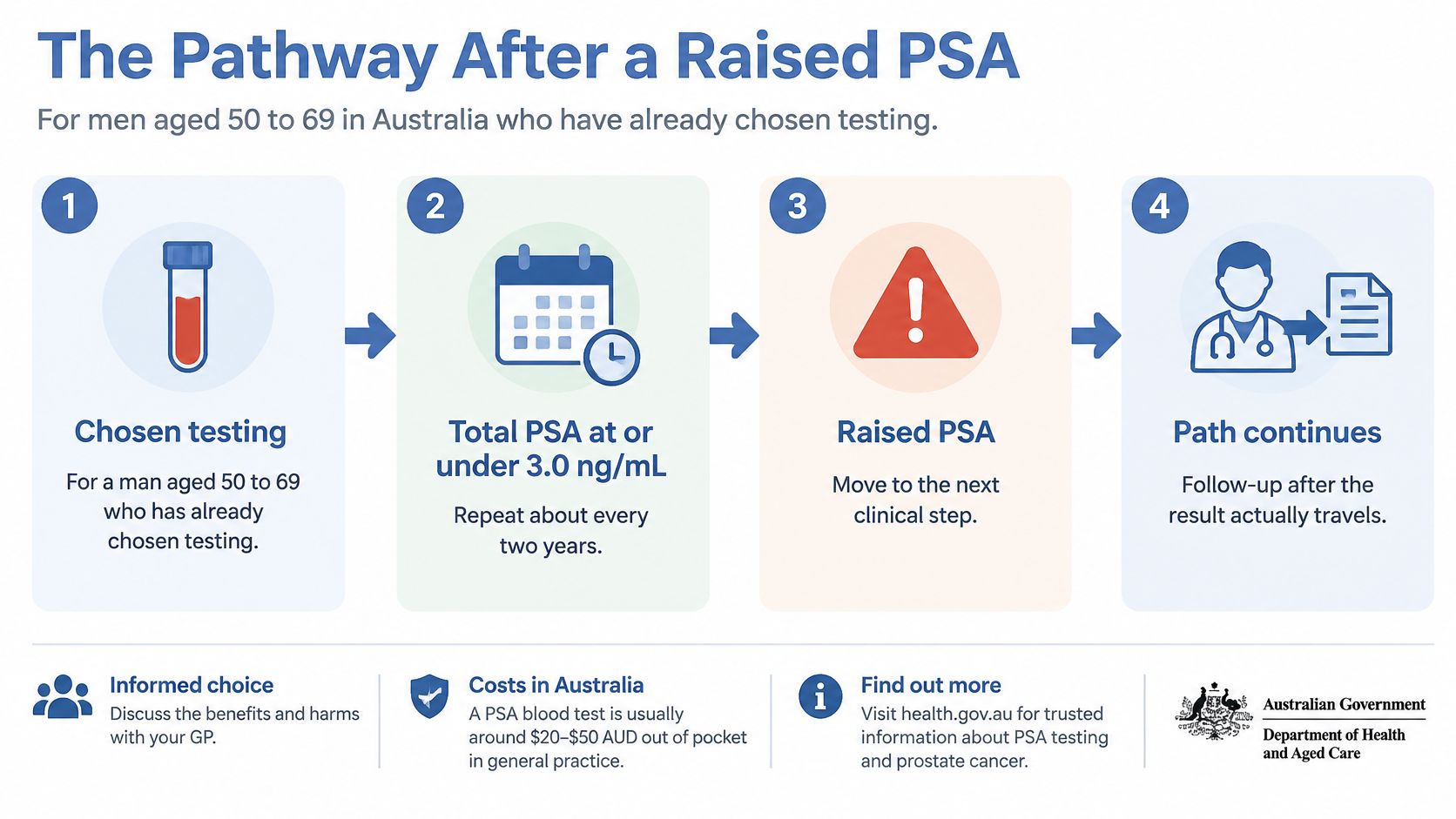
A raised PSA doesn't mean immediate biopsy, and it doesn't mean immediate treatment. The first task is to check the result in context and decide whether it needs confirming.
The Australian Journal of General Practice discussion of the diagnostic pathway describes repeating a PSA above 3.0 ng/mL within 1–3 months, with persistent elevation potentially leading to urology assessment and multiparametric MRI. For men aged 50–69 who choose routine testing, the usual interval is every 2 years.
The pathway has several decision points rather than a direct jump from a laboratory flag to an invasive test.
Confirm, then assess
When arranging a repeat, the clinician reviews possible temporary influences and decides when another sample will be useful. Don't arrange repeated tests at short intervals on your own in an attempt to obtain a reassuring number.
If elevation persists, further assessment may include a specialist consultation and MRI. Multiparametric MRI provides detailed images that can help the specialist decide whether there is an area worth sampling.
MRI isn't treatment, and a reassuring scan doesn't always finish the assessment. The specialist considers the scan alongside the PSA pattern and the rest of your clinical information.
Biopsy and surveillance aren't interchangeable with treatment
A biopsy checks tissue for cancer. If recommended, ask what question it will answer, what its risks are and how the result would change management.
If a suitable low-risk cancer is found, active surveillance may be offered. This involves planned monitoring, potentially including PSA tests, examinations, imaging and further tissue assessment, with treatment considered if the findings change. It's not the same as ignoring a diagnosis.
A visual explanation can help you prepare questions for the clinician.
Before leaving any result-review appointment, know who is arranging the next step and how you'll hear about it. A convenient private test can provide access to a result, but it can't decide what that result means.
What to do with a PSA result
| Situation | What it does not mean | Usual next step |
|---|---|---|
| At or under 3.0 ng/mL while aged 50 to 69 and choosing testing | Not a lifetime all-clear | Repeat about every 2 years while testing stays appropriate |
| One total PSA above 3.0 ng/mL | Not a cancer diagnosis | Repeat within 1 to 3 months |
| Repeat still above 3.0 ng/mL | Not an automatic biopsy or treatment | Clinician review; urology assessment and multiparametric MRI may follow |
| Low-risk cancer already found | Not an order to operate immediately | Active surveillance may be offered instead of immediate treatment |
Match your situation, then book the appropriate conversation rather than the most invasive next test.
How Testing Spread Without a National Program
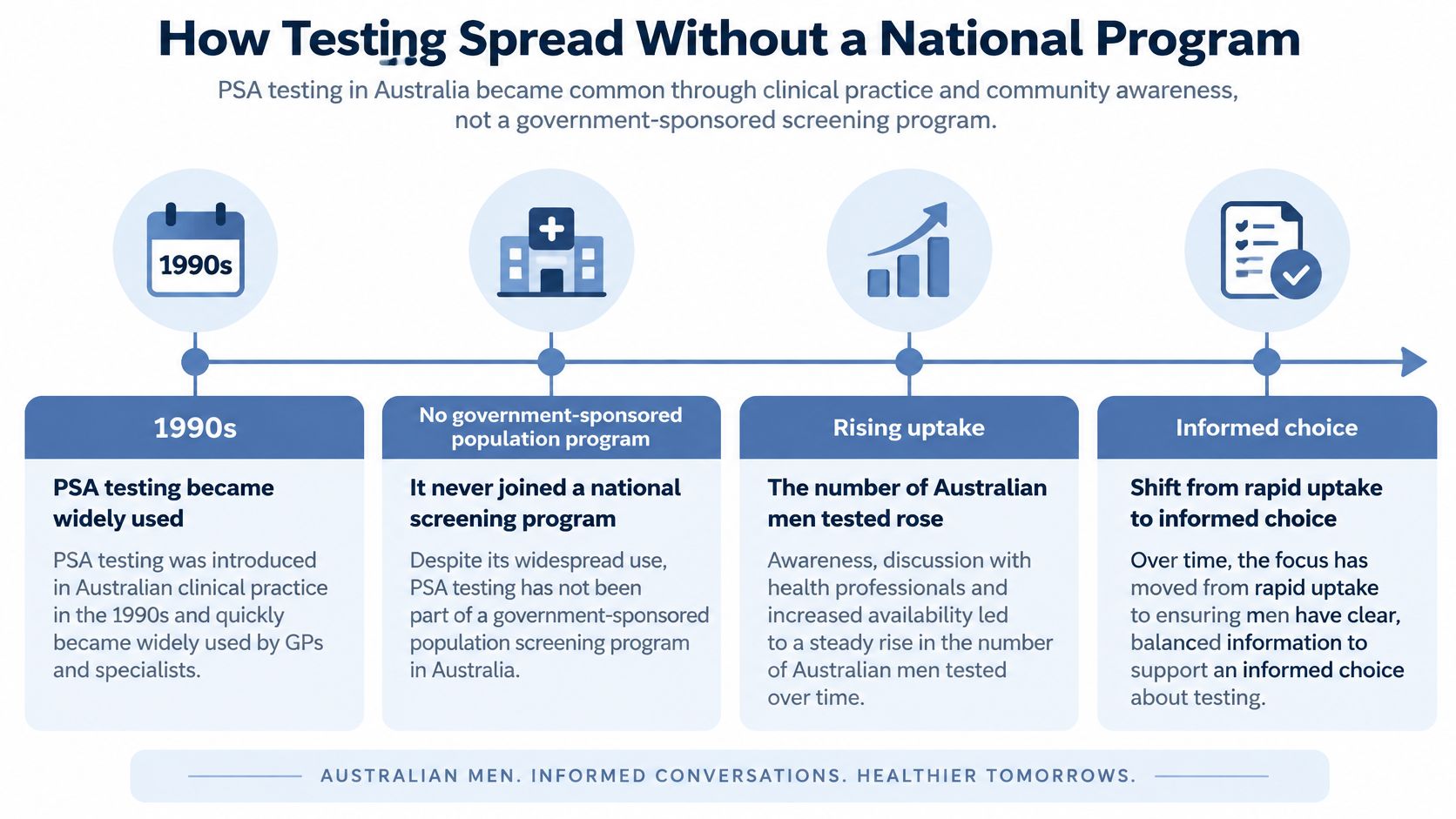
PSA testing became established through clinical practice rather than a centrally organised invitation system. That history helps explain why men can receive quite different advice from friends, relatives and clinicians.
A historical review of Australian PSA testing reports that the number of men tested increased five-fold between 1989 and 1996, reaching approximately 1.1 million men in 1996. It also describes the 2016 national guidelines as a move towards shared decisions rather than automatic testing.
The broad shift was from widespread uptake towards a more explicit discussion of who might benefit and who might be harmed.
What Medicare activity can tell us
The Australian Institute of Health and Welfare supplementary tables record 778,469 PSA tests under MBS item 66655 in calendar year 2012, with approximately 80.1% among men aged 45–74. The table below reproduces the age-band counts and places them alongside the usual testing offer.
Medicare PSA tests by age in 2012
| Age band | Tests recorded | How it sits against usual guidance |
|---|---|---|
| 0 to 34 | 8,698 | Outside the usual offer |
| 35 to 44 | 59,339 | Below the usual average-risk start |
| 45 to 54 | 195,753 | Inside the broad 45 to 74 majority |
| 55 to 64 | 247,757 | Largest band |
| 65 to 74 | 180,061 | Still inside the 45 to 74 majority |
| 75 to 84 | 75,168 | Beyond the usual stop at 69 |
| 85 and older | 11,693 | Outside the usual offer |
| All recorded ages | 778,469 | Ages 45 to 74 were about 80.1 percent |
These are test counts, not counts of cancer diagnoses. They don't tell us why each test was ordered, whether a man had symptoms, or whether testing was appropriate for his circumstances.
The age bands also cross clinical decision boundaries. A broad administrative category can't show whether every person within it matched a particular recommendation.
Availability isn't an invitation
A PubMed-indexed Australian study published in 2025 reported that NSW testing fell from 8,470 to 4,910 tests per 100,000 males between 2009 and 2018, an approximate 5% annual decline. That's a finding about testing activity in NSW, not a measure of what an individual man should do.
Direct access adds another distinction: being able to purchase a test doesn't establish that you need it. Our explanation of private blood tests describes the access route, which should remain separate from the clinical decision about whether PSA belongs in your care.
The practical lesson is simple. Common testing isn't the same as a national recommendation for everyone, and testing outside the usual offer needs a reason.
Decide With a Clinician Before You Test
A useful appointment should leave you with a decision you can explain: test now, decline for now, or revisit testing when your circumstances change. You don't need to arrive knowing all the medical terminology. You do need an opportunity to ask questions before the blood is drawn.
Bring your family history, current medicines and details of recent illness or procedures. If you have previous PSA results, make them available rather than relying on memory.
Leave with a named follow-up clinician
Use these questions to make the discussion concrete:
- Is PSA appropriate for me? Ask how your family history, age, health and preferences affect the decision.
- What would an abnormal result trigger? Agree on how repeat testing and further assessment would be arranged.
- Who will review it? Know which clinician will interpret the result and who will contact you.
- What if I choose not to test? Ask when to revisit the decision and which symptoms warrant an appointment.
Private blood tests are available in Australia without a GP referral. At Vital iQ Health, we also offer telehealth GP consultations, where partnered GPs review findings, answer questions and recommend next steps from home.
That convenience doesn't replace informed consent or automatically establish ongoing responsibility for an abnormal result. Confirm the follow-up arrangements rather than assuming someone else is monitoring your report.
Before you order: Be able to name the clinician you'll contact if the result needs review.
If you already have urinary symptoms, blood in your urine or unexplained persistent bone pain, book a clinical appointment. Those symptoms don't establish prostate cancer, but they deserve assessment rather than a screening purchase.
The best decision isn't necessarily to test. It's to choose deliberately, understand the possible consequences and have a workable plan for whatever comes back.
Vital iQ Health offers private blood testing and telehealth consultations with partnered GPs who can explain results and recommend next steps. Visit Vital iQ Health to explore testing and clinical support, and discuss whether PSA testing is appropriate for you before ordering.
Written with Outrank