Private Blood Tests in Australia: A 2026 Guide
See how private blood tests work in Australia in 2026, from panels and collection centres to cost, turnaround and who reads an abnormal result.
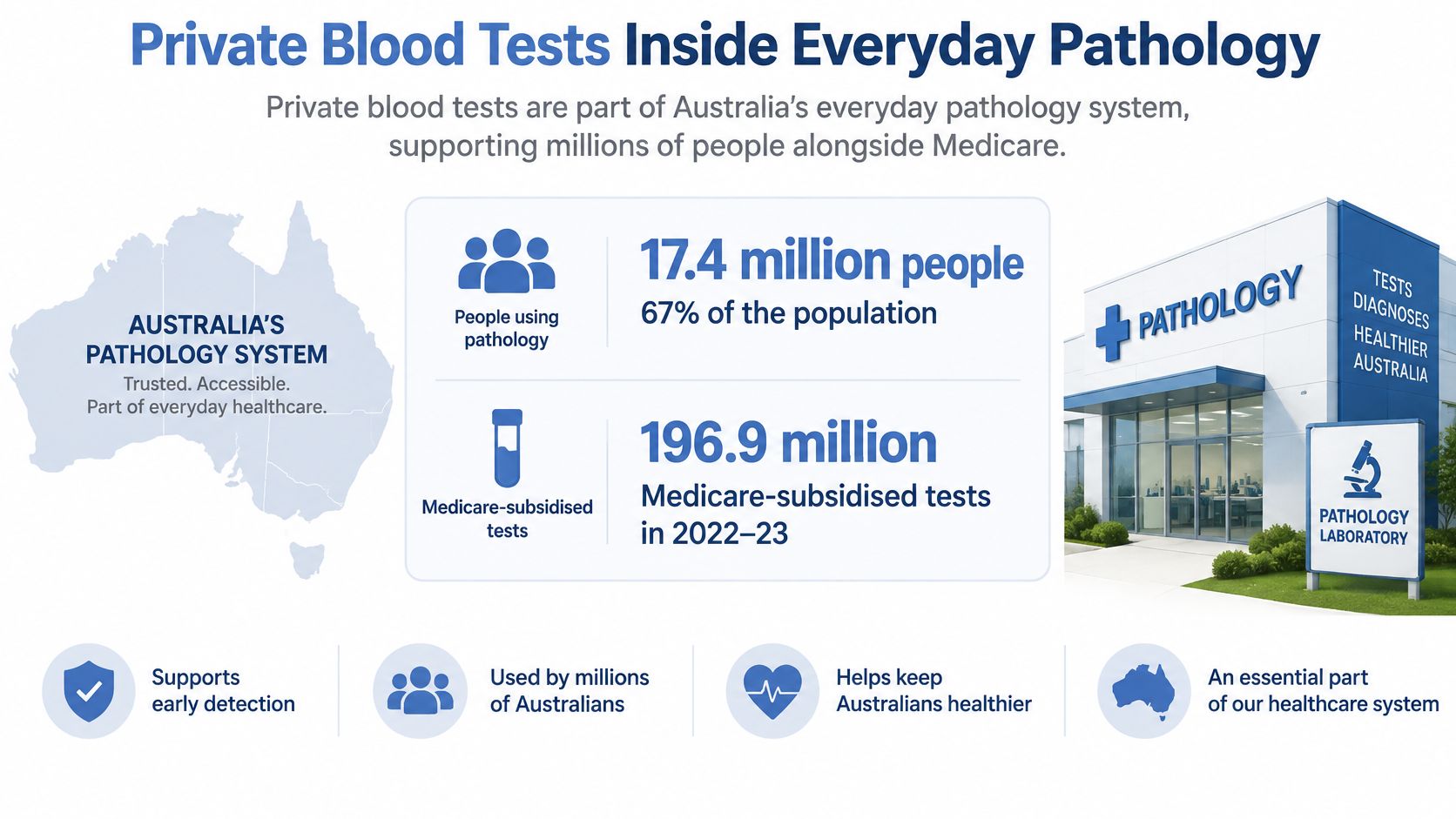
59% of Australians received at least one pathology service in 2022–23, according to the Australian Institute of Health and Welfare. Blood testing sits within everyday healthcare, not a separate world of wellness products. The important question about private blood tests isn't how quickly you can order them. It's whether someone will help you decide what the results mean and what to do next.
Private Blood Tests Inside Everyday Pathology
Say you're tired despite sleeping reasonably well. You could book your usual GP, describe your symptoms and discuss testing, or purchase a private blood test online before that appointment. Both routes can lead to a laboratory measuring the same substance in your blood, but the decisions surrounding that measurement aren't necessarily the same.
A private blood test is a pathology test you purchase yourself, often without first visiting your usual GP. Private describes the purchasing and funding arrangement. It doesn't mean the sample belongs to a different category of science.
Our samples are tested through NATA-accredited laboratories. Accreditation matters for laboratory quality, but it doesn't establish that every available test is appropriate for every customer.
Separate the request from the purchase
Online ordering can make arranging a test easier. However, buying a panel, authorising its pathology request and explaining the report are distinct tasks.
Keep these questions separate:
- Requester: Who is named on the pathology request, and who receives the laboratory's communications?
- Funding: Are you paying privately, or is the test eligible for Medicare funding?
- Follow-up: Is a clinician consultation included, optional or something you must organise elsewhere?
A checkout confirmation answers none of those questions by itself. Neither does a promise of a clear online report.
Start with a decision you might change
For the person with fatigue, a useful starting point is whether a particular investigation could change their care. Their symptoms might call for targeted pathology, but they might also need a medication review, sleep assessment or physical examination.
Practical rule: Buy an answer to a health question, not the longest available list of measurements.
Treat private testing as an entry point into care rather than a replacement for it. The useful outcome isn't possession of a report. It's a sensible decision supported by that report, your history and, where necessary, an examination.
Private Orders Compared with Medicare Pathology
| Question | Medicare-referred test | Private blood test |
|---|---|---|
| Who authorises it | A clinician requests testing using the required patient and requester details | Direct online purchasing still needs an authorised requester on the pathology form |
| Who pays | Usually bulk billed; Australian Clinical Labs states that 99.6% of pathology services in Australia were bulk billed in 2024 | The patient pays; purchasing privately doesn't guarantee a Medicare rebate |
| What is tested | Tests the clinician considers medically indicated | Available panels or individual biomarkers selected by the customer, subject to the service's ordering arrangements |
| Where blood is taken | An approved collection centre, with patient choice when clinically appropriate | A participating pathology collection centre; our collection centres are NATA accredited |
| When results arrive | The laboratory sends results to the requesting clinician; timing follows the tests and laboratory workflow | Our results are generally available within 24 to 72 hours and delivered securely to the customer |
| Who explains an abnormal result | The requesting clinician manages interpretation within the care arrangement | Interpretation isn't automatically part of every purchase; a separate consultation may be needed |
What convenience buys you
Private access can remove the need to arrange an initial GP visit solely to discuss a pathology request. That can help when appointment availability, work or travel makes the conventional route awkward.
It doesn't follow that private testing is always faster overall. A customer might receive a report promptly but then wait for the appointment needed to interpret it. A clinician-led request may take longer to arrange initially while providing a more direct connection between the result and a treatment decision.
The comparison is therefore access to a measurement versus access to a complete episode of care. Neither route should be judged by the collection appointment alone.
Count the care after the test
Before purchasing, consider the potential cost of a consultation, repeat testing or further investigation. Don't assume that a privately purchased result guarantees publicly funded follow-up, or that every subsequent test will be clinically justified.
This matters particularly if you can afford the panel but would struggle to pay for the next step. Finding something uncertain without an affordable way to clarify it can create anxiety rather than useful information.
- Choose clinician-led testing when you already have symptoms, an established condition or a doctor who has identified a reason to investigate.
- Consider private access when obtaining the initial request is the main barrier and you have a realistic plan for interpreting the findings.
- Pause before paying when you're unsure what decision the result could change.
A broad catalogue gives you more purchasing choices. It doesn't necessarily give you better clinical choices.
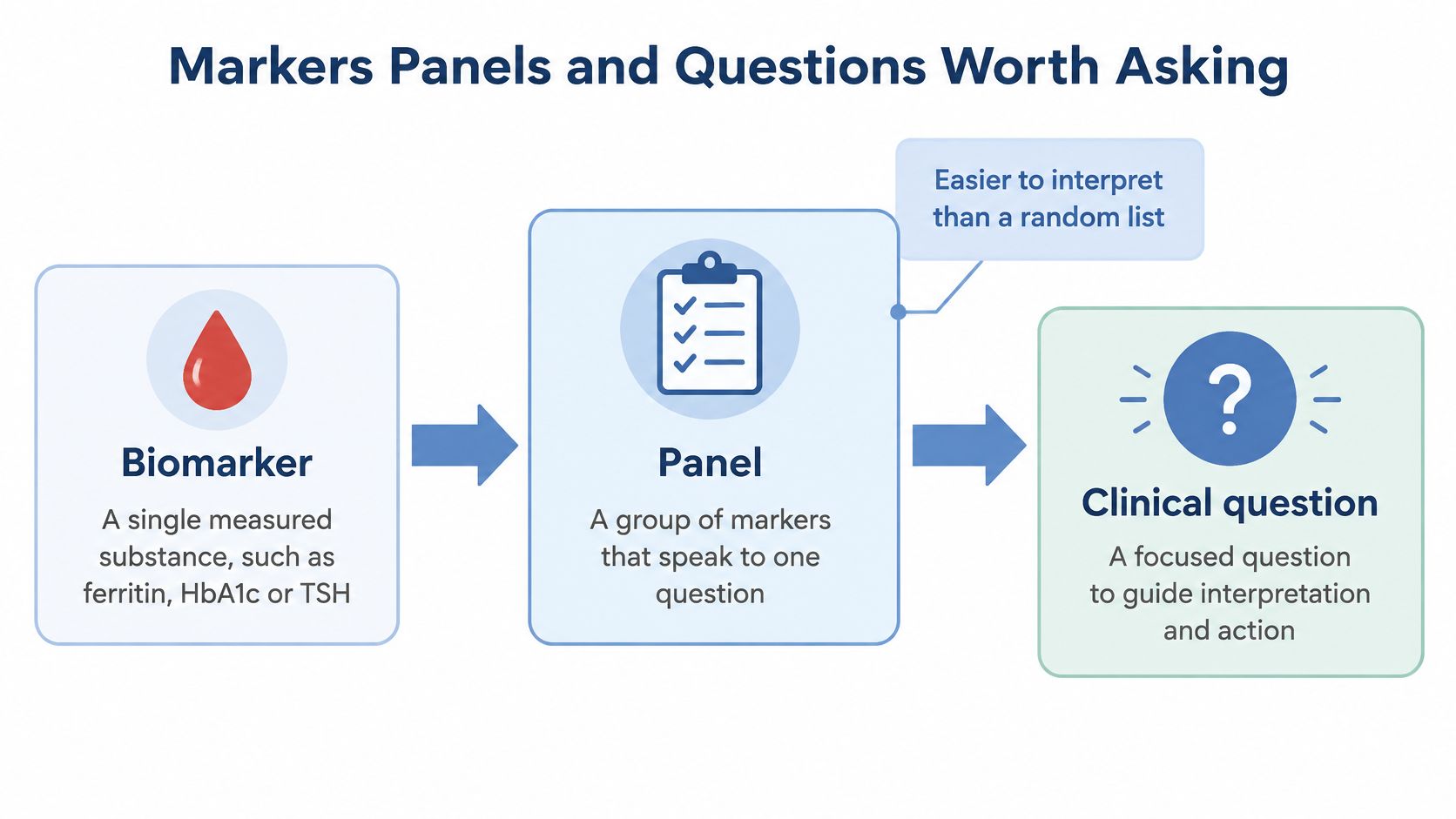
Markers Panels and Questions Worth Asking
A biomarker is something measured to help assess health. Ferritin helps assess iron stores, HbA1c reflects blood glucose exposure, and thyroid-stimulating hormone, or TSH, helps assess thyroid function.
A panel groups related measurements. A well-chosen panel helps answer a defined question; a large bundle may include measurements that have little bearing on why you're being tested.
Match the category to the concern
Common catalogue categories are useful starting points, but their names aren't diagnoses. Check the actual biomarkers rather than relying on words such as complete or advanced.
| Panel category | A question it may help address | A reason it may be the wrong fit |
|---|---|---|
| Standard health screening | Are cholesterol, glucose, iron or organ-function markers worth discussing? | It can't certify that you're free of disease |
| Thyroid and metabolic testing | Could thyroid dysfunction contribute to energy, weight or temperature symptoms? | Similar symptoms can have non-thyroid causes |
| Vitamins and minerals | Is a particular nutritional deficiency plausible given diet, symptoms or absorption problems? | It isn't an assessment for chest pain or unexplained severe pain |
| Hormone testing | Could a specific reproductive, adrenal or thyroid problem explain the symptoms? | An untimed collection may be difficult to interpret |
| Men's or women's health | Which sex-specific and general health questions need attention? | A hormone panel doesn't replace cervical or bowel screening |
| Sports-style assessment | Is there a specific concern about iron status, recovery or general health during training? | Blood results don't measure overall training readiness |
Narrow the question before widening the panel
Hormone measurements need particular care. Cycle timing, contraception and time of collection can affect interpretation, so a result without that context may answer less than you expect.
Nutrition testing also works better when targeted. Someone avoiding animal products has a different question from someone with unexplained tingling or suspected poor absorption. A guide to the B12 blood test can help you understand that specific measurement before choosing a wider nutritional screen.
Custom testing can be useful when a predefined panel includes unrelated markers. It should mean selecting the measurements relevant to a clinical question, not building a personal wish list from online health discussions.
Every additional marker creates another opportunity for an incidental or borderline finding. That doesn't make extra tests wrong, but it does mean they need a reason.
The smallest useful set is the set that can change a decision. More lines on the report aren't automatically more reassurance.
How to Order and Give the Sample
The practical journey starts before checkout. Have your question, collection arrangements and intended follow-up clear enough that you won't be making those decisions while looking at an unexpected result.
The basic ordering and collection sequence is straightforward.
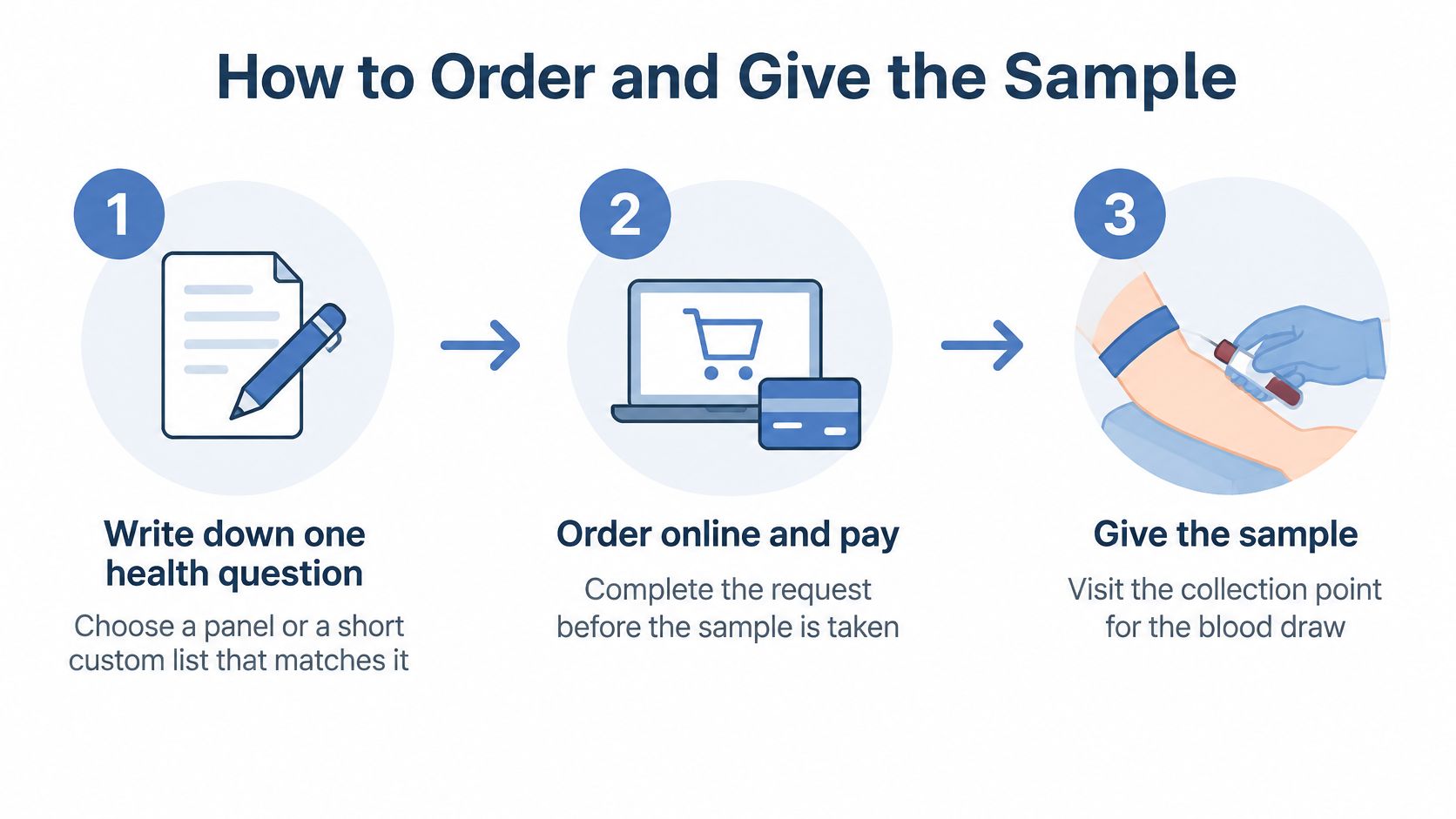
Follow the request through to collection
Write down your health question. Include your symptoms, relevant diagnoses and what you hope to learn. Choose a matching panel or short custom list rather than adding unrelated tests at checkout.
Complete the online order. Our pathology request form is emailed after payment. No prior GP referral doesn't mean there is no authorised requester: Services Australia sets out the required patient and requester details for pathology requests and explains patient choice of approved collection centre when clinically appropriate.
Locate a participating centre and read the preparation instructions. Our network includes QML Pathology, Laverty Pathology, Dorevitch Pathology, Western Diagnostic Pathology and TML Pathology, covering every Australian state and territory. Select your laboratory network to find the nearest participating collection centre, then check opening hours and any booking requirements.
Attend with your request and identification. Tell the collector if you've previously fainted during a blood draw or have difficulty with needles. Explain any departure from the preparation instructions before the sample is taken, rather than hoping it won't matter.
Receive and retain the complete report. Our results are delivered securely and privately to you. Save the full document, including units, reference ranges and laboratory comments, so the clinician reviewing it has more than a screenshot of a highlighted number.
Prepare for your actual tests
Don't assume every blood test requires fasting or morning collection. Follow the instructions attached to your request, and clarify anything that conflicts with your usual medication schedule.
Tell the requesting clinician about medicines and supplements, particularly biotin, which can interfere with some laboratory measurements. Don't stop prescribed medication on your own to prepare for testing.
- Shift workers: Check whether the collection time should relate to clock time or your sleep schedule, particularly for hormone testing.
- People with mobility limitations: Confirm an accessible collection location before purchasing. Don't assume an online service includes an available home visit.
- Athletes: Mention recent strenuous exercise and your training schedule when arranging interpretation.
Young adults and athletes may have genuine biological variations that don't require treatment. Accurate preparation helps the clinician distinguish a meaningful pattern from a collection-related complication.
Use the rules printed on your own request, not fasting advice copied from someone else's panel.
Who Should Read an Abnormal Result
A result outside its reference range is a prompt for interpretation, not a diagnosis. The range describes results seen in a reference population, like a crowd photo rather than a personal verdict. Someone outside it may be well, while someone inside it may still need investigation because of their symptoms.
A clinician reads the numbers alongside your health history, medicines and reason for testing.
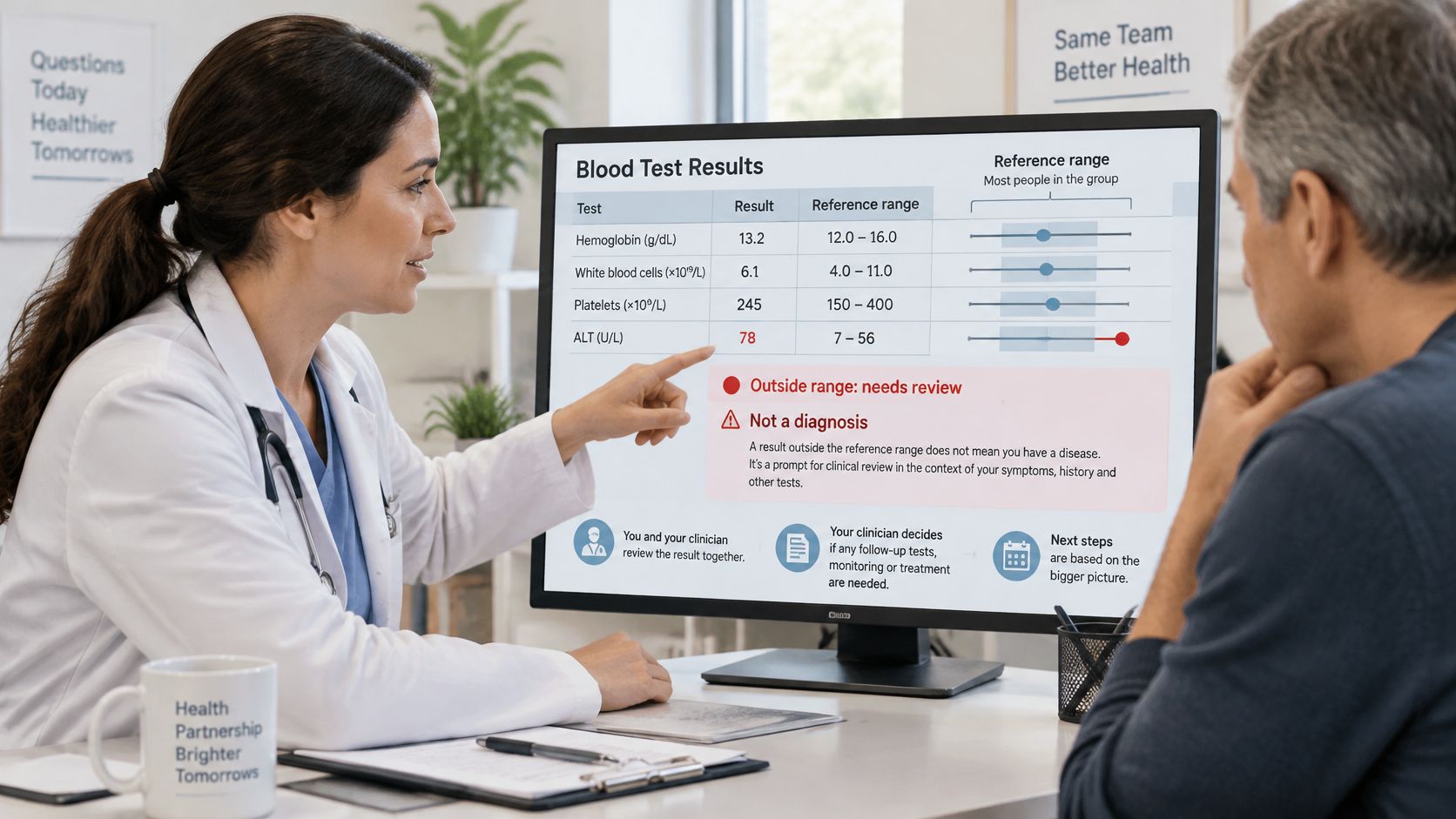
Know who owns the next step
Before ordering, find out who reviews the report, who contacts you about a concerning result and where to get advice. The test price may not include a consultation, and a secure portal does not explain what a result means.
Patients are increasingly able to see pathology results through My Health Record. Access to a report can make information easier to find, but it does not replace clinical interpretation. The RACGP review of overdiagnosis and overtesting warns that testing outside evidence-based screening can cause harm.
Overdiagnosis can happen when testing finds an abnormality that would never have caused harm, but leads to further tests or treatment. Broader panels create more opportunities to find such results, so each test should have a clear reason.
Choose the appropriate response
The right response depends on the result and the whole clinical picture, not just a colour or flag on the report.
- Urgent symptoms: Chest pain, fainting, severe breathlessness, heavy bleeding or rapidly worsening illness need urgent assessment. Don't wait for an online panel or use a reassuring result to delay care.
- An isolated borderline result: Arrange clinical review. Depending on the marker and context, a clinician may suggest repeating the test, checking how it was collected or reviewing medicines before considering treatment.
- A substantial abnormality or concerning pattern: Contact the requesting clinician promptly and follow any urgent instructions from the laboratory or service. Multiple abnormal findings need a clinical plan, not self-treatment.
A slightly abnormal TSH, for example, does not automatically mean thyroid medicine is needed. Recent illness, other thyroid measurements and changes over time may affect its meaning.
Bring the complete report and an up-to-date list of medicines and supplements to your consultation. Ask what might explain the result, whether it needs confirmation and which symptoms should prompt earlier care.
Before closing the consultation: Confirm what happens next, who arranges it and how you'll hear the outcome.
Cases Where a Private Panel Helps or Misleads
Consider someone with persistent fatigue who arranges thyroid, metabolic and iron testing. Their TSH comes back just outside the laboratory range, and they take the report to a GP rather than ordering thyroid medicine online. The useful outcome is a discussion about symptoms, medicines and whether further thyroid testing is appropriate, not an immediate label.
A recreational athlete takes a different approach before a demanding training block. They retain selected iron and cardiovascular markers as background information but don't treat a hormone result as deficient because a podcast recommends a higher target. Their clinician also considers diet, training load, recovery and symptoms.
A traveller unable to see their usual GP arranges a general screen. A high glucose result prompts a consultation and a plan for confirmation, rather than a drastic diet change based on an isolated measurement. Private access has helped them start the process, but the important clinical work comes afterwards.
Which private check fits the question
These hypothetical situations illustrate how the same report can be useful or misleading depending on the question asked.
| Situation | Sensible focus | How the result can mislead |
|---|---|---|
| Unexplained fatigue | Thyroid and metabolic markers plus iron, guided by symptoms | An isolated borderline TSH becomes a diagnosis without review |
| Training or recovery | Iron, lipids, organ function and selected hormones when indicated | A population range is treated as a personal athletic target |
| Suspected nutritional gap | Relevant vitamins and minerals; antioxidant measurements only with a clear rationale | A low measurement prompts supplementation without considering cause or suitability |
| No symptoms, general check | Cholesterol, glucose, organ function and iron where appropriate | A wider panel generates findings unrelated to a useful health decision |
| Hormonal symptoms | Selected reproductive, adrenal or thyroid hormones | Numbers are interpreted without cycle timing, contraception or symptom history |
A baseline needs a purpose
A baseline can be useful when there is a reason to compare a marker later. It isn't automatically useful just because the measurement is available, and it doesn't mean treatment should change on the day the report arrives.
Before repeating a private panel, decide what you're checking: response to treatment, resolution of an abnormality or a clinically relevant trend. Repeating everything can add expense without clarifying the original concern.
Choose the row that best matches the question you'd take to a doctor. If none fits, a clinical conversation may be more useful than a catalogue search.
Decide the Test and Book the Follow-Up
The best route starts with your current situation. Acute or rapidly worsening symptoms belong in urgent care, not an online ordering process, even if you're mainly worried about a blood marker.
If you already have a GP and a clear reason for testing, ask whether a Medicare-funded request is appropriate. You may gain more from a focused consultation and targeted request than from buying a broad panel independently.
Use private access for a defined gap
Private testing can be reasonable when the obstacle is arranging the initial appointment, rather than uncertainty about a serious symptom. The purchase should fit both your health question and your ability to act on the answer.
Before committing, make a short written plan:
- The question: What exactly are you trying to clarify?
- The consequence: What would you do differently if the result were normal, borderline or clearly abnormal?
- The reviewer: Which clinician will interpret it, and how will you arrange that consultation?
- The practical limit: Can you manage the cost and logistics if further assessment is recommended?
If you can't identify a possible next decision, reconsider whether the test is needed. Curiosity is understandable, but it shouldn't be confused with a clinical indication.
Arrange interpretation as part of the purchase decision
Vital iQ Health is a national private-testing option for people taking this route. We offer telehealth GP consultations in which partnered GPs review findings, answer questions and recommend next steps from home.
That support is most useful when the clinician has the full picture, including symptoms, previous results and current medicines. Tell them why you ordered the test, rather than asking only whether the highlighted numbers are bad.
Choose a focused question and make room for the consultation that turns measurements into a plan. Private blood tests can improve access, but informed follow-up is what makes that access useful.
At Vital iQ Health, you can arrange private blood tests online without a prior GP referral and access partnered telehealth GPs to discuss the findings. Visit us to choose testing that matches your health question and arrange a results consultation, so you're not left interpreting an unexpected number alone.
Produced via Outrank