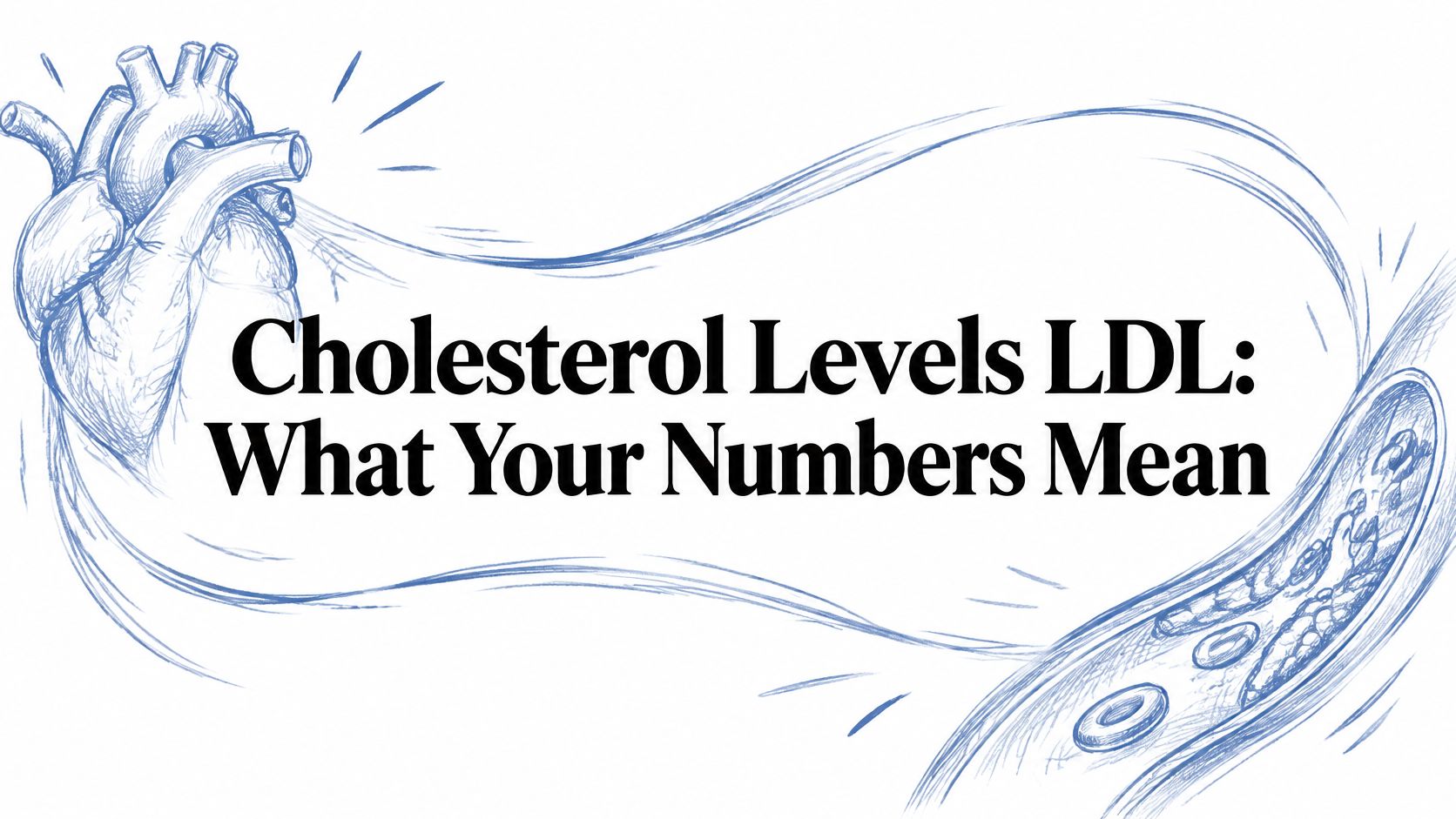
Cholesterol Levels LDL: What Your Numbers Mean
Understand cholesterol levels LDL in mmol/L, read them within a full lipid profile, and see why doctors weigh more than one result.
Many Australian adults sit at or above the point where LDL cholesterol is flagged, and many don't know it because high LDL causes no symptoms you can feel. That silence makes a single result easy to misread. A number that looks mildly high can carry real weight if you've already had a heart event or a strong family history of early heart disease. The same number can mean something quite different in a healthy non-smoker in their 40s.
Treat your cholesterol levels LDL result as the start of a question. What matters is the band it falls into, the unit it's reported in, the rest of your lipid profile, and your own situation: age, smoking, blood pressure, and whether you're already on treatment. Each piece changes what the number means. Some results you can act on yourself, and some need a doctor's review, so it helps to know which is which before you decide on a next step.
LDL Cholesterol Bands and How Common High LDL Is
Australian labs report LDL cholesterol, written as LDL-C, in mmol/L, so the first job is to place your number inside a local band. The table uses the national measures bands first, then the higher thresholds that should prompt a check for inherited causes.
| LDL-C (mmol/L) | Category | What it signals | Typical next step |
|---|---|---|---|
| Below 3.0 | Not flagged | Not flagged as elevated in national measures; other risk factors still count | Routine review with a full lipid profile |
| 3.0 to below 3.5 | Near-high | Common range; read alongside other risk factors | Lifestyle review and repeat test as advised |
| 3.5 and above | Abnormally high | Flagged as abnormally high in ABS national measures | GP review of overall cardiovascular risk |
| 4.9 and above (untreated adult) | Familial hypercholesterolaemia assessment threshold | Consider inherited causes, especially with early heart disease or family history | Medical review of family and personal history |
| 5.0 and above | Familial hypercholesterolaemia consideration threshold | Needs medical follow-up, not self-management | Specialist or genetic referral when indicated |
How common these bands are in Australia
High LDL is common enough that a raised result should not be brushed off as bad luck or a lab quirk. The Australian Bureau of Statistics National Health Measures Survey 2022–24 found 27.8% of Australians aged 18 years and over had an abnormally high LDL cholesterol concentration, defined as at least 3.5 mmol/L. A further 19.0% sat in the near-high range from 3.0 to below 3.5 mmol/L, so 46.8% of adults were at 3.0 mmol/L or higher.
The split by sex was fairly close in that measured survey: 29.5% of adult males and 26.3% of adult females had abnormally high LDL cholesterol. These figures come from blood measures rather than people remembering a diagnosis. The ABS calculates LDL cholesterol from measured total cholesterol, HDL cholesterol, and triglycerides. Self-reported surveys tend to be smaller because they capture people who know a result and report it.
A band tells you where a result sits in the population. It does not, on its own, set your personal risk or decide whether you need medicine.
The longer trend behind today's numbers
Older surveillance shows the burden has shifted but not disappeared. According to ABS high cholesterol reporting drawing on AIHW analysis, 63% of Australian adults, approximately 8.5 million people, had dyslipidaemia in 2011–12, and within that picture 33% had high LDL cholesterol. High blood cholesterol affected 36% of Australians aged 25 years and over in 2011–13, down from 48% in 1999–2000.
Age still shapes the pattern strongly. That same reporting put high cholesterol at 24% of people aged 18–44 and 48% of those aged 55–64, so a raised result in your 30s is not unusual, but it becomes much more common by your late 50s. Self-reported figures tell a smaller story: 8.4% of Australians, or about 2.1 million people, reported high cholesterol in 2022, compared with 6.8% in 2011–12.
That measured-versus-reported gap is the practical point. Feeling well, eating reasonably, or exercising cannot prove your LDL is low if you have not had a blood test. The reverse also matters: landing at 3.5 or above is a signal to ask better questions, not a verdict by itself. The same result carries different weight depending on age, blood pressure, diabetes status, smoking, kidney health, family history, whether you are already on treatment, and whether you have had cardiovascular disease. A 3.6 mmol/L result in an untreated 29-year-old with no other risk factors raises a different conversation from 3.6 mmol/L after a heart event. The band sorts the result; your history decides what should happen next.
Converting LDL Results Between mg/dL and mmol/L
Unit confusion causes unnecessary alarm. Australian pathology reports usually use mmol/L, while some overseas labs, older reports, wearable dashboards, and United States websites use mg/dL. A result of 135 looks frightening until you realise it's in mg/dL, which puts it in a completely different band from 135 in a local report.
The conversion in four steps
- Confirm the unit first: Check the unit printed right next to your LDL-C value, not the unit used elsewhere on the page.
- Convert mg/dL to mmol/L: Divide the mg/dL value by 38.7. To go the other way, multiply mmol/L by 38.7.
- Find your band: Match the converted mmol/L value to the bands in the table above.
- Check the reference range: Confirm the lab's own reference range uses the same unit before you compare your result with it.
Say your overseas report shows LDL-C of 147 mg/dL. Divide 147 by 38.7 and you get about 3.8 mmol/L, which sits in the abnormally high band locally. If you'd read 147 as if it were a mmol/L figure, you'd have misunderstood the result completely.
Thresholds people most often look up
| LDL-C (mmol/L) | Approximate LDL-C (mg/dL) | Where it matters |
|---|---|---|
| 1.4 | 54 | Post-acute coronary syndrome target, with at least 50% reduction from baseline |
| 3.0 | 116 | Near-high band starts |
| 3.5 | 135 | Abnormally high band starts |
| 4.9 | 190 | Familial hypercholesterolaemia assessment threshold in untreated adults |
| 5.0 | 194 | Familial hypercholesterolaemia consideration threshold |
Use these conversions for reading only. They're approximate, rounded to whole numbers, and they don't replace the reference range printed by the lab that ran your sample. Clinical decisions use that lab range, whether you were fasting, whether you're already on cholesterol medicine, and your overall risk profile. If a converted number lands close to a threshold, don't split hairs over a decimal point. Take the original report to your GP and let them interpret it in context.
What LDL Cholesterol Is and How It Builds Up
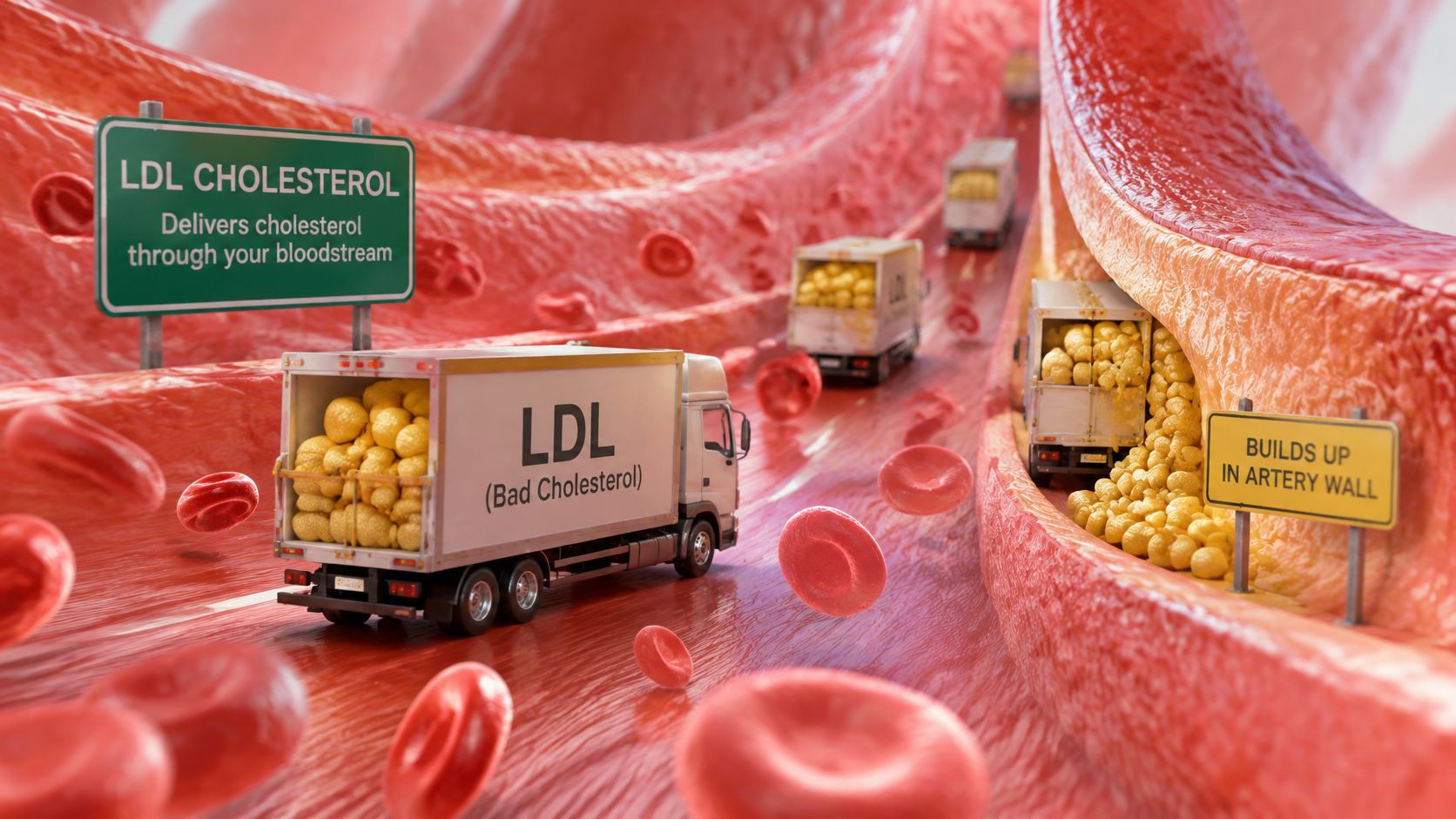
Cholesterol is a fatty substance your body needs to build cells and make certain hormones. It doesn't dissolve in blood, so it travels packaged inside particles called lipoproteins. Think of LDL as delivery trucks. They load up with cholesterol at the liver and carry it out to cells around the body that need it for repair and growth.
The illustration below shows that delivery idea inside an artery, with surplus material starting to settle on the wall.
When delivery exceeds demand
Your liver makes most of the cholesterol in circulation, and food adds a smaller amount. Trouble starts when there are more LDL trucks delivering cholesterol than your cells can use. The surplus doesn't just vanish. Particles can lodge in artery walls, where cholesterol and other material gradually build into plaque over years.
Plaque narrows the artery and stiffens its wall. You won't feel this happening. There's no pain signal for rising LDL, which is why a blood test is often the first sign anything's changed. A person can run, work, and feel completely well while plaque slowly accumulates.
The short video below walks through that build-up process visually if you prefer to watch rather than read.
What raises LDL, and how HDL differs
People often assume dietary cholesterol is the main driver. For many adults, saturated fat intake, body weight, and genetics influence LDL more strongly than the cholesterol in food alone. That's why two people eating similar diets can end up with very different results, and why a lean person can still record a high reading.
HDL works in the opposite direction, which helps explain the nickname contrast. If LDL trucks deliver cholesterol to tissues, HDL particles collect surplus cholesterol and return it toward the liver for clearance. That's why higher HDL is generally read as protective alongside LDL, rather than as another number to push down.
Sentence to remember: LDL is the carrier, and the risk is what it leaves behind in artery walls over time.
When a lab reports LDL-C, it's measuring the amount of cholesterol carried inside those LDL particles. That single figure is useful, but it's still only one line of a lipid profile. Reading it well means understanding the lines around it.
Reading LDL Within a Full Lipid Profile
Your LDL result rarely arrives alone. A standard lipid profile usually reports four linked measures together: total cholesterol, LDL-C, HDL cholesterol, and triglycerides. Reading only the LDL line is like judging a delivery service by counting trucks without asking what they're carrying, where returns go, or how much fuel is sloshing around the system.
What each line actually counts
Total cholesterol is the overall sum of cholesterol carried across the main lipoprotein types. It's a useful headline check, but it blends together fractions that behave very differently. A high total driven mainly by high HDL means something different from the same total driven mainly by high LDL, so don't stop at the total.
LDL-C is the main treatment target in most conversations about lowering risk. When a GP discusses lifestyle change or medicine, LDL-C is usually the number they're aiming to move, and repeat tests track whether it's responding. That's why it gets the attention, even though it shouldn't be read in isolation.
HDL cholesterol reflects cholesterol being carried back for clearance. Higher is generally better in this context, and a low HDL alongside raised LDL paints a less favourable picture than raised LDL with solid HDL. It doesn't cancel out a high LDL, but it does change how the whole profile reads.
Triglycerides are a different type of blood fat, used for energy storage. They matter for LDL in a practical way too. In many labs LDL-C is calculated rather than directly measured, using total cholesterol, HDL, and triglycerides in the calculation. When triglycerides run high, that calculation becomes less reliable, and the LDL figure needs more cautious reading.
Why the four values move together
Because LDL-C is often calculated from the other three, the values are mathematically linked. A change in triglycerides can shift the calculated LDL even if your underlying pattern hasn't changed as much as the printout suggests. Comparing results from different labs, or fasting versus non-fasting samples, can add further wobble.
- Non-HDL cholesterol: This is total cholesterol minus HDL, so it captures cholesterol in LDL and other potentially harmful particles in one figure. It's a handy cross-check when triglycerides are high and calculated LDL looks uncertain.
- Ratios on some reports: Some labs print a total cholesterol to HDL ratio. It can help summarise balance, but it doesn't replace looking at the individual values your GP will act on.
- Fasting status: Food, especially a fatty meal shortly before collection, can raise triglycerides and affect calculated LDL. Follow the fasting instruction on your request form if there is one.
Practical rule: Order and keep the full lipid profile, not LDL alone, and note whether you fasted so future results are comparable.
If you're arranging testing yourself, choose a panel that includes the full set rather than a single marker, and check the collection instructions before you attend. Bring previous reports to any review appointment. A trend across two or three full profiles tells your GP far more than one isolated LDL value, and it sets up the key question: given everything else about your health, how much does this particular number matter for you?
Inherited High LDL in Younger Adults
High cholesterol is often framed as an ageing or lifestyle problem. That framing misses a group who can be overlooked for years: younger adults whose LDL is high because they inherited a tendency to clear it poorly. If you're in your 20s, 30s, or 40s, eat well, train regularly, and still record a markedly high LDL, don't assume you must be doing something wrong.
The thresholds that should trigger a closer look
Familial hypercholesterolaemia is an inherited condition where LDL remains high from early life, often without symptoms. The RACGP guidance on familial hypercholesterolaemia in general practice recommends assessing for it when untreated adult LDL-C exceeds 4.9 mmol/L, particularly with premature cardiovascular disease or a family history of cardiovascular disease before age 60. Assessment then goes beyond the single number: family history, your own disease history, physical signs, and the untreated LDL-C value are scored together.
That scoring step is where context changes the answer. The same high reading means something different in a 28-year-old whose father had a stent at 45 than in someone with no affected relatives. And an untreated LDL above 4.9 mmol/L sits well clear of the common near-high range, so it needs medical follow-up rather than diet tweaks alone, even if you feel fit and your weight is normal.
What follow-up actually involves
One test doesn't diagnose inherited disease. Your GP will usually work through a short sequence:
- Exclude secondary causes: Conditions such as hypothyroidism can raise LDL, so they're checked and treated first where present.
- Confirm the value is untreated: A result recorded while you're already on lipid-lowering medicine reads differently from a true baseline.
- Review your relatives: Heart attacks, stents, or very high cholesterol in parents, siblings, or children before age 60 strengthen the picture and may prompt testing for them too.
- Consider referral: A lipid specialist assessment or genetic testing may be appropriate when the score and history point that way.
Normal weight, a clean diet, and good fitness don't rule out inherited high LDL. Genetics can override an otherwise healthy routine.
A confirmed diagnosis changes what happens next. Standard therapy comes first, and newer lipid-lowering medicines are available for some people with inherited high LDL, which is why a firm label matters rather than a vague note that cholesterol runs high. Diagnosis also triggers family screening, so relatives can be tested before they have an event. If your untreated LDL is at or above 4.9 mmol/L, book a GP review and bring any family history you can gather. That decision belongs with your treating team rather than a self-management plan.
LDL Targets After a Heart Attack or Stent
General bands stop being the right yardstick once you've had a heart event. After a heart attack, unstable angina, or a stent, you have established coronary disease, and your chance of another event is far higher than someone with the same LDL who has never had symptoms. Your target is therefore much stricter, and your treating team sets it.
The intensive secondary prevention target
For Australians recovering from acute coronary syndrome, the 2025 clinical guideline overview from the Heart Foundation specifies an LDL-C target below 1.4 mmol/L together with at least a 50% reduction from baseline. Both parts matter. Dropping from 4.0 to 2.0 mmol/L is a 50% reduction but still leaves you above 1.4. Reaching 1.3 from a baseline of 1.8 meets the level but not the proportional fall if that baseline was untreated.
This is deliberately more aggressive than population screening bands. The goal isn't to nudge you out of a flagged category. It's to lower the absolute risk of a recurrent event in arteries already known to be diseased, where the payoff from each reduction is larger.
How monitoring works in practice
Each new result gets compared with three things: your pre-treatment baseline, your current dose and how reliably you're taking it, and how long therapy has had to work. A test taken two weeks after a dose change tells a different story from one taken three months later. Keep your discharge summary and first post-event lipid results, because that baseline anchors every later comparison.
If LDL-C stays above target, common reasons include:
- Missed or stopped doses: Side effects, cost, or falling out of routine after discharge can blunt the effect quickly.
- A dose that's too low: The starting dose may not deliver the reduction your baseline requires.
- Secondary causes: Hypothyroidism or nephrotic disease can hold LDL up despite treatment and need their own management.
- Need for escalation: Your clinician may add or switch lipid-lowering therapy rather than waiting longer on a regimen that isn't reaching target.
If you've had a heart event, don't judge your result against the general 3.0 or 3.5 bands. Ask your doctor what your personal target is and whether you're meeting both parts of it.
These decisions require medical review, not interpretation of a private result on your own. If a self-arranged test shows you're above 1.4 mmol/L after an acute coronary syndrome, bring it to your cardiologist or GP promptly rather than adjusting doses yourself. Bring your medicine list, note any missed doses accurately, and ask when the next check should happen. The number is feedback on a treatment plan, not a grade you pass or fail alone.
Decide Your Next Step After a High LDL Result
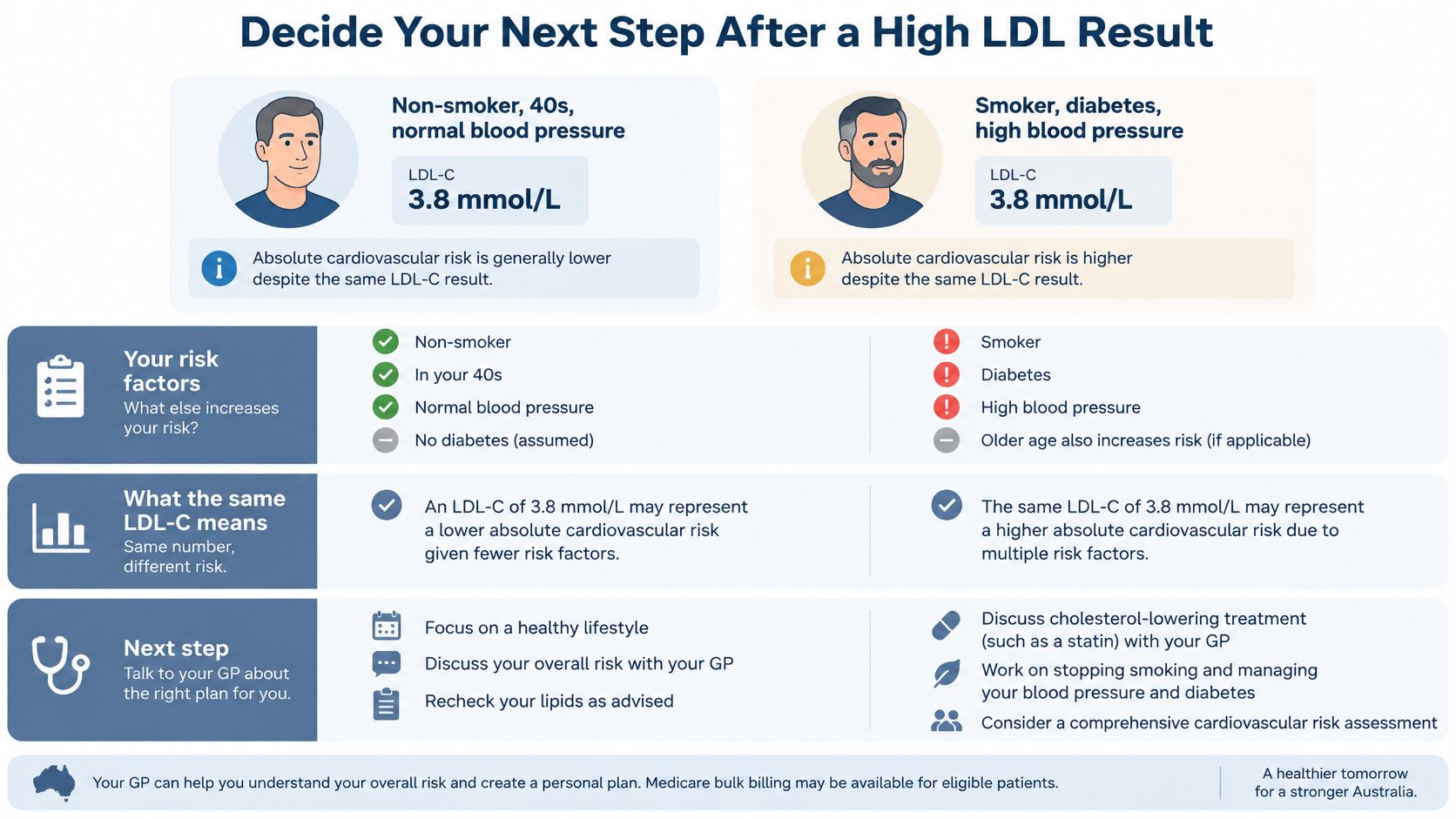
Say two people receive the same result: LDL-C of 3.8 mmol/L. One is a non-smoker in their 40s with normal blood pressure and no diabetes. The other smokes, has diabetes, and has high blood pressure. Their LDL numbers match. Their absolute cardiovascular risks do not, so the sensible next step differs for each of them.
Combine LDL with your overall risk profile
LDL is read within a full risk picture rather than against one universal value. The Heart Foundation pharmacological lipid guidance notes targets vary with factors including age and family history, and a high result should be considered alongside blood-pressure status, diabetes, smoking, kidney disease, prior cardiovascular disease, and family history before deciding next steps. The same concentration can imply materially different absolute risk in different individuals.
That combined picture feeds one practical decision: is lifestyle intervention alone appropriate for now, or should drug therapy be discussed? Australian guidance identifies statins as the most effective lipid-lowering approach and generally the first-line pharmacological option when treatment is indicated. Repeat testing then shows response and adherence, instead of treating one isolated result as definitive.
Five steps to work through
- Find your band: Locate your mmol/L value in the first table and note whether you're near-high, abnormally high, or at an inherited-disease threshold.
- List your risk factors: Write down your age, blood pressure, diabetes status, smoking, kidney disease, family history, and any prior heart disease.
- Check the test conditions: Note whether you fasted and whether you already take cholesterol medicine, since both change how the value reads.
- Book a GP review when flagged: Do this if your result is 3.5 mmol/L or higher, 4.9 mmol/L or higher with early family heart disease, or any result after a heart event.
- Repeat as advised: Follow-up testing shows whether lifestyle change or treatment is moving the number, and whether you're taking therapy as planned.
If you need a starting point, our Standard Health Panel covers cholesterol, blood glucose, organ function, iron levels, and key health markers, which lets you read LDL alongside glucose rather than in isolation. You can order private blood tests online without a GP referral, choose from 41 pathology panels, visit a NATA-accredited collection centre near you, and receive results within 24 to 72 hours. Take those results to your GP for the risk conversation above. One number starts that conversation. It isn't the final answer.
If you don't know your LDL, or your last result left you unsure which band you're in, Vital iQ Health lets you order a cholesterol-related panel online without a GP referral and attend a NATA-accredited collection centre near you. Bring the result to your GP so your next step is based on your overall risk, the band you're in, and whether medicine, lifestyle change, or monitoring makes sense.