Anti Thyroglobulin Antibody Test: What a Result Means
Anti thyroglobulin antibody results explained: what the test measures, why it is ordered and how to read it with TSH and free T4.
If a thyroid antibody test is positive, does that mean your thyroid isn't working properly? Not necessarily. An anti thyroglobulin antibody result describes an immune response, not how much thyroid hormone you're making, and its meaning changes considerably after thyroid cancer treatment.
The useful question isn't whether the result is positive. It's what the result means beside your thyroid function tests, symptoms, laboratory method and medical history.
What the Test Measures and How to Read Each Result
The anti-thyroglobulin antibody test, usually abbreviated to TgAb, measures immune proteins that target thyroglobulin. Thyroglobulin is a protein your thyroid uses to make and store thyroid hormones. It isn't itself a thyroid hormone.
A positive result supports the presence of thyroid-directed autoimmune activity. Think of it as a smoke alarm: it signals something worth checking, but it doesn't locate the problem, measure its severity or establish whether the thyroid is underactive or overactive. The antibody concentration isn't a direct measure of thyroid damage.
To assess function, clinicians look primarily at thyroid-stimulating hormone, or TSH, and free thyroxine, or free T4. TSH is the signal that tells the thyroid to produce hormone; free T4 measures circulating thyroid hormone available to the body.
How TgAb results read alongside thyroid function
These patterns are general guidance, not diagnoses. Medicines, pregnancy, recent illness and the clinical situation can change their interpretation.
| TgAb result | TSH and free T4 pattern | Usual meaning | Typical next step |
|---|---|---|---|
| Negative | Normal TSH and free T4 | No TgAb signal detected; thyroid function is normal | Routine review if symptoms or family history change |
| Negative | Raised TSH; free T4 needs assessment | Possible thyroid dysfunction without a TgAb signal; other causes remain possible | Further thyroid assessment with a clinician |
| Positive | Normal TSH and free T4 | Antibodies are present, but thyroid function remains normal | Review clinical context; repeated antibody testing often isn't needed |
| Positive | Raised TSH, normal or low free T4 | Supports autoimmune thyroid dysfunction, such as Hashimoto thyroiditis | Clinician review; ultrasound may be considered if examination or structural findings warrant it |
| Positive | Low TSH, raised free T4 | Thyroid overactivity; an autoimmune cause such as Graves disease is possible | Prompt clinical review, with specialist assessment where appropriate |
| Positive | Any pattern after thyroid cancer surgery | Thyroglobulin measurements may be unreliable because of antibody interference | Clinician review of thyroglobulin and TgAb trends |
A raised TSH with normal free T4 isn't equivalent to a raised TSH with low free T4. The distinction matters because the degree of dysfunction, symptoms and treatment decisions may differ.
Likewise, TgAb doesn't establish Graves disease. If an overactive pattern needs clarification, a clinician may request a thyrotropin receptor antibody test, which assesses a different antibody involved in that condition.
Practical rule: Read the antibody result as context for the thyroid function tests, not as a substitute for them.
Bring the following to your appointment:
- The complete TgAb result, including units and any laboratory comments.
- TSH and free T4, preferably from the same blood collection.
- The printed reference interval, not just the positive or negative flag.
- Other thyroid antibody results, such as thyroid peroxidase antibodies, if tested.
Why Your Doctor Might Order This Test
Say you visit your GP because your neck looks fuller and you've been feeling unusually cold. Your doctor finds an enlarged thyroid, requests thyroid function tests and adds antibodies to help investigate whether an autoimmune process could explain the findings. The antibody test answers a different question from the hormone tests.
An enlarged or uneven thyroid, sometimes called a goitre, can prompt this assessment. Examination findings matter because an antibody result can't show the gland's size, shape or whether a lump needs separate investigation.
Symptoms and abnormal thyroid function
Fatigue, unexplained weight change, palpitations, heat or cold intolerance, and altered bowel habits may lead a clinician to investigate thyroid function. None is specific to thyroid disease, so the doctor considers the whole pattern rather than treating one symptom as proof.
If you're asking why you're always tired, antibody testing alone won't settle the question. A clinician may need to assess sleep, medicines, nutritional issues and other explanations alongside thyroid function.
An abnormal TSH or free T4 can also prompt antibody testing even when symptoms are mild. In that situation, TgAb may help explain why thyroid function has changed.
Medical history and specialised follow-up
Other reasons for considering the test include:
- Autoimmune history: Personal or family thyroid disease, or conditions such as type 1 diabetes, coeliac disease or vitiligo, may influence the assessment.
- Pregnancy with known thyroid disease: Antibody tests may form part of an individual care plan, although TgAb isn't a universal pregnancy screening test.
- Follow-up after thyroid cancer surgery: TgAb is measured alongside thyroglobulin to help assess whether that measurement can be trusted.
The test is most useful when the clinician has a specific question to answer. It may be requested because of an examination finding or symptom pattern, not because another result is already abnormal.
Ask: Why was this test requested, and what would its result change about my care?
How Common Positive Results Are in Healthy People
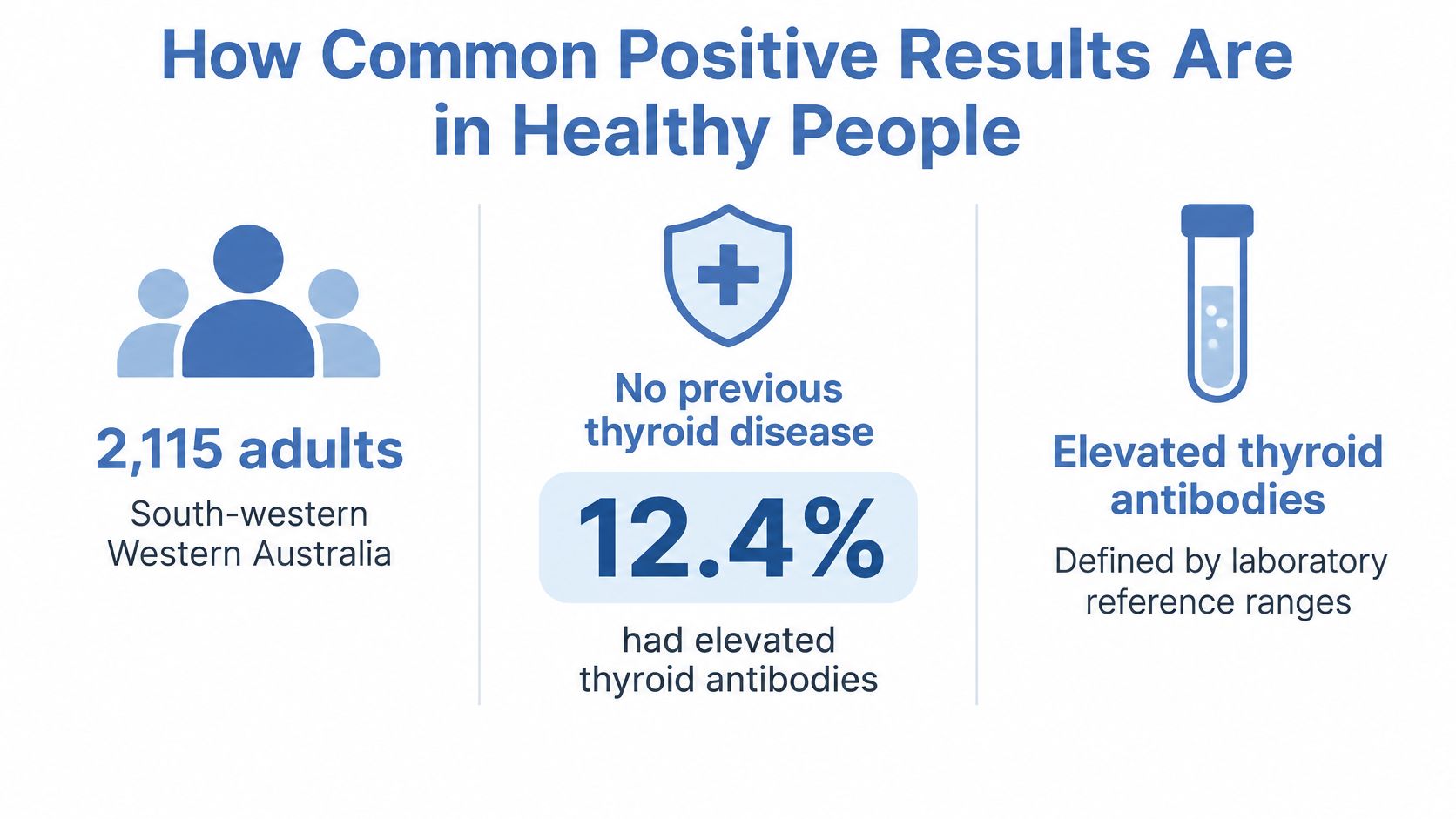
In the Busselton Thyroid Study, a community sample of 2,115 adults in south-western Western Australia provided blood samples, and 12.4% of participants without a previous history of thyroid disease had raised thyroid antibodies, defined using thyroid peroxidase and/or thyroglobulin antibodies. Positivity was more common in women.
That distinction matters: this wasn't an anti-thyroglobulin-only percentage, and having no documented thyroid disease isn't identical to having a complete assessment showing normal thyroid function. Nevertheless, the study demonstrates why an antibody flag shouldn't automatically be treated as a new diagnosis.
Age and sex provide context
An Australian community study published in 1978 found that the proportion of women with microsomal or thyroglobulin antibodies was almost three times that observed in men, and antibody prevalence increased with age in both sexes. Participants lived in a region that wasn't iodine deficient.
These demographic patterns help explain why apparently healthy people can receive positive results. They don't provide a diagnosis for an individual, and they aren't a reason to dismiss symptoms.
Consider a hypothetical woman who feels well, has normal TSH and free T4, and receives a positive TgAb result during screening. Her doctor would assess the finding differently from the same antibody result accompanied by abnormal thyroid hormones or a new neck swelling.
A positive antibody result and normal thyroid function can coexist. The next decision concerns clinical follow-up, not automatically treatment.
Make the result useful
If you're investigating a possible autoimmune condition, understanding the role of a blood test for autoimmune disease helps prevent a common misunderstanding: detecting an antibody doesn't establish every feature of an illness.
Check whether your report includes thyroid function tests. If those are normal, ask whether any follow-up should focus on TSH and symptoms rather than repeated antibody measurements. Your clinician can tailor that decision to your history, including pregnancy plans or existing thyroid disease.
Reading Reference Ranges Across Laboratories
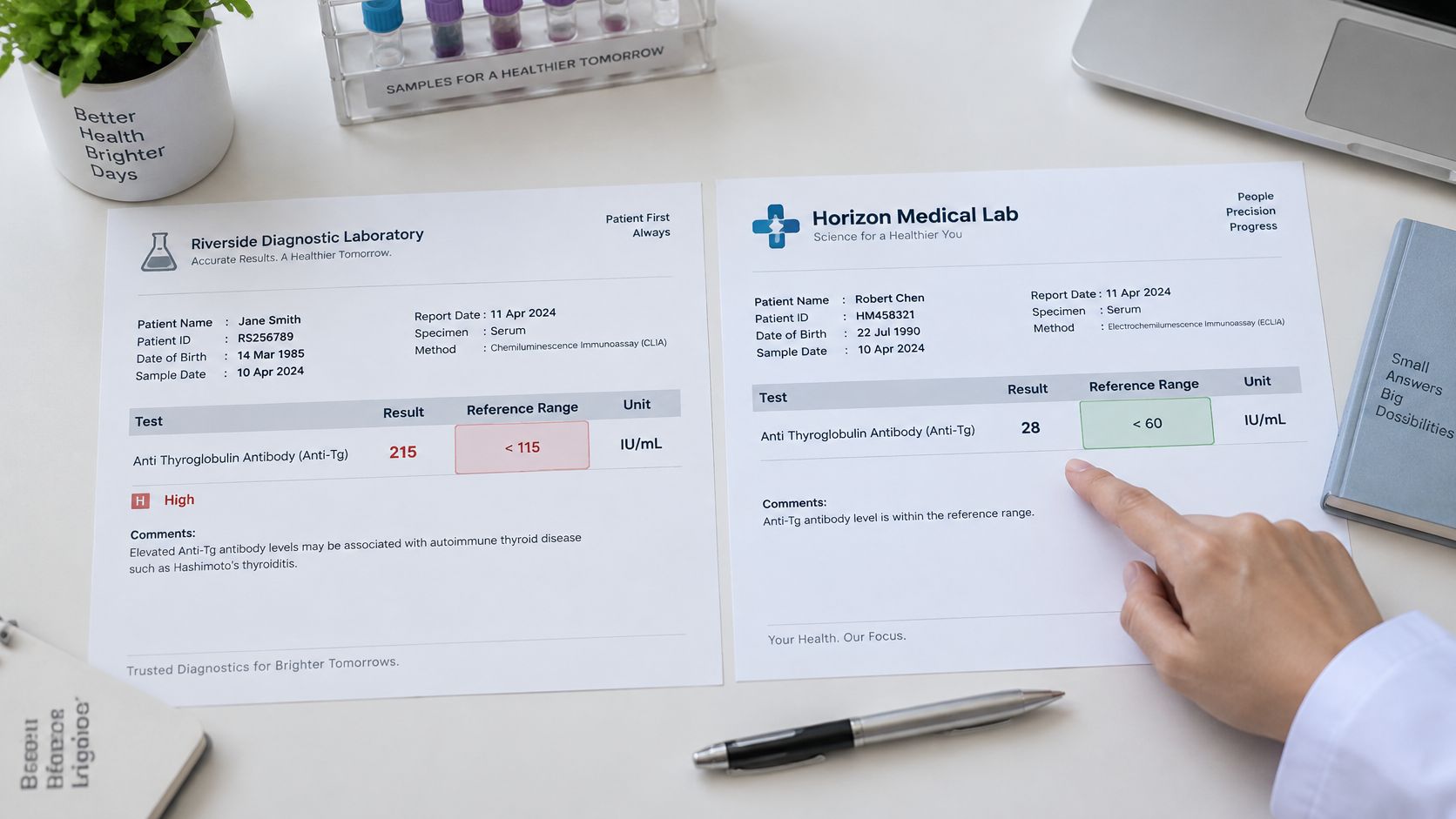
There isn't a universal TgAb number that every Australian laboratory must use to define a positive result. Laboratories use different immunoassays, meaning tests that detect antibodies through a laboratory binding reaction, and apply method-specific reference intervals.
For example, the Busselton community thyroid study used an immunochemiluminescent assay and established a study-derived TgAb reference limit of <55 kIU/L. That limit belongs to that study and its method, not to every report you might receive.
A value flagged by one laboratory may fall within another laboratory's interval. That doesn't necessarily mean either laboratory made an error, and it doesn't mean the antibody concentration changed.
Factors that change how a TgAb result reads
| Factor | Why it changes the reading | What to check |
|---|---|---|
| Assay method | Different immunoassays can produce different values for the same sample | The assay name on the report, or information available from the laboratory |
| Reporting laboratory's reference interval | Laboratories use method-specific cut-offs, established or verified for their testing system | The reference interval and flag printed beside your result |
| Sex and age | Antibody positivity has demographic patterns, which affect clinical context | Whether the report includes relevant comments; don't adjust the cut-off yourself |
| Thyroid hormone results | Antibodies with normal function require a different assessment from antibodies with abnormal function | TSH and free T4 from the same date |
| Previous results | Changing laboratories or assays can make apparent trends misleading | Whether the same laboratory and method were used |
Compare the complete reports, not cropped screenshots of the numbers.
How to compare results sensibly
Suppose your latest report shows a higher number than an earlier report from a different pathology provider. Before concluding that autoimmune activity has worsened, check the units, assay and reference intervals. The numerical difference may reflect the measurement system rather than a meaningful biological change.
A result just above the laboratory's threshold also doesn't tell you how severe a condition is. The flag indicates that the measurement crossed that method's reference limit; a clinician still needs to decide whether it changes your care.
Ask your doctor or laboratory:
- Which assay was used? The laboratory can clarify the method if it isn't printed.
- What reference interval applies? Use the interval attached to that particular result.
- Can this be compared with earlier testing? Confirm whether the method has changed, even if the laboratory name hasn't.
Don't use an online cut-off to override your report. A laboratory flag is a prompt for review, not a conclusion about diagnosis or treatment.
Thyroid Cancer Follow-Up and the Cancer Question
No, a positive TgAb result doesn't mean you have thyroid cancer. TgAb is primarily an autoimmune marker and, in cancer follow-up, a warning that another laboratory measurement may be affected.
The expert consensus on thyroglobulin antibody testing describes TgAb in roughly 10–20% of otherwise healthy people, more often in women, and in about 25% of Australian patients with differentiated thyroid cancer. Because these groups overlap, an isolated positive result can't distinguish autoimmune thyroid disease, transient antibody positivity and malignancy.
A consultation should clarify which clinical question the test was intended to answer.

Thyroglobulin and its antibody aren't the same test
Thyroglobulin, abbreviated to Tg, is the thyroid protein itself. TgAb is the antibody directed against that protein. Their similar names can cause confusion, but they serve different purposes in follow-up.
After total thyroidectomy for differentiated thyroid cancer, clinicians use Tg to help assess whether thyroid tissue remains or disease has returned. In this setting, Tg should normally be undetectable, but any detectable result requires interpretation alongside treatment history, imaging and the overall monitoring plan.
The complication is analytical interference. According to the RCPA Manual's thyroglobulin guidance, TgAb can cause falsely low Tg results, potentially masking residual or recurrent disease, so TgAb should be measured whenever serum Tg is measured.
Think of this as a faulty gauge: a low reading isn't reassuring until you know the gauge can be trusted. It doesn't prove recurrence, but it prevents the clinician from accepting an apparently reassuring Tg result without further assessment.
The monitoring rule after thyroid cancer surgery
The practical monitoring approach is:
- Measure TgAb whenever Tg is measured. A Tg result without its antibody context may be incomplete.
- Interpret Tg with the antibody result and assay method. Imaging, previous treatment and clinical findings remain part of the assessment.
- Review persistent or newly detectable TgAb. This warrants clinician assessment even when Tg appears reassuring; it isn't, by itself, proof of recurrent cancer.
- Follow trends using the same laboratory and method where possible. If a method changes, the clinical team needs to consider whether the earlier and later results are comparable.
Your endocrinologist may therefore continue monitoring antibodies even when routine repetition wouldn't help someone being assessed solely for autoimmune thyroid disease. The purpose of testing determines whether repeat measurements are useful.
This video offers another format for learning about the topic.
The reference cut-off isn't the interference threshold
A subtle but important distinction is that the laboratory's positive cut-off and the concentration at which TgAb can interfere with Tg measurement aren't necessarily identical. Expert consensus recognises that TgAb above an assay's limit of quantification may potentially interfere during differentiated thyroid cancer follow-up.
The limit of quantification is the lowest concentration the assay can measure with acceptable reliability. It answers a different question from the reference interval used to classify antibody positivity, so laboratories need to verify their detection limits and reference ranges.
For cancer follow-up: Don't interpret an apparently negative antibody flag as proof that every thyroglobulin measurement is free from interference.
Outside this specialised setting, positive TgAb with normal thyroid function often doesn't require treatment aimed at the antibody itself. Conversely, a negative TgAb result doesn't rule out thyroid disease, because thyroid dysfunction can occur without this particular antibody being detected.
Before leaving the appointment, ask whether TSH and free T4 were measured, whether this assay's reference cut-off differs from its potential interference threshold, and how the findings compare with earlier Tg and TgAb results. The interference question is particularly relevant if you've previously been treated for thyroid cancer.
What to Do Next After Your Result
Use the complete report to organise your next step, rather than acting on a positive flag alone.
- Confirm what was measured. Find TgAb, TSH, free T4, units and the reporting laboratory's reference interval. If thyroid function wasn't tested, ask whether it's needed to answer the original clinical question.
- Arrange the appropriate review. Book a GP or endocrinologist appointment if TgAb accompanies abnormal thyroid function. If the result appears during thyroid cancer surveillance, contact the team responsible for your follow-up.
- Ask what needs repeating. Repeated TgAb measurements generally don't change management when thyroid function is normal. Your clinician may instead recommend reviewing thyroid function according to your circumstances.
- Keep comparable records. Save complete reports and use the same laboratory where practical. Include your medicines, supplements, symptoms and relevant treatment history when discussing changes.
Privately ordered results still need interpretation
Private testing is an option for obtaining results without an initial GP referral, but it doesn't replace clinical assessment. Persistent fatigue, palpitations, weight changes or neck symptoms deserve evaluation even if the antibody result seems to offer a convenient explanation.
At our collection centres, both collection and laboratory testing are NATA accredited. Whether testing is privately ordered or requested by your doctor, bring the complete results to a clinician before starting treatment or supplements to address an antibody number.
We offer private blood testing across Australia without a GP referral, with online ordering and NATA-accredited collection centres and laboratories. Visit Vital iQ Health to explore thyroid-related testing options, then arrange clinical interpretation so your TgAb result is assessed alongside thyroid function and your medical history.