Blood Test for Autoimmune Disease Explained
A blood test for autoimmune disease supports assessment but does not diagnose. See ANA, RF and anti-CCP limits, and why symptoms still lead.
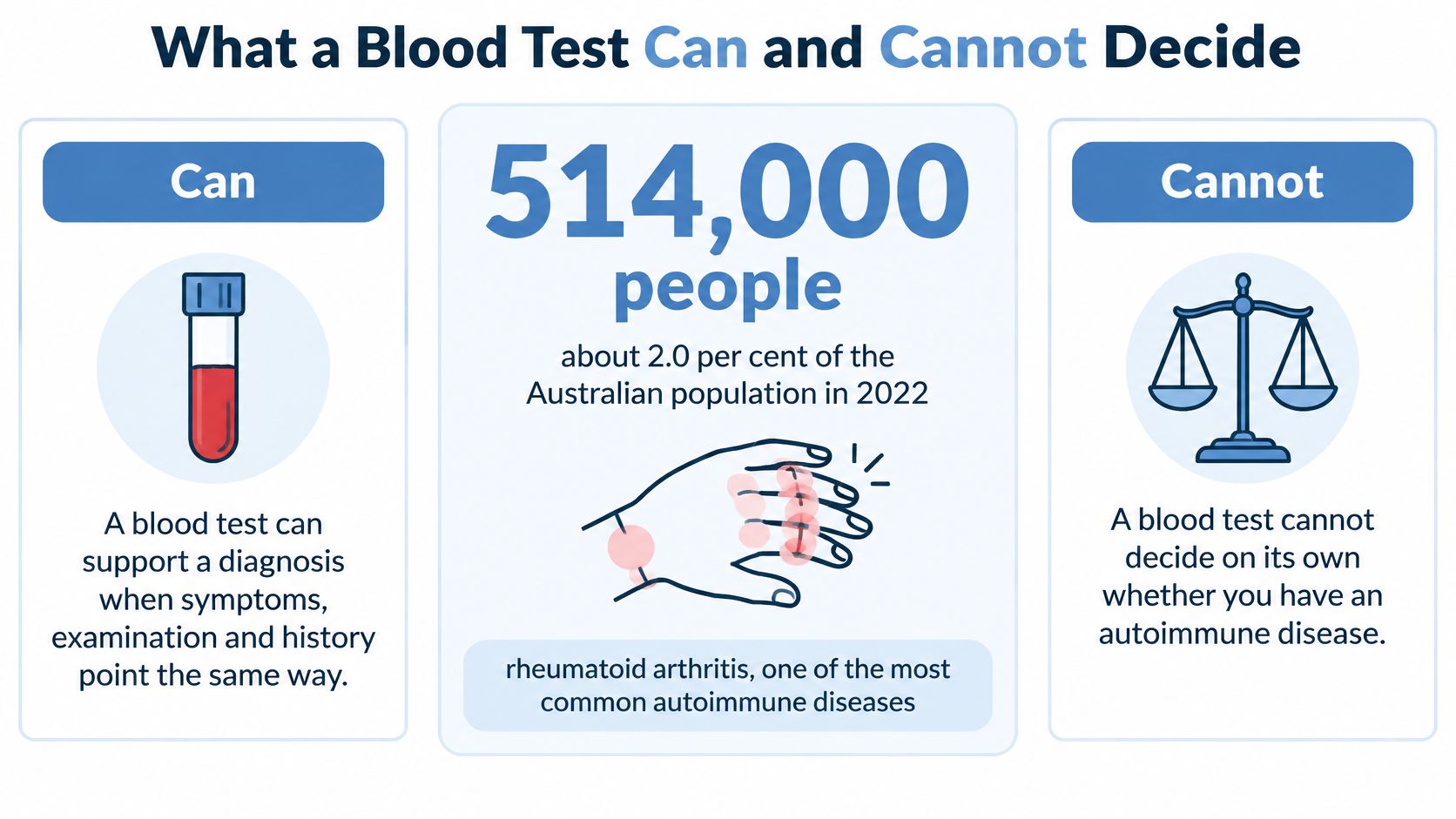
Approximately 514,000 Australians, or 2.0 per cent of the population, were living with rheumatoid arthritis in 2022, based on self-reported National Health Survey data reported by the Australian Institute of Health and Welfare. Autoimmune disease isn't a rare curiosity, but investigating it isn't as simple as ordering a blood panel. A blood test for autoimmune disease can support an assessment, but it can't diagnose or exclude every condition on its own.
What a Blood Test Can and Cannot Decide
Say you wake with stiff fingers and notice that your knuckles look swollen. A clinician asks which joints hurt, examines them and orders blood tests to investigate possible inflammatory arthritis. The blood sample contributes evidence, but it doesn't replace what happens during that consultation.
Now consider someone who feels well and orders the same antibodies out of curiosity. Even if their laboratory report contains the same positive flag, the clinical meaning may be quite different. A result has to fit the person, not just the laboratory reference range.
A clue rather than a verdict
Rheumatoid factor, usually shortened to RF, illustrates the problem. It can support a rheumatoid arthritis assessment, but it can also be detected in someone who doesn't have that disease.
Think of an antibody test as a smoke alarm. An alarm can sound because there's a fire or because you've burnt the toast. You investigate what caused it rather than treating the sound itself as proof of a fire.
The same reasoning applies when an antibody result is negative. A silent alarm doesn't tell you everything about every room in the house, particularly if the problem you're looking for needs a different detector.
The distinction between supporting an assessment and deciding a diagnosis is important.
What the clinician puts together
A useful assessment combines different kinds of evidence:
- Your symptom history: Where the problem occurs, when it started and whether it changes over time.
- Physical findings: Whether joints are swollen, muscles are weak or a rash has features that need investigation.
- Laboratory findings: Antibodies, inflammatory markers and tests looking for effects on blood cells or organs.
- Further assessment: Imaging, specialist review or other investigations when the clinical question requires them.
These pieces don't all carry equal weight in every situation. A clearly swollen joint may need investigation even when an antibody test is negative, while an unexpected antibody in a well person may need context rather than treatment.
The practical question isn't whether a report says positive or negative. It's whether the finding helps explain the symptoms and changes what should happen next.
Common Blood Tests Used in an Autoimmune Assessment
| Test | What it looks for | Where it helps | Key limit |
|---|---|---|---|
| ANA | Antibodies against cell nuclei | Early direction when systemic rheumatic disease is suspected | Can occur in healthy people; isn't a general health screen |
| ENA | Extractable nuclear antigen antibodies | Helps distinguish lupus, Sjögren syndrome and mixed connective tissue disease | Needs a relevant clinical question, not indiscriminate screening |
| Anti-dsDNA | Antibodies to double-stranded DNA | Adds disease-specific information when lupus is suspected | A positive result still needs the clinical picture |
| RF | Rheumatoid factor | Supports assessment of possible rheumatoid arthritis with inflammatory joint symptoms | Can be positive without rheumatoid arthritis |
| Anti-CCP | Antibodies to cyclic citrullinated peptide | Adds diagnostic information in a rheumatoid arthritis assessment | Doesn't replace joint examination |
| ESR and CRP | Non-specific markers of inflammation | Help assess inflammatory activity | Normal results don't exclude every autoimmune disease |
| Full blood count and urinalysis | Blood-cell changes and possible kidney involvement | Look for effects beyond the presenting symptoms | Neither identifies a specific autoimmune disease alone |
Urinalysis is a urine test, not a blood test. It's included because an autoimmune assessment may require evidence that a blood sample can't provide.
Why tests are selected in stages
The Australian Department of Health pathology immunology report describes ANA as an early investigation when symptoms, examination findings or other laboratory results already suggest systemic rheumatic disease, with ENA testing helping distinguish conditions such as lupus, Sjögren syndrome and mixed connective tissue disease.
That sequence matters. The clinician starts with a suspected pattern, then chooses tests that can clarify it. They don't need every available antibody just because autoimmune disease is somewhere on the list of possibilities.
For example, a systemic pattern involving skin and joints may prompt a different laboratory pathway from persistent inflammatory swelling in the hands. RF and anti-CCP belong in the latter assessment when appropriate, rather than being added automatically to a general wellbeing check.
Different tests answer different questions
Antibody tests investigate an immune response. ESR, or erythrocyte sedimentation rate, and CRP, or C-reactive protein, investigate inflammation without naming its cause.
If your report flags CRP, understanding what a high C-reactive protein result means can help you prepare questions for your appointment. It shouldn't lead you straight to an autoimmune diagnosis.
Blood counts and urine testing have another role: checking whether the suspected condition may be affecting blood cells or the kidneys. Those findings can influence how promptly someone needs further assessment, even when the original complaint seems limited to joint pain or fatigue.
Practical rule: Before a test is ordered, you should be able to ask what question it answers and what the clinician would do differently after either result.
An isolated positive ANA therefore calls for interpretation, not automatic labelling as lupus. Equally, this collection of investigations isn't a reliable screening package for someone without relevant symptoms.
Why a Positive Result Is Not a Diagnosis
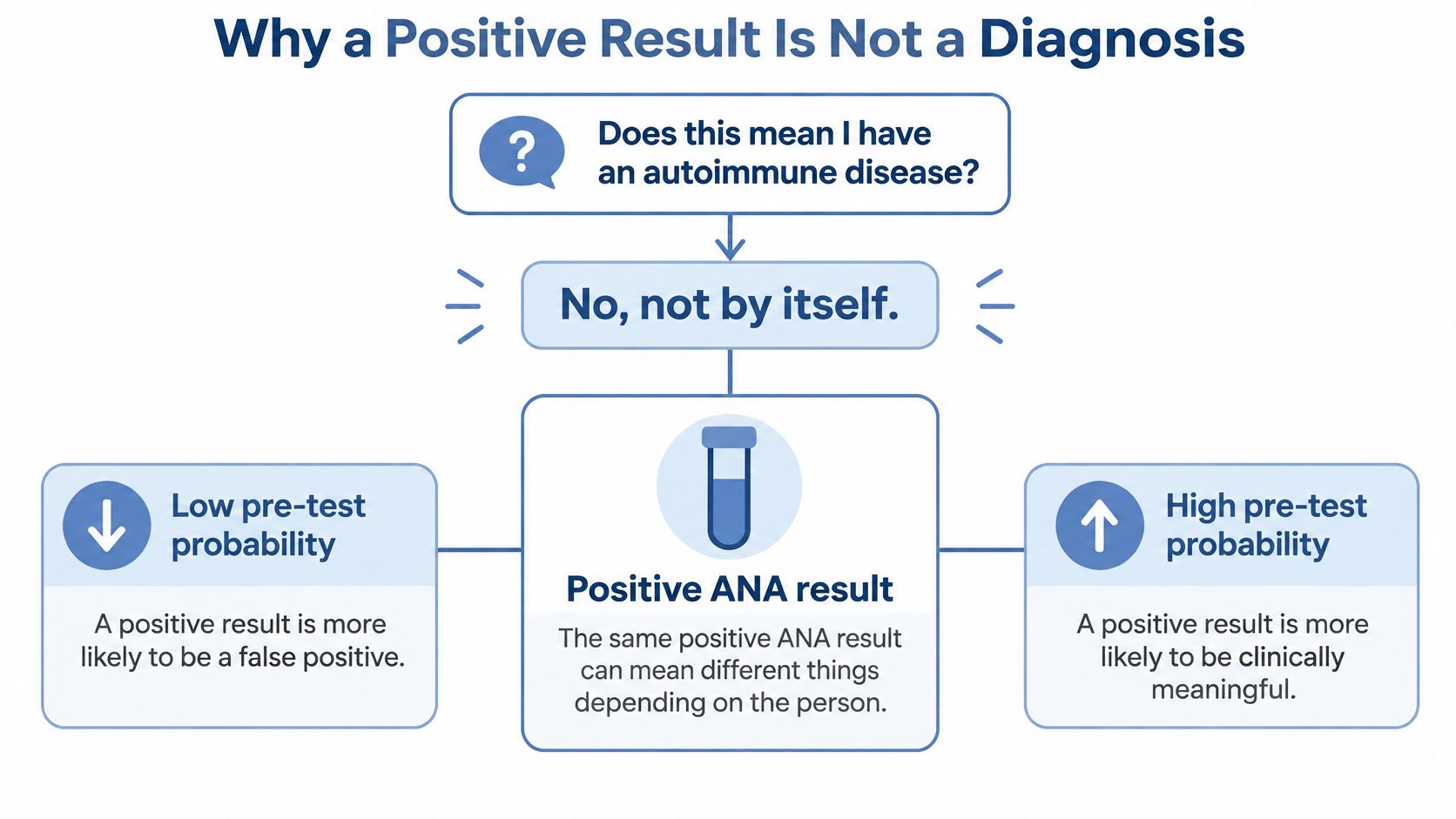
An unexpected positive ANA can make a routine results notification feel frightening. The immediate question is understandable: does this mean I have an autoimmune disease? No, not by itself.
The Royal Australian College of General Practitioners guidance on ANA testing notes both that ANA is positive in more than 95 per cent of people with systemic lupus erythematosus and that the majority of individuals with a positive ANA but no suggestive symptoms won't develop autoimmune disease over the following three years.
Those statements aren't contradictory. A test can detect antibodies in many people with a disease while also detecting them in people who don't have it.
This is why the circumstances around the result matter.
The meaning of pre-test probability
Pre-test probability means how plausible a condition was before the test was performed. It's the clinician's starting assessment, based on symptoms, examination and history.
Consider someone with a facial rash, recurrent mouth ulcers and joint symptoms. A positive ANA may contribute to a coherent clinical picture that needs targeted investigation.
Contrast that with a well person who bought a broad panel out of curiosity. The same laboratory flag is less convincing evidence of disease because there wasn't a matching clinical pattern beforehand.
ANA can occur in healthy people and alongside infections, malignancy or other non-rheumatological conditions. That doesn't mean a positive result requires an investigation for every possible cause. It means the clinician must decide which explanations are relevant to that person.
What to do instead of chasing the result
A titre describes the concentration of antibody detected. A low titre can occur in someone without autoimmune disease, positivity becomes more common with age, and ANA can remain high during remission without reliably measuring disease activity.
Useful follow-up focuses on the unanswered clinical question:
- Review the reason for testing: Was there a symptom pattern suggesting systemic disease?
- Check for objective findings: Examination and assessment of possible organ involvement matter more than the positive flag alone.
- Choose targeted investigations: More specific antibodies, blood counts or urine tests may help when the clinical picture warrants them.
- Discuss referral: A convincing disease pattern or possible organ involvement may justify specialist assessment.
Repeating ANA to see whether it becomes negative may add little useful information. Specialist review should be driven by the person's clinical needs, not a low-titre result alone.
For an additional explanation of ANA results, the following video provides a visual reference.
How Results Differ Across Real Conditions
Similar-looking laboratory reports can lead to different decisions. These hypothetical situations show how clinicians use the clinical pattern without turning an antibody result into a do-it-yourself diagnosis.
Swollen hands and prolonged morning stiffness
An adult develops painful, swollen finger joints and has difficulty making a fist after waking. The clinician examines the joints, asks about the course of symptoms and considers investigations for inflammatory arthritis.
RF and anti-CCP can add useful evidence in that setting. The decision isn't based on joint pain alone, because soreness and demonstrable joint inflammation aren't interchangeable.
A positive RF in someone with no signs of joint inflammation doesn't establish rheumatoid arthritis. Conversely, convincing swelling deserves clinical attention even if the expected antibody isn't detected.
A pattern involving several body systems
Another person reports joint symptoms, a recurring rash and mouth ulcers. Here, the clinician considers whether the symptoms form a systemic connective-tissue disease pattern and whether there's evidence of organ involvement.
An AIHW report on arthritis and other musculoskeletal conditions cited published prevalence estimates for lupus and other systemic connective-tissue disorders of 19 to 53 cases per 100,000 people, and recorded 245 deaths in 2013 with these disorders as the underlying cause. These are historical, group-level figures, not a prediction of an individual's risk.
Although less common than rheumatoid arthritis, these disorders can affect joints, skin, muscles, blood vessels and other organs. That breadth explains why an assessment may extend beyond antibodies to urine testing, blood counts and examination of the affected systems.
ANA may direct the initial laboratory assessment, while ENA or anti-dsDNA can help clarify a suspected condition. None substitutes for checking whether the person's symptoms and physical findings fit.
A positive report without a matching illness
A well adult receives a positive ANA after private screening. Their clinician reviews the report, takes a history and finds no suggestive features on examination.
The task is to decide whether any further investigation is justified and explain which new symptoms would warrant reassessment. It isn't necessary to force a disease label onto an unexplained laboratory finding.
A separate question arises when symptoms suggest a particular organ rather than a systemic rheumatic disorder. For example, thyroid antibody testing addresses a different clinical pathway from an ANA-led assessment.
A laboratory pattern becomes useful when it answers a question about the person. A collection of positive flags isn't a diagnosis.
These examples aren't symptom checklists for identifying a disease yourself. Their purpose is to show why the same result can lead to investigation, observation or a different diagnostic pathway.
When a Normal Blood Test Still Leaves Symptoms
A report marked normal can provide genuine reassurance. It becomes misleading when it's treated as clearance for every autoimmune disease or as an explanation for symptoms that haven't resolved.
The Australasian Society of Clinical Immunology and Allergy guidance on autoimmunity laboratory testing places laboratory findings within an assessment that includes clinical history, examination and, when appropriate, imaging or biopsy. Blood results alone don't have enough predictive value to act as a universal screen.
A negative ANA doesn't exclude rheumatoid arthritis, spondyloarthropathies, inflammatory myopathies or vasculitis. Not everyone with lupus has a positive ANA either, so the next decision depends on what condition the clinician suspects.
Persistent symptoms need an explanation
Return for assessment if symptoms persist, progress or become more specific, particularly:
- Joint swelling: Visible or clinically detectable swelling that doesn't settle.
- Skin or mouth changes: Recurrent rashes or mouth ulcers, especially with other symptoms.
- Muscle weakness: Difficulty rising from a chair, climbing stairs or lifting your arms, rather than tiredness alone.
- Unexplained organ abnormalities: Findings that need investigation even if antibody tests are unremarkable.
These symptoms don't automatically mean autoimmune disease. They mean a normal panel shouldn't end the effort to identify a cause.
Normal ESR or CRP also needs context. Neither test surveys every possible immune process, and neither explains why someone remains unwell.
More biomarkers aren't automatically better
Ordering a longer panel can seem like the logical response to uncertainty. In someone with a low likelihood of autoimmune disease, however, extra testing can produce non-specific findings that generate more appointments and anxiety without explaining the symptom.
A better plan identifies the leading clinical possibilities and chooses investigations that distinguish between them. Sometimes that means disease-specific testing; sometimes imaging, a different medical assessment or reviewing how symptoms change over time is more useful.
Safety first: Don't wait for another blood panel when symptoms suggest a potentially serious problem.
Seek urgent in-person assessment for chest pain, shortness of breath, severe headache with neurological changes, markedly reduced urine or rapidly worsening weakness. These symptoms can have several causes, and urgency doesn't depend on whether an autoimmune test was positive.
For persistent but non-urgent symptoms, arrange a follow-up appointment and bring the original report. A normal result can lower concern about particular conditions while still leaving a clinical question worth answering.
How Symptoms and Examination Guide the Tests
A clinician doesn't start with an empty request form and tick every autoimmune marker. They first work out what needs explaining, then select investigations capable of changing a decision.
The blood test is a torch. The history tells the clinician which room to point it into. Without that direction, a broad panel may illuminate an incidental finding while leaving the original problem unexplained.
The clinical sequence
Map the symptom pattern. Describe which joints, skin areas, muscles, glands or other systems are affected. When symptoms started, whether they come and go, and what daily activities have changed help determine which conditions are plausible.
Identify urgency before routine testing. The clinician checks whether the person needs immediate assessment rather than waiting for an outpatient result. This changes the setting and speed of care, not merely the test selection.
Review the background. Medicines, supplements, recent infections, family history and age can alter the interpretation of symptoms or antibody findings. Bring a medication list, but don't stop prescribed treatment to prepare for testing unless your treating clinician advises it.
Examine the affected system. A description of painful hands isn't the same as an examination showing joint swelling. Likewise, a clinician may need to distinguish true muscle weakness from pain-limited movement or general exhaustion.
Choose the narrowest useful investigations. Each test should address a realistic possibility or assess a potential complication. A symptom such as persistent fatigue deserves a broader clinical discussion rather than an automatic autoimmune panel; understanding why you're always tired can help organise that conversation.
Decide what the result changes. The clinician considers whether the findings justify treatment, a more specific investigation, specialist referral or planned reassessment. An abnormal number that doesn't change a decision may not justify repeated measurement.
How to prepare for the appointment
You don't need to arrive with a suspected diagnosis. Bring a short symptom timeline, previous pathology reports and photographs of intermittent visible changes, such as swelling or a rash.
Describe function as concretely as possible. Difficulty opening a jar, getting out of a chair or completing usual exercise gives the clinician more to work with than saying you feel inflamed.
- Record changes: Note new symptoms and whether existing ones are improving or worsening.
- Bring the actual reports: Test names and laboratory comments are more useful than a recollection that your autoimmune bloods were normal.
- Ask for a plan: Clarify what would trigger another appointment or a different investigation.
A good test is the one chosen for your clinical situation, not the longest list available.
Decide Your Next Step After the Result
Your next action should depend on your symptoms and the reason testing was performed, rather than the colour of a flag on a laboratory report.
If you have symptoms suggesting inflammatory or systemic disease, arrange a GP assessment with examination and targeted investigations. A specialist referral may follow when the clinical pattern, potential organ involvement or unresolved findings justify it.
If you already have a report, take the complete document to that appointment. Ask what each relevant result contributes, which possibilities remain and whether further testing would change management.
Separate diagnostic care from general monitoring
A private pathology service can help you gather general health information. It can't provide the physical examination or complete clinical reasoning needed to investigate suspected autoimmune disease.
At Vital iQ Health, we offer online ordering without a GP referral, with 41 pathology panels, collection at a nearby NATA-accredited collection centre, and results within 24 to 72 hours. We use NATA-accredited laboratories, and all our collection centres are NATA accredited.
Those results can support health monitoring and a subsequent medical discussion. They aren't a stand-alone way to prove or clear autoimmune disease, and access to testing shouldn't delay assessment of concerning symptoms.
Match the action to your situation
- Urgent or rapidly worsening symptoms: Seek in-person medical care first rather than arranging routine private pathology.
- Persistent unexplained symptoms: Book a symptom-led clinical review and bring any existing results.
- An unexpected antibody result: Arrange interpretation in context instead of repeatedly testing for reassurance.
- General preventative health goals: Keep monitoring separate from the investigation of a suspected disease, and discuss relevant findings with a clinician.
Before arranging another blood test, write down the question you want answered. If that question is whether your symptoms represent autoimmune disease, the useful starting point is a clinical assessment, not a larger panel.
We offer private blood testing to help you gather general health results for monitoring and medical discussion. Visit Vital iQ Health to explore testing options, and arrange clinical review if you're investigating autoimmune symptoms or need help interpreting an unexpected result.