LDH Blood Test: What a High Result Means
An LDH blood test shows cell injury, not one disease. See why a high result in Australia may be haemolysis and is not a diagnosis on its own.
A high LDH blood test marks cell injury or faster cell turnover somewhere in the body, and it is not, by itself, a diagnosis of liver disease, a heart attack, or cancer. The advice that treats every flagged number as hidden illness sends people down the wrong path. An isolated, modest rise often says more about a damaged blood sample than about a disease you cannot feel. Australian reviewers took lactate dehydrogenase off the routine liver panel for that reason. The useful reading starts with what the enzyme does, then with the pattern on the report, and only then with whether a fresh tube is wiser than a long search.
What Lactate Dehydrogenase Does in Your Cells
Think of a busy kitchen at the end of service. The knives, tongs and measuring spoons stay in the toolbox until a cook needs them. Lactate dehydrogenase, usually shortened to LDH, works the same way inside your cells. It is a helper enzyme, kept ready rather than left loose on the bench.
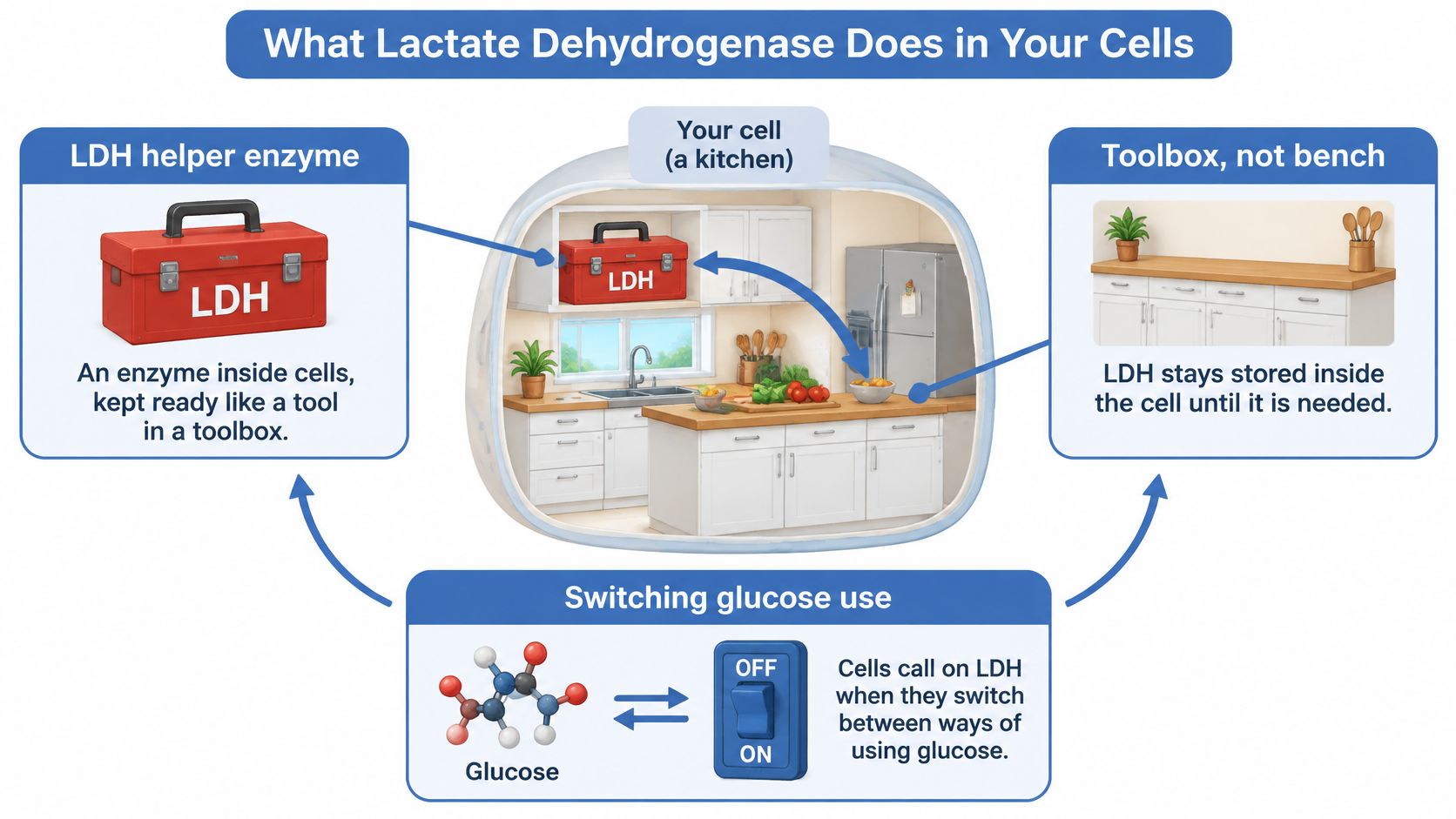
Cells call on that tool when they switch between ways of using glucose. With enough oxygen, they run the slower, efficient route. When oxygen is short, or when a tissue is working hard and fast, they fall back on a quicker path that makes lactate. LDH sits at that switch. Healthy cells hold almost all of it inside. A small amount in the serum, the liquid part of blood, is expected. A larger amount usually means cells have been damaged and have leaked, or that many cells are being made and broken down at once.
Why one enzyme cannot name one organ
The same helper is stocked in many rooms of the body. Heart muscle and skeletal muscle carry it. So do the liver, red blood cells, kidney, lung, and some tumours. That spread is the whole reason an LDH blood test cannot point to one address. A smoke alarm tells you something is burning. It does not tell you which room, and it does not tell you whether the toast or the wiring started it.
That is why the same enzyme once looked useful for heart attacks and for liver checks, and why it is now treated as a nonspecific marker. The number on a report, given in units per litre, only makes sense against that laboratory's method and its printed reference interval. A single high value is a clue to investigate. It is not a finished explanation.
There are five related forms of the enzyme, often called isoenzymes. Different tissues emphasise different forms. That detail matters only when a clinician already has a reason to look closer, which is a separate test from the total you usually see first.
Practical rule: Read the units against the interval printed beside your result. A number borrowed from a website is the wrong ruler for your sample.
How to Read an LDH Blood Test Result
Serum LDH rises when cells leak the enzyme or turn over faster. The figure marks injury or turnover somewhere. It does not name an organ or an illness. Healthdirect's guidance on liver function tests puts the same point in clinical language: an increased serum LDH concentration is a marker of cell injury or increased cellular turnover rather than a liver-specific diagnosis, and individual pathology results generally do not establish a diagnosis.
Match the pattern in order, and keep each companion test beside what it cannot prove.
| Result pattern | Possible meaning | Does not prove | Sensible next step |
|---|---|---|---|
| Isolated mild rise, no symptoms | Sample haemolysis, hard exercise or minor tissue stress | Cancer, liver disease or a heart attack | Check the haemolysis comment and consider a repeat |
| Rise with anaemia or jaundice | Red-cell breakdown or increased cell turnover | One specific blood disorder | Compare with the full blood count and seek review |
| Rise with abnormal ALT, AST or bilirubin | Tissue injury that may include the liver | LDH alone diagnoses liver disease | Read it with the liver tests, not instead of them |
| Rise with muscle pain or high creatine kinase | Muscle injury, including strenuous exercise | Heart damage by itself | Match the history with creatine kinase |
| Rise with fever, weight loss or cancer monitoring | Higher cellular turnover | A new cancer diagnosis from LDH alone | Clinician-directed targeted tests |
| Abnormal kidney markers or reduced kidney function | Kidney tissue or kidney function may belong in the picture | That every LDH rise is kidney disease | Include renal markers in the clinical review |
| Child or neonate result | Must be judged on an age-specific interval | That an adult internet range applies | Use the reporting laboratory's age interval |
What to check before you name a cause
Start with an isolated mild rise and no symptoms. Look for a haemolysis comment, a difficult draw, recent strenuous exercise, trauma, and medicines. That pattern does not prove cancer, liver disease, or a heart attack. The requesting clinician weighs those same details, including haemolysis risk, before deciding on a repeat or a targeted test.
A rise beside anaemia or jaundice points toward red-cell breakdown or high turnover. Compare it with the full blood count. Do not jump to one named blood disorder from the enzyme alone.
A rise sitting next to alanine aminotransferase (ALT), aspartate aminotransferase (AST), or bilirubin is read with those liver results. Abnormalities can come from hepatic, muscular, haematological, renal, infectious, or malignant processes. LDH never stands in for the liver tests.
Muscle pain, or a high creatine kinase, points to skeletal muscle. A hard training session can do this. It does not, by itself, mean heart damage.
Fever, unexplained weight loss, or monitoring of a cancer already diagnosed raises a turnover question for a clinician. LDH alone does not diagnose cancer. Abnormal kidney markers belong in that same review. They do not turn every rise into kidney disease.
The interval on your report is the ruler
Use the interval printed by the reporting laboratory. A generic internet cut-off is the wrong ruler, and adult, child, and newborn intervals are not interchangeable. Healthdirect's blood testing guidance notes that most common blood-test results are generally available within 1–2 days, and that reference ranges describe values generally considered normal for a population. They are not automatically diagnostic for every individual.
The same guidance is blunt about specimen damage. Red blood cells contain substantially more LDH than plasma, so a ruptured sample can produce a value that reflects collection or transport rather than your biology. The laboratory may call the sample unsuitable or add a haemolysis comment. A first high result should be rechecked on a properly collected sample before major conclusions are drawn.
Persistent or substantial elevation, especially with anaemia, jaundice, muscle symptoms, abnormal liver tests, fever, weight loss, or reduced kidney function, warrants clinician-directed assessment. One flag starts confirmation, not a label. The same habit of reading a marker beside its companions applies when a high C-reactive protein shows up on a preventative panel.
Why LDH Is Ordered and Why It Left Routine Liver Tests
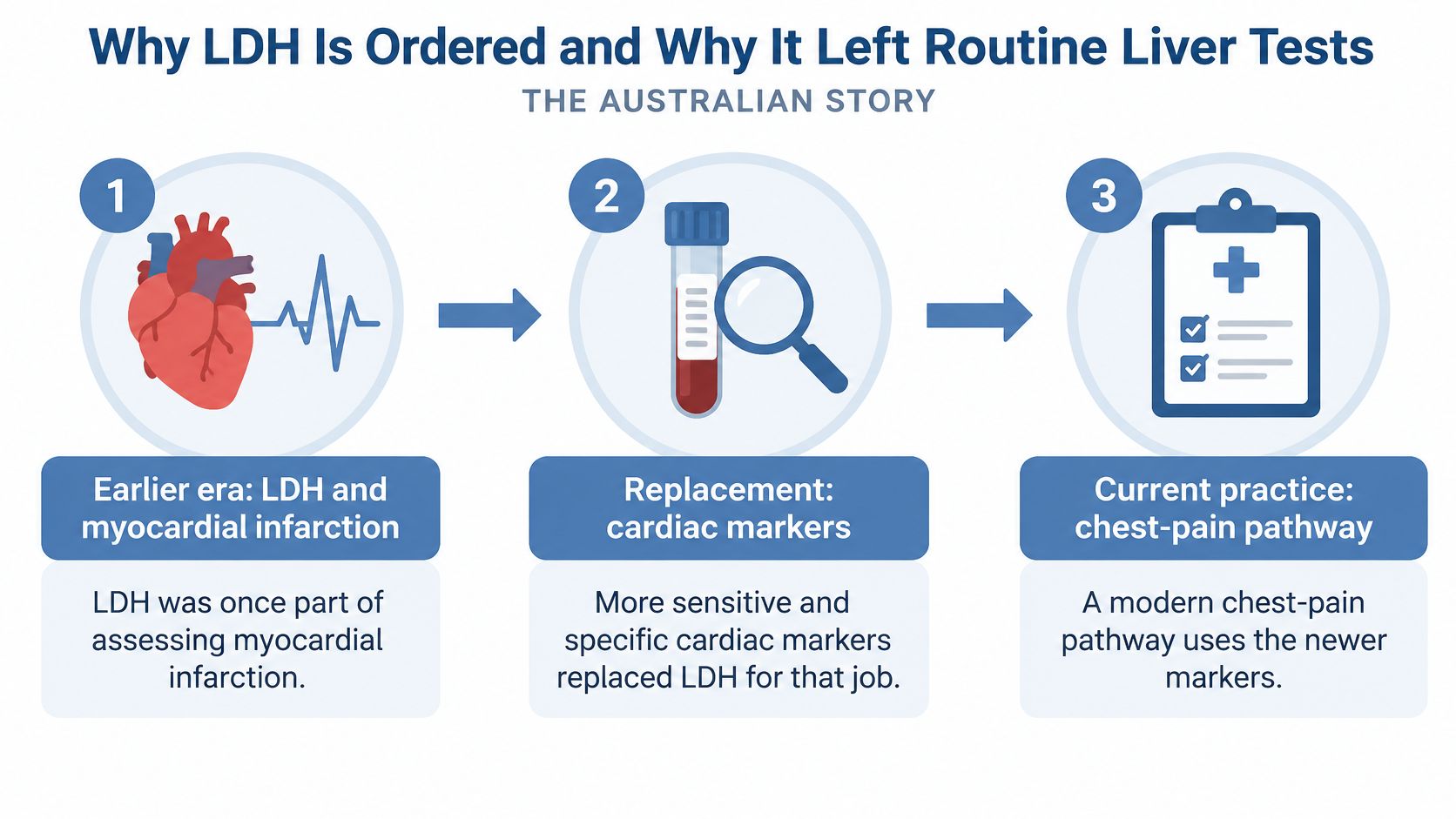
LDH used to sit in a very different job. It was formerly part of assessing myocardial infarction, the damage that follows a blocked coronary artery. More sensitive and specific cardiac biomarkers replaced it for that job. A modern chest-pain pathway does not rest on this enzyme.
The 2021 turning point
In 2021, the Australian Government's Chemical Pathology Clinical Committee reviewed LDH and reported a high rate of false-positive results, meaning a raised result may occur without a specific disease diagnosis. Its recommendation was to retain LDH as an available single pathology test, while excluding it from the routine liver-function-test panel, because LDH does not generally change the clinical management of liver disease. That finding is set out in the Chemical Pathology Clinical Committee report.
Available is not the same as useful on every panel.
The review named haemolysis, red-cell destruction or contamination from damaged blood cells, as the primary practical use. It also recognised that increased LDH can indicate conditions involving increased cellular turnover. An isolated high result on a preventative or monitoring panel should not automatically be treated as liver or heart disease. It commonly needs clinical context, a repeat, or a check for specimen haemolysis.
Questions that still justify the test
Three questions still make the order reasonable.
Is there haemolysis? That is the clearest use, whether red cells are breaking down in the body or the sample itself was damaged.
Is cellular turnover higher than expected? Some blood disorders and some cancers raise turnover. The enzyme can support that question. It does not open it on its own.
Is tissue injury already showing on other results? LDH can sit beside those results. It should not lead them. Kidney markers are a separate question, and a renal function test answers kidney performance more directly than this enzyme ever will.
The preventative-panel trap
Seeing LDH beside liver tests on an old request form does not mean an isolated high result is liver disease or heart disease. The useful order is the clinical question first, then the enzyme, then the company it keeps. Treat it as a nonspecific marker of tissue injury or cell turnover, not as a stand-alone diagnostic test.
When a Blood Draw Itself Raises LDH
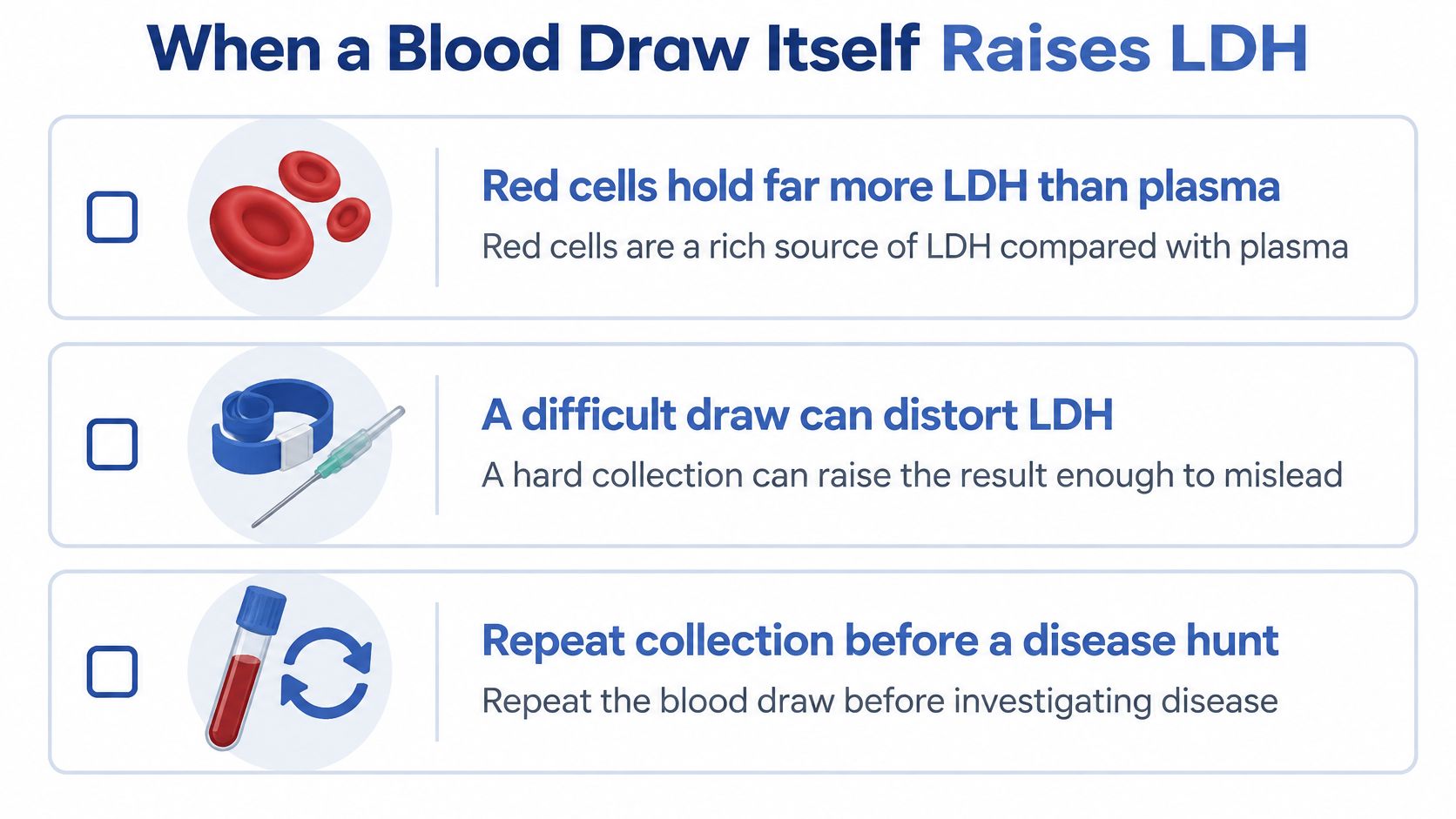
A modest isolated rise may describe the tube more than it describes you. People rarely get a straight answer to the obvious question: how far can a difficult blood draw distort an LDH result, and should you repeat it before anyone hunts for disease? No published figure in routine patient guidance states how many units a hard draw adds. The decision rests on a haemolysis comment, an unsuitable-sample note, or pink serum, then a fresh collection.
How the tube invents a high number
Red cells hold far more LDH than plasma. If they rupture in the tube, during a slow or traumatic venepuncture, or after a very tight tourniquet and a squeezed arm, that enzyme spills into the serum. You can feel well and still see a high number. Delayed separation, and refrigerating blood that has not been separated, can do the same after you have left the collection centre.
The RCPA Manual entry for lactate dehydrogenase identifies LDH as particularly vulnerable to in-vitro haemolysis for exactly this reason. Delayed processing or refrigerating unseparated blood can produce an artefactual elevation. Because the enzyme is spread through many tissues, a high result may reflect haemolysis, liver disease, ineffective erythropoiesis, malignancy, muscle injury, or other tissue damage, rather than one diagnosis. The manual's practical point is the one consumer lists often skip: an isolated, modestly raised LDH may be more informative about specimen quality than about hidden illness. Use the reporting laboratory's interval, not a generic internet threshold.
What to look for on the report
Check three things before you assume illness.
- A haemolysis comment: The report says red cells broke in the sample.
- An unsuitable-sample note: The laboratory is telling you the value should not be used.
- An index flag, or visibly pink or red serum: That colour is the laboratory's clue, even when you never see the tube.
A short walk-through of why collection technique changes chemistry results is worth a few minutes if your report already carries one of those notes.
Two stories, same number
Say the first result is mildly high after a hard draw. The full blood count is normal, you have no symptoms, and the report mentions haemolysis. That result is more informative about specimen quality than about hidden illness. A repeat on a clean sample is the right next move.
Say the second result is the same height, with no haemolysis comment, and it stays high on a clean repeat. That pattern deserves clinical context. Compare the number with how you feel and with the other tests already on the form. Ask whether a fresh sample is the right move before you assume serious disease. Reference ranges describe what is generally considered normal for a population. They are not a diagnosis for every person who sits outside them.
LDH Isoenzymes and the Extra Step
Total LDH says the toolbox was opened. It does not say which tools are on the bench. Isoenzymes are five relatives of the same enzyme, often labelled LDH-1 to LDH-5. Different tissues favour different relatives. Heart muscle and red cells are often discussed with the faster-moving forms. Liver and skeletal muscle are linked with other forms. Patterns overlap. A fraction is still not a diagnosis.
Electrophoresis is the extra step that separates those relatives. It is a follow-up, not a smarter version of a screening total.
What Medicare actually lists
In Australia this work has been on the Medicare Benefits Schedule for a long time. Pathology item 66641 covers electrophoresis of serum or another body fluid to demonstrate lactate-dehydrogenase isoenzymes, or alkaline-phosphatase isoenzymes, with preliminary quantitation of the relevant enzyme activity. The July 2023 Medicare Benefits Schedule for pathology services records a fee of $29.20, a benefit of $21.90 at the 75% rate, and $24.85 at the 85% rate. The item's start date is 1 November 1998, so formal recognition had already lasted more than 25 years by 2024.
Older schedule wording has also listed LDH among analytes tied to liver-function billing terminology. Later chemical pathology advice was not to put it in the routine liver panel, because of limited clinical utility and false-positive concerns. Those two records sit side by side on purpose.
A billed, recognised test can still be nonspecific.
When fractionation helps, and when it does not
Medicare recognition means the service is codified. It does not mean routine LDH screening is diagnostically specific. Value depends on the clinical question, specimen quality, the results beside it, and whether the clinician is assessing haemolysis, tissue injury, or abnormal cellular turnover.
Isoenzymes earn their place when that question is already formed. They are not an upgrade for a mildly high total on a preventative panel. If the total is explained by a haemolysed tube, fractionating that same sample does not rescue it. You would be sorting leaked red-cell enzyme, not mapping disease.
Decide on a Repeat or a Clinical Review
You now have a pattern. The next decision is a fork, not a new theory.
Fork one, repeat the sample
Choose a repeat when the report carries a haemolysis comment, the draw was difficult, or the rise is isolated and modest. Ask for LDH again on a fresh, properly handled sample before anyone searches for serious disease. A clean collection means a comfortable tourniquet time, a steady vein, prompt separation, and no refrigerated whole blood sitting in a bag.
If the repeat is normal, the first figure was a poor guide to your health. You can stop there unless symptoms appear later. Most isolated flags are not emergencies.
Fork two, book a clinical review
Choose review when the repeat stays high, or when anaemia, jaundice, muscle symptoms, abnormal liver tests, fever, weight loss, or reduced kidney function are already on the page. Bring the whole report, including the laboratory interval, not a screenshot of one flagged line.
The clinician decides whether any further test is worth doing. That might be a blood count, liver enzymes, creatine kinase, or something aimed at a symptom you can describe. Add LDH for a stated reason. Do not add it as a cancer screen or a liver screen. Some people also meet this enzyme while sorting inflammatory symptoms, which is a different brief from the one covered in a blood test for autoimmune disease.
How to arrange that next step in Australia
Private blood tests are available in Australia and do not require a GP referral. You can order online, choose from 41 pathology panels, attend a NATA-accredited collection centre near you, and receive results within 24 to 72 hours. If the pattern needs a person rather than another vial, partnered GPs offer telehealth consultations, review the results, answer questions, and recommend next steps from home. The safe path is one clean sample plus someone qualified to read it.
If you want an LDH blood test checked for a clear reason, rather than as a stand-alone screen, Vital iQ Health lets you order private pathology online and have a partnered GP talk through the pattern with you. Bring the haemolysis comment and the laboratory interval to that conversation so a high number is read as a sample problem or a real clue, not as a label. Visit Vital iQ Health to arrange the collection and the review.