AMH Normal Level by Age: What Your Result Really Means
Wondering about your AMH normal level? Learn how ranges vary by age and lab, how to read an Australian report, and what AMH cannot tell you.

You're holding a pathology report, and the AMH result has sent you searching for a normal level. Perhaps there's a low flag beside it, or perhaps the number looks reassuring until you compare it with someone else's. Before drawing a conclusion, check what the test measures, which units the laboratory used, and how the result relates to your age.
AMH is useful information, but it isn't a fertility score. A calm reading of the full report is more helpful than matching one number to an internet chart.
Why One Normal AMH Number Does Not Exist
Consider two women, one in her twenties and the other in her later thirties, whose reports show exactly the same AMH result. The younger woman's clinician may describe it as lower than expected for her age, while the older woman's clinician may find it less unusual. Neither interpretation is necessarily wrong.
Anti-Müllerian hormone, usually shortened to AMH, is produced by small growing follicles in the ovaries. Follicles are the small sacs in which eggs develop. Measuring AMH helps estimate ovarian reserve, meaning the pool of follicles available to be recruited, rather than providing an exact egg count.
That distinction matters. A result can describe follicle quantity without grading the health of the eggs or settling whether someone can become pregnant.
What changes the interpretation
Three considerations shape the meaning of an AMH result:
- Age: The expected pattern changes across reproductive life, so a result shouldn't be interpreted without knowing your age.
- The assay: This is the laboratory's testing method. Different methods can produce results that aren't directly interchangeable.
- The clinical question: Fertility planning and preparation for ovarian stimulation involve different decisions, even when the blood test is the same.
A reference interval is the comparison range printed by the laboratory. It describes results within a reference population, not a target every person must reach to be healthy.
A result outside the reference interval needs interpretation, not an immediate conclusion about your future.
Searching for an AMH normal level is therefore a reasonable starting point, but it won't produce one reliable number for everyone. Start with the unit printed beside your result, then the laboratory's interval, and finally the personal circumstances that prompted testing.
Check the Units Before Comparing AMH Results
Age changes what a given AMH number means. A result of 10 pmol/L at 37 and a result of 10 pmol/L at 25 are not read the same way, even before the laboratory's interval is applied.
A useful age guide comes from a Flinders University study of 238 Australian women aged 18 to 46. It reported a relatively stable AMH plateau of approximately 20 to 25 pmol/L between ages 18 and 29. After age 30, the decline accelerated, reaching about 10 pmol/L by age 37.
| Age band | Typical AMH (pmol/L) | What the study shows |
|---|---|---|
| 18-29 | Approximately 20-25 | Stable plateau in the cohort |
| 30-36 | Between the plateau and about 10 | Decline begins after 30 |
| 37 | About 10 | Approximately half the younger-adult range |
These are cohort observations, not diagnostic boundaries. The cited figures do not provide a separate value for every birthday, and they do not establish a complete clinical reference interval.
How to use the age comparison
The useful comparison is between your result and expectations for your age, not between your result and the highest number in the table. A result near the later-age observation would raise a different discussion for someone in early adulthood than for someone approaching the later reproductive years.
The laboratory's own interval remains part of the picture. A study table can help explain the age pattern, but it cannot replace the testing method and clinical context behind your report.
Check the units before doing any arithmetic
AMH reports may use pmol/L, meaning picomoles per litre, or ng/mL, meaning nanograms per millilitre. The two units work like rulers marked in different increments: they can describe the same concentration with different numbers. Do not compare the numerical values directly.
If your report uses ng/mL and a chart uses pmol/L, do not decide that your result is lower because its number is smaller. Ask your laboratory or clinician to confirm the conversion before making the comparison.
- Copy the complete result: Include the number, decimal point and unit.
- Match like with like: Only compare values expressed in the same unit.
- Keep assay differences separate: Converting units does not make different laboratory methods identical.
A unit conversion changes how a result is expressed. It does not decide whether that result is appropriate for you.
How Laboratories Set Different Reference Ranges
AMH testing has become more common in Australian general practice. A national Australian general-practice study covering 1,393,931 women aged 20 to 44 found that the age-standardised prevalence of AMH test requests increased from 0.32 per 1,000 women in 2011 to 4.33 per 1,000 in 2021.
The national testing trend is illustrated below.
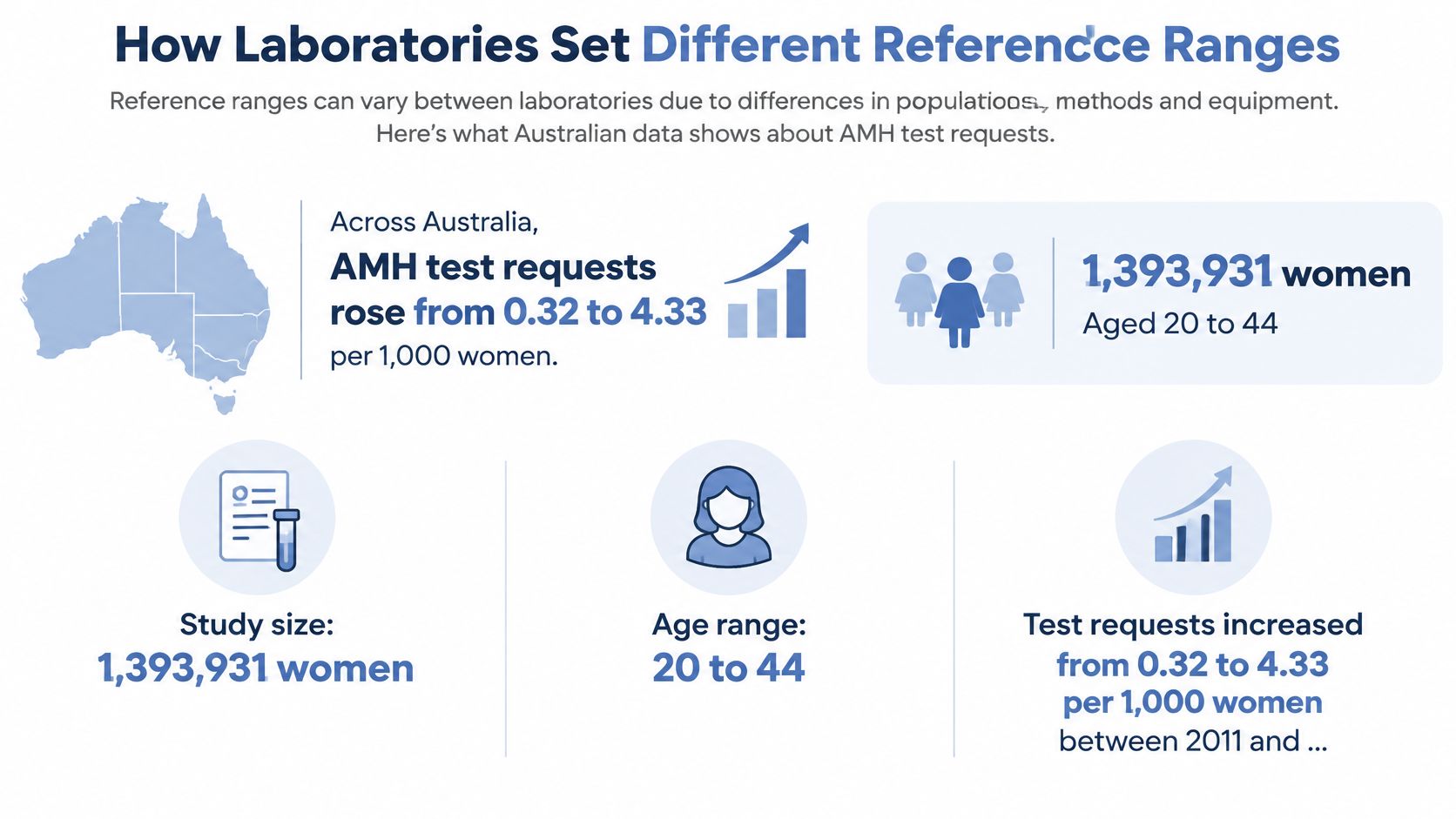
More testing doesn't mean every report uses the same definition of normal. Among tests with a documented reference range in that study, 35.1% used a fixed range, while 64.9% used an age-variable range.
Those approaches answer slightly different comparison questions. A fixed interval compares the result with the same band regardless of age, whereas an age-variable interval incorporates age into the comparison.
Why the same result can receive a different flag
Suppose you have a repeat test through a different pathology provider. Your result might receive a different flag because the provider uses another assay, another reference population, or a different approach to age adjustment.
That doesn't automatically mean either laboratory made an error. It means you need to compare the methods and intervals before interpreting the apparent change.
The Australian Medical Services Advisory Committee consultation protocol describes the absence of an international gold standard for ovarian-reserve testing and notes that AMH results vary by assay. A unit conversion alone can't solve that lack of standardisation.
Practical rule: Use the reference interval on the report that actually contains your result, not the interval on someone else's report.
If repeat testing is clinically useful, using the same laboratory can make comparison more straightforward. Your clinician should still consider whether the method has changed and whether any difference is relevant to the decision being made.
Keep previous reports rather than recording only the AMH numbers in a phone note. The laboratory name, collection date, units, interval and comments may explain an apparent discrepancy that the numbers alone cannot.
How to Read Your AMH Report Step by Step
Read the report as a complete document, not just the highlighted line. Healthdirect's guide to understanding pathology tests explains that a result flagged high or low may not itself indicate disease and needs clinical interpretation.
The visual guide highlights the basic checks on the page.
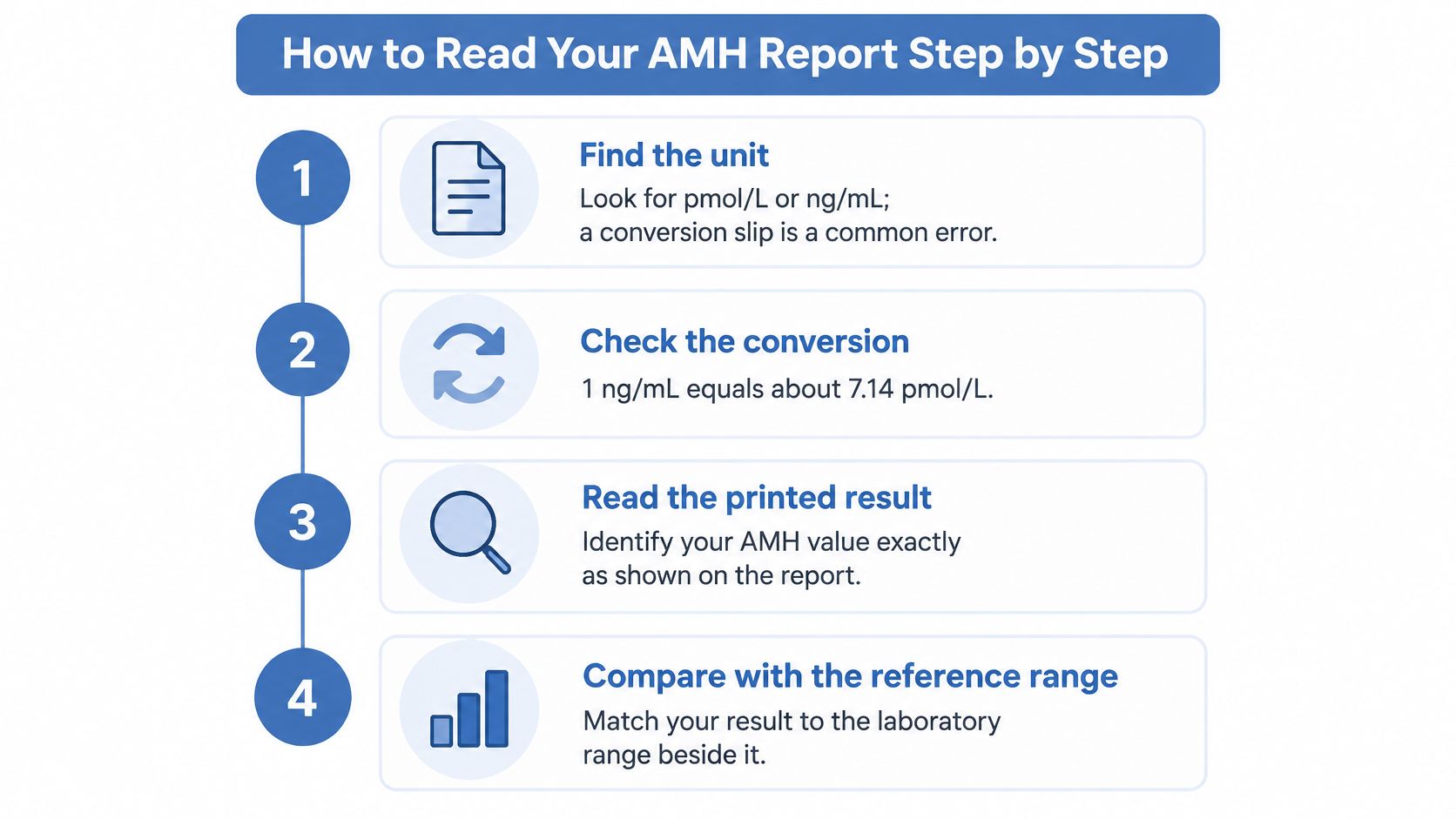
Work through the report in order
Find the result and its unit. Copy them exactly as printed, including any decimal point or less-than symbol. Don't compare a number from your report with an online chart until you've checked that the units match.
Locate the printed reference interval. It may sit beside the result or in a comment underneath it. Check whether the report identifies an age-related range rather than assuming the laboratory has already adjusted for your age.
Confirm your age at collection. Use your age when the sample was taken, particularly if you're reviewing an older report. An old result shouldn't be treated as a current measurement.
Record hormonal contraception and other medication. Include what you were taking when the sample was collected, not only what you take now. Share that history with your clinician rather than stopping prescribed medication to change a test result.
Write down why the test was requested. Fertility planning, IVF assessment, irregular cycles and menopause questions aren't interchangeable reasons for testing. Ask what decision the result was intended to help with.
Read any flag and laboratory comment together. A highlighted result is a prompt for review, not a diagnosis. Don't let a single letter beside the value outweigh the rest of the report.
If you're organising broader investigations, this guide to hormone testing in Australia provides background on the testing process. Selecting a test and interpreting its result are separate tasks.
Prepare a useful appointment folder
Bring information that helps your clinician connect the laboratory finding with your circumstances:
- The complete report: Include every page, reference interval and laboratory comment.
- The collection date: Add previous reports if you have them.
- Your cycle history: Note whether periods are regular, absent or changing.
- Your medication list: Include hormonal contraception and recent changes.
- Your questions: Write down the decision you're trying to make, such as whether further assessment would help.
If you've already had an antral follicle count, bring that report too. This is an ultrasound count of visible small follicles, and it provides another piece of information for the clinical assessment.
What AMH Can and Cannot Tell You
| Question | Can AMH answer it? | Why |
|---|---|---|
| How many follicles remain | Partly | Helps estimate the recruitable follicle pool, not an exact count |
| Egg quality | No | Reflects quantity rather than egg health |
| Likely eggs retrieved in IVF | Partly | Can help estimate the response to ovarian stimulation |
| Exact menopause timing | No | Cannot provide an individual menopause date |
| Possible PCOS | Partly | A higher result can support assessment alongside other findings |
Discussing these distinctions with a clinician helps separate a laboratory finding from the conclusion you're worried about.

Quantity isn't the same as outcome
AMH's most direct use is estimating follicle quantity. It doesn't inspect individual eggs, and it can't tell you whether a particular egg will result in a pregnancy.
For IVF, clinicians can use AMH to help anticipate the ovarian response to stimulation medication. That's a treatment-planning question, not a direct prediction of natural conception or a guarantee of live birth.
Fertility assessment may also involve factors outside the ovaries. Where relevant, understanding sperm testing and finding a collection service can help keep the investigation broader than a single hormone result.
Menopause and PCOS require different assessments
Healthdirect's blood-testing guidance, reflecting Australasian Menopause Society advice, states that AMH shouldn't routinely be measured to diagnose menopause in women over 45 with typical symptoms; for suspected premature ovarian insufficiency, particularly before age 40, clinical assessment and follicle-stimulating hormone testing are more relevant.
Follicle-stimulating hormone, or FSH, is another hormone used in assessing ovarian function. A clinician chooses and interprets these investigations according to symptoms and menstrual history, rather than using AMH as a menopause countdown.
A higher AMH result can also occur with polycystic ovary syndrome, or PCOS, and with polycystic ovarian appearance on ultrasound. Neither a high result nor an ultrasound appearance alone proves the syndrome is present.
The accompanying video provides another way to approach a conversation about AMH.
The useful clinical question is therefore specific: what does this finding contribute to the assessment, and what other information is needed? Asking that question prevents a marker of follicle quantity from being used to answer questions it cannot settle.
Misreadings to Avoid After an Abnormal Result
A reassuring-looking result can lead someone to postpone a fertility discussion. A low flag can lead someone else to assume their options have disappeared. Both reactions give the number more authority than it deserves.
An abnormal result is a reason to clarify the situation, not to make an irreversible decision on your own. The response should match your symptoms, reproductive plans and the reason testing was undertaken.
Don't blame the collection day automatically
People sometimes worry that they chose the wrong day of their cycle. The Royal Australian College of General Practitioners' clinical review explains that AMH varies little across the menstrual cycle, so testing can generally occur on any day, while values above 30 pmol/L may suggest PCOS in the appropriate clinical context rather than establish a diagnosis.
That doesn't mean collection instructions are irrelevant. If other hormones were ordered at the same time, their timing requirements may differ, so follow the instructions for the whole request.
Nor does a higher result mean there's nothing to discuss. A clinician may need to investigate associated symptoms or consider the possibility of an excessive response if ovarian stimulation is planned.
Respond to the finding, not the fear
Check whether confirmation would change care. Your clinician can decide whether the result needs clarification or whether repeating it would add useful information. Repeating a test to seek a more comforting number may not help.
Review the medication history. Explain any hormonal contraception and recent treatment changes. Don't stop contraception or another prescribed medicine without discussing the consequences and an appropriate plan.
Assess the relevant possibilities. Depending on the finding, your clinician may consider PCOS or diminished ovarian reserve using cycle history, symptoms and antral follicle count. The aim is to answer a clinical question, not attach a diagnosis from the blood result alone.
Connect the finding to your plans. Someone considering pregnancy soon may need a different discussion from someone exploring future options. Be clear about what you want to know and what decisions are ahead.
Leave with an agreed action. Ask whether you need another investigation, specialist advice or no further testing at present. Request an explanation of why that recommendation fits your situation.
You don't need to turn a laboratory flag into a fertility plan before speaking with a clinician.
Avoid buying supplements or making treatment decisions solely to move AMH into a preferred range. A useful consultation focuses on your options and the evidence needed to choose between them, rather than treating the laboratory number as the outcome to pursue.
Confirm Your Next Step With a Clinician
If your result is flagged, or your fertility question remains unanswered, book a GP or fertility-specialist appointment and bring the full report. You don't need to interpret every laboratory term before making that appointment.
Make the purpose of the consultation explicit. You might want to understand whether the result is unexpected for your age, whether further assessment is appropriate, or whether it changes a decision about pregnancy planning.
Ask questions that lead to a decision
Useful questions include:
- What comparison applies to me? Ask whether the laboratory interval is age-adjusted and how your clinician interprets it.
- What information is missing? Find out whether cycle history, an ultrasound or another investigation would clarify the picture.
- Would repeating this test help? Ask what a repeat result would change before arranging another collection.
- What should I do next? Leave with a clear recommendation, including whether specialist review is appropriate.
Bring your medication history, previous reports and any ultrasound findings. If you're feeling overwhelmed, write your main concern at the top of the page so it doesn't get lost in the discussion.
Independent testing still needs interpretation
You can arrange private blood tests in Australia without a GP referral. That offers a route to testing, but it doesn't remove the need to choose an appropriate investigation and understand its limitations.
Through our service, customers order online, attend a nearby NATA-accredited collection centre and receive results within 24 to 72 hours. If you arrange testing independently, plan the interpretation appointment as part of the process rather than waiting until an unfamiliar result arrives.
Keep the complete report and discuss it alongside your age, symptoms, cycle history and reproductive goals. Your clinician can then decide whether further testing or referral would help.
No fertility decision should rest on an AMH number alone.
At Vital iQ Health, we offer private blood testing across Australia, with online ordering without a GP referral and collection through NATA-accredited centres. If you're considering testing as part of a hormone or fertility discussion, explore our available tests and arrange clinician interpretation so your results inform a practical next step.