Womens Health Hub: Women's Health Hub
Womens health hub - Discover what a Women's Health Hub offers, which preventive checks to book by age, and how hormone and thyroid tests work across Australia

More than 138,296 occasions of service in a single year is a lot of care for a model some people still treat as a side door. In the 2023-24 reporting period, Women's Health NSW members delivered that volume, involving over 202,783 presenting health issues, according to the Women's Health NSW annual report. Those visits weren't for one disease. They covered many problems at once, which is how community women's health has worked in Australia for decades.
A women's health hub can mean two quite different things, and mixing them up sends people to the wrong next step. One is a national library of policy and evidence. The other is a local place, or a digital pathway, where you get checks, tests and a route into clinical care. The pages below keep those meanings apart, then set out which preventive checks to book, what hormone and thyroid blood tests can show, and why a normal result doesn't close the case on pelvic pain.
What a Women's Health Hub Actually Covers
Say a friend searches after months of heavy periods. She might land on a national website full of policy papers, or she might find a community clinic that can book a screen and refer her on. Both answers use the same words. They do different jobs, and only one of them can take a history.
The national layer is the Women's Health Hub revitalised by the Australian Women's Health Alliance across 2022-23 to 2024-25. The refreshed Hub launched in the project's second year and grew to approximately 900 policy-aligned resources by 30 June 2025, as the Women's Health Hub monitoring, evaluation and learning report records. From its public launch in July 2023 through June 2025 it recorded 98,689 page views. It was built for gender-responsive approaches through co-development, online learning, evidence and policy engagement, not as a direct clinical service. You can't book a blood test there. You can learn how services are meant to work, and who they are meant to reach.
The local layer is the one most readers need. A service hub is a community access point that brings together general health checks, screening, reproductive and mental health support, and referral. Think of it as a railway interchange. Several lines meet so you can change to the right service without starting again at the ticket window.
Practical rule: If a page offers evidence and advocacy but no appointment, you're in the information hub. If it offers assessment, screening or a referral pathway, you're at a clinical access point.
Three questions carry the rest of this guide.
- Which checks to book: age-based screening versus tests a GP orders because of risk.
- What blood tests show: thyroid and cycle hormones, and where those numbers stop.
- How to reach care: a route from a symptom note to a GP, a specialist or urgent help.
Preventive Checks to Book by Age
Most preventive checks follow your age band and are free through national programs. Others wait on your risk, and a GP sets the timing.
| Check | Who it suits | How often | Notes |
|---|---|---|---|
| Cervical screening (HPV test) | Women and people with a cervix aged 25 to 74 | Every 5 years | Self-collection available |
| Breast screening (mammogram) | Women aged 50 to 74; women 40 to 49 can ask to start | Every 2 years | Free mammogram through BreastScreen Australia |
| Bowel cancer screening (home kit) | People aged 45 to 74 | Every 2 years | Free kit posted through the National Bowel Cancer Screening Program |
| Blood pressure check | Adults from age 18 | At least every 2 years; yearly if raised | Quick GP or pharmacy check |
| Cholesterol and blood glucose (HbA1c) | Adults with risk factors, often from age 30 | Set by GP based on risk | Blood test; risk includes family history and weight |
| Bone density scan (DXA) | Women 65 and over, or earlier with fracture risk | Set by GP | Risk factors include early menopause and steroid use |
| Thyroid test (TSH) | Women with symptoms or family history | Only when clinically indicated | Not routine screening for well women |
How to read your row
Look at three things before you book anything. Age band decides the national screens. Risk decides cholesterol, glucose and bone density. Last result date tells you whether you're due or early.
Cervical screening is an HPV test every five years for women and people with a cervix aged 25 to 74. Self-collection is available if a clinician taking the sample feels difficult. A normal HPV result doesn't replace care for bleeding or pain between screens.
Breast screening invites women aged 50 to 74 for a free mammogram every two years, and women aged 40 to 49 can ask to start. A mammogram looks for breast changes. It doesn't investigate pelvic symptoms, so don't treat a clear mammogram as an all-clear for period pain.
Bowel screening is a home kit posted every two years from age 45 to 74. Do the kit even if you feel well. Blood you can't see is the point of the test.
Blood pressure, from age 18, is at least every two years, and yearly if a reading was raised. A pharmacy or GP check takes minutes. Cholesterol and HbA1c aren't on a fixed national timetable. Family history, weight, smoking, medicines and menopause change the interval, so your GP sets it. The same applies to a DXA scan, usually from 65, or earlier after early menopause, fractures or long-term steroid use. TSH isn't a routine screen for well women. Order it when symptoms or family history give a reason.
Match the row to your life, not to a friend's list. Age 32 with no risk factors is a different booking from age 52 after early menopause.
Before you ring, answer three questions. What is my age band? Do I have a risk factor? When was my last result?
Hormone and Thyroid Tests Decoded
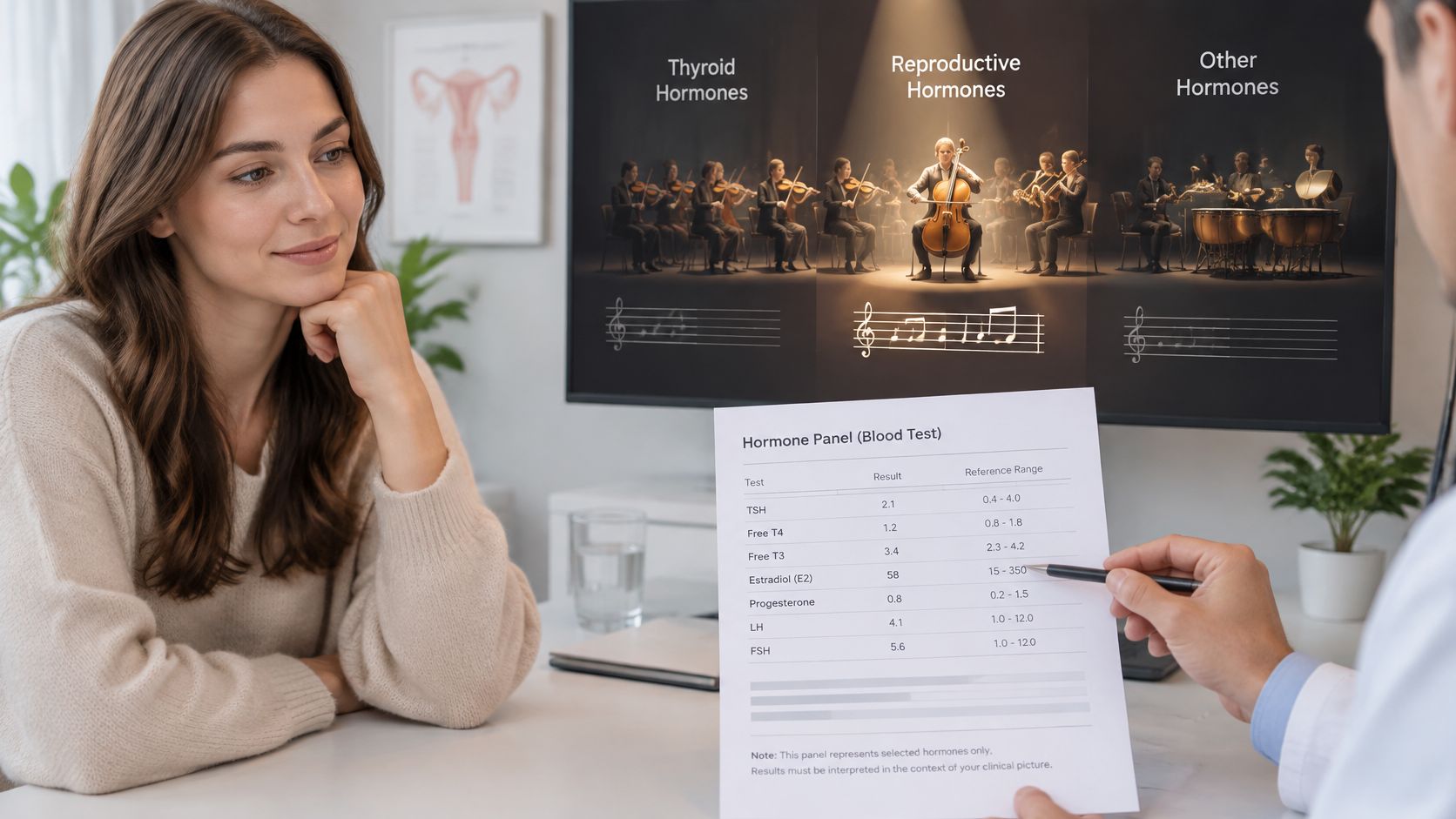
Thyroid and reproductive hormones work like sections of an orchestra. A blood test listens to one instrument at a time, so a single reading is a partial picture, not the whole piece.
A consultation is where that partial picture gets matched to how you feel, not to a printout on its own.
Thyroid tests first
TSH is the usual first thyroid test. It's the pituitary signal that tells the thyroid how hard to work, and it often shifts before the hormone level itself looks clearly wrong. Free T4 is the active thyroid hormone in the blood. Labs often add it when TSH is abnormal, to show whether the gland is underactive or overactive. Fatigue, weight change, palpitations or low mood are common reasons to test. A normal TSH in a well woman doesn't need repeating every year "just in case".
Reproductive hormones and cycle day
Oestradiol, FSH and LH are timed to the menstrual cycle. The day you have the blood taken changes the number on the page. These tests help most with irregular cycles, a question about perimenopause, or fertility planning. FSH and LH are often drawn around day 2 to 5, when the ovaries are quiet and the baseline is easier to read. Total testosterone comes in when there's excess hair growth, acne or irregular cycles, and it's one marker among others when a GP is thinking about PCOS. Prolactin, a pituitary hormone, is checked for missed periods or unexpected breast discharge. Stress, some medicines and recent hard exercise can lift it, so one high result isn't a diagnosis on its own.
Write the cycle day on the request, and list medicines, including the contraceptive pill, before the needle goes in. The pill changes oestradiol, FSH and LH, and a result read without that context misleads both of you. A clear walk-through of hormone testing in Australia is worth reading before you book, so you know which marker answers which question.
| Test | What it measures | Often ordered for | Interpretation note |
|---|---|---|---|
| TSH | Pituitary signal that drives thyroid hormone | Fatigue, weight change, palpitations, low mood | First-line thyroid test |
| Free T4 | Active thyroid hormone in the blood | Abnormal TSH | Clarifies whether the thyroid is under or overactive |
| Oestradiol (E2) | Main oestrogen | Irregular cycles, perimenopause, fertility | Timing matters; ask about the cycle day |
| FSH and LH | Signals that drive ovarian function | Irregular or absent periods, perimenopause | Often tested on about day 2 to 5 of the cycle |
| Total testosterone | Main androgen in women | Excess hair growth, acne, irregular cycles | Often used alongside other markers when assessing PCOS |
| Prolactin | Pituitary hormone | Missed periods, unexpected breast discharge | Stress, some medicines and recent exercise can raise it |
Once you can name the test, it helps to hear how a clinician talks a panel through, rather than reading every line in isolation.
What Blood Tests Can and Cannot Tell You
The common trap is a normal hormone, iron or thyroid panel that feels like proof nothing is wrong. Blood tests cannot confirm many causes of pelvic pain or heavy bleeding. A normal result does not rule out endometriosis, adenomyosis, fibroids or other structural conditions.
Those conditions are usually found through a clinical examination and imaging such as a pelvic ultrasound, not a hormone panel. Endometriosis tissue and fibroids don't announce themselves on TSH or oestradiol. A clear blood panel only tells you those particular markers sat in range on that day.
The Australian Government's 2025 Status of Women report card reports that 4 in 5 women aged 18 to 44 experienced chronic menstrual symptoms during the previous five years, and almost half missed work or study because of them. Primary-care commentary puts endometriosis at about 1 in 7 Australian girls and women, with diagnosis and care commonly taking six to eight years after symptoms begin. Waiting on a "perfect" blood panel is one way those years slip past.
Three misreadings to drop
A normal result rules the condition out. It doesn't. It only says those markers sat in range that day. One abnormal result is the diagnosis. It isn't. It flags a question for a clinician, who still has to match it to symptoms and, often, a scan. Any day of the cycle gives the same answer. It doesn't, for oestradiol, FSH and LH. A mid-cycle oestradiol and a day-3 oestradiol answer different questions.
If you're arranging private blood tests, treat the report as a conversation starter. Bring a symptom log to the appointment so the numbers have something to sit beside.
- Cycle day: where you were in the month when symptoms peaked.
- Bleeding: how many days, clots, and whether you soaked pads hourly.
- Pain: location, timing, and whether it stopped work or study.
- Bowel or bladder changes: pain with opening your bowels, or urinary urgency.
- Impact: days missed, sleep lost, plans cancelled.
A log from two or three cycles is more useful than a single bad week remembered in the waiting room.
How to Move From Symptoms to Clinical Care
Moving from a symptom to care is a route with stops, not one decision. Queensland's integrated Women and Girls' Health Hubs are built as community entry points rather than replacements for general practice. The Queensland Health women and girls' health strategy describes that mix of assessment, screening, immunisation, reproductive, gynaecological, mental-health and chronic-disease care, plus links to housing, legal and hospital support. AUD 20.4 million over four years funds two hubs, in Caboolture and Cairns South, including a First Nations-designed and led service in North Queensland. Earlier local care is meant to stop problems reaching hospital in pieces.
The same idea works for an individual. You notice something, you match it to checks already due, you use an access point, and you get handed to the right clinician.
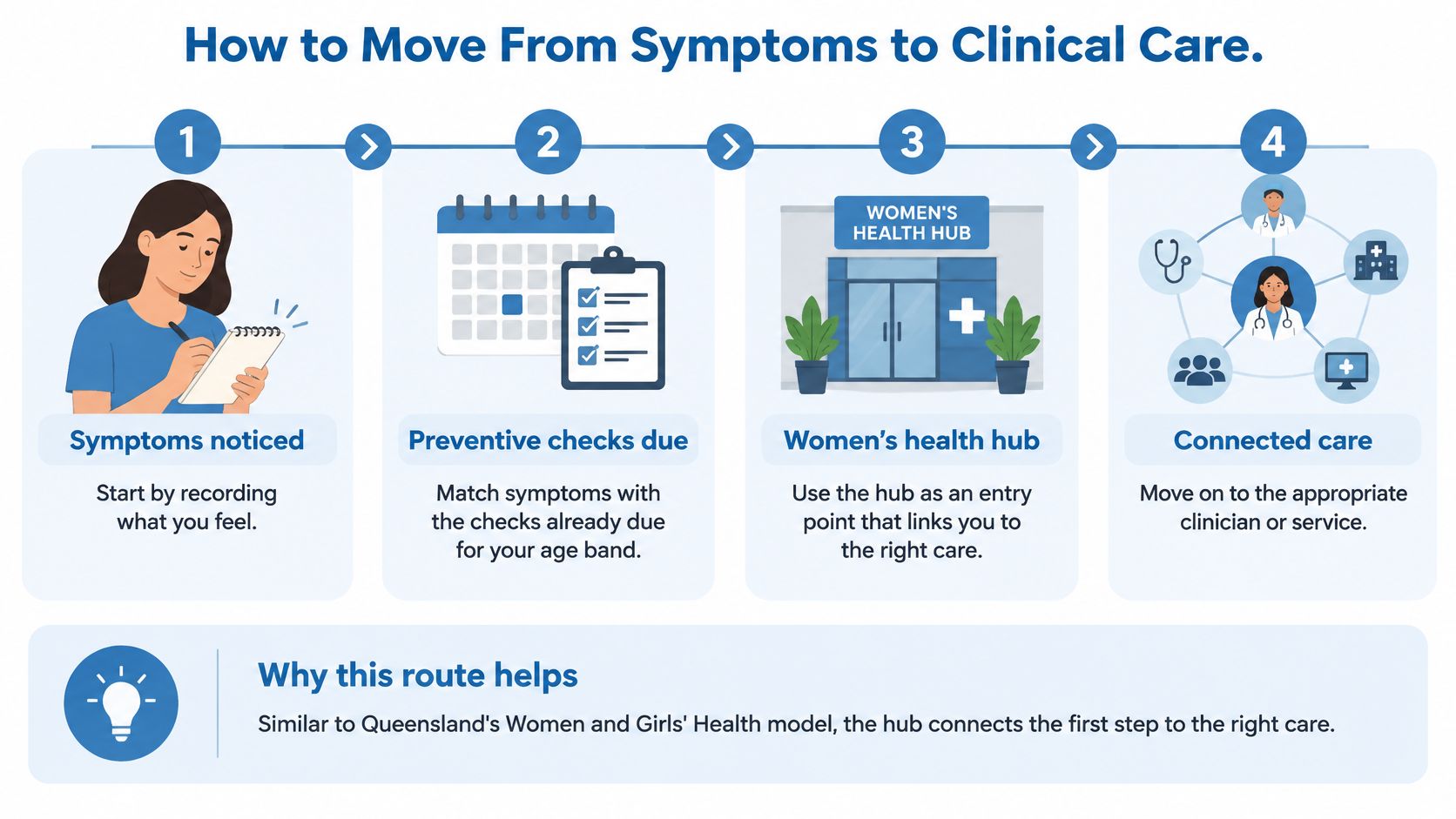
Six stops on the route
Write the log first. Note symptoms, cycle timing and medicines before you ring anyone. A clinician can use a page of dates faster than a vague "my periods are awful".
Book the GP and bring the log. Ask which preventive checks your age band is due for at the same visit, so screening doesn't wait for a second appointment months later.
Ask whether a hormone or thyroid test is indicated. Ask what each result would change. A test with no agreed next step is just a number. If fatigue is the main issue, a B12 blood test is a separate question from TSH, and it belongs in that same conversation rather than as an afterthought.
Request a referral if the pattern holds. If results stay abnormal, or pain and heavy bleeding persist beyond two to three cycles, ask for a gynaecologist or an endocrinologist rather than another identical panel.
Set the review date before you leave. Ask the GP to document follow-up so a result doesn't sit unread in a portal with nobody responsible for explaining it.
Use telehealth between visits for interpretation and for questions that don't need an examination. It doesn't replace a pelvic exam when pain or bleeding is the problem you're trying to solve.
Sudden severe pain, heavy bleeding with dizziness, chest pain or fainting needs emergency care, not a booked appointment. Call 000.
Choosing Between GP, Specialist and Urgent Care
The GP is almost always the first contact. They hold your history, order tests and coordinate referrals. A specialist is most useful once that GP has named a pattern that needs a closer look. Urgent care is for symptoms that can't wait for either queue.
| Concern | First contact | When to escalate |
|---|---|---|
| Routine checks, medicines and referrals | GP | Not urgent; book a routine visit |
| Abnormal thyroid or hormone result | GP, then endocrinologist if needed | Persistent symptoms or results still abnormal after review |
| Heavy bleeding or irregular cycles | GP, then gynaecologist | Soaking pads hourly or bleeding with dizziness |
| Persistent pelvic or period pain | GP, then gynaecologist | Pain that stops daily activity or lasts beyond 2 to 3 cycles |
| Result explanation between visits | Telehealth GP | Results that need in-person examination |
| Sudden severe pain, chest pain or fainting | Emergency care, call 000 | Immediately |
Two decision rules
If you need a result explained and you can't get to a clinic this week, a telehealth GP consultation is a reasonable option. When the question is "what does this number mean", you don't have to wait for a face-to-face slot that is three weeks away.
If waiting for a specialist would mean months of untreated pain or bleeding, ask the GP about a priority referral or a second opinion at the same time as the public referral. Pathways and wait times differ by state, so ask about public and private options in one conversation rather than discovering the wait after the letter has already gone.
A good consultation ends with a plan and a date, not a printout you have to decode alone. Providers should explain results against your symptoms. If the plan is "repeat the same test with no reason", ask what would be different next time, and what symptom would trigger a referral instead.
Book Your First Preventive Check
You can start this week with three actions, and none of them needs a perfect plan. List the preventive checks due for your age band. Write the symptom log for anything that has been going on. Book a GP visit to confirm which hormone or thyroid tests, if any, are indicated.
A simple desk setup is enough. A calendar, a short log and your Medicare card will do more than another evening of searching.
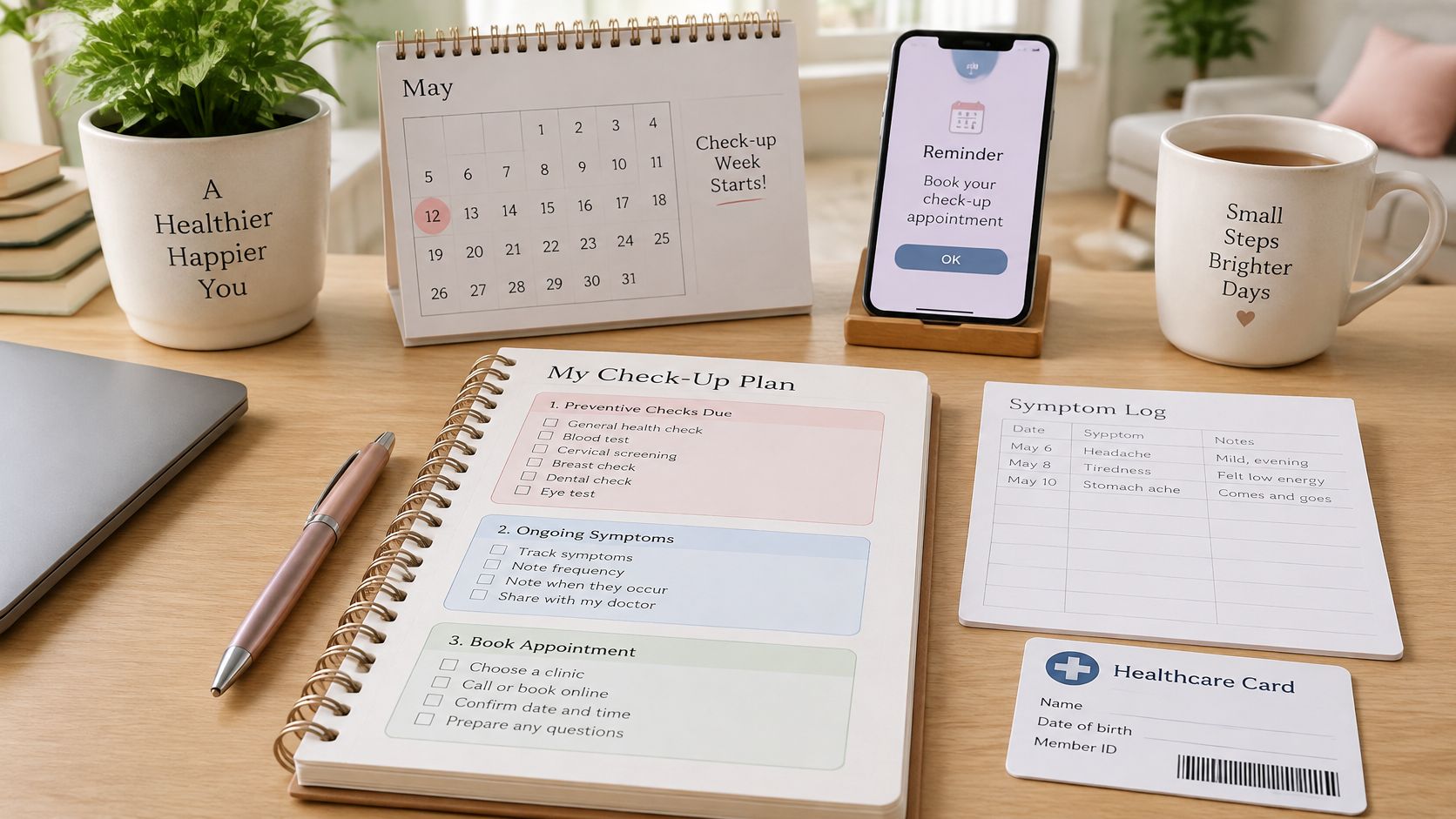
If a GP appointment is hard to get, a women's health service or a telehealth review can still help you arrange testing and talk through results. Vital iQ Health offers a Women's Health Panel covering female hormones, thyroid function and metabolic health, with collection through accredited pathology networks in Queensland, New South Wales, Victoria, Western Australia, South Australia, Tasmania and the Australian Capital Territory. Partnered GPs can review results by telehealth and recommend next steps from home. A panel is a starting point for that discussion, not a diagnosis. Your symptoms still sit beside the numbers, and a clinician should read them together.
Which check is due for you, and when did you last have it?
If you want hormone, thyroid and metabolic markers checked without waiting on a first referral, Vital iQ Health offers a Women's Health Panel and telehealth GP consultations so a partnered GP can explain the results and suggest what comes next. That sits alongside your usual GP, not instead of examination or imaging when pain or bleeding needs them. Visit Vital iQ Health to see the panel and book a conversation about your results.