Hormone Testing Australia: Which Tests to Ask for and Why
Hormone Testing Australia explained: the common tests, when to take them, how to get them with or without a GP referral, and how to read results.
Would a bigger hormone panel explain your symptoms, or just give you more numbers to interpret? That's the question to ask before arranging hormone testing in Australia, because the most useful test is the one that answers a specific clinical question.
Fatigue, changing periods, low libido and unexplained weight changes deserve attention. But they don't all call for the same investigation, and a result inside the laboratory's reference range doesn't necessarily explain why you feel unwell. Good testing connects symptoms, collection conditions and a clear next decision.
Which Hormone Test Answers Which Question
Common hormone tests, what they measure and timing rules
| Test | What it measures | Usually used to investigate | Timing note |
|---|---|---|---|
| TSH (thyroid-stimulating hormone) | Pituitary signal that drives thyroid output | First-line thyroid assessment | Usually collected at any time of day; interpret with free T4 when indicated |
| Free T4 (thyroxine) | The unbound fraction of circulating thyroxine | Clarifying an abnormal TSH | Usually collected at any time of day; follow instructions about thyroid medicines |
| Total testosterone | Total circulating testosterone, a major androgen | Suspected androgen deficiency in men with symptoms | Fasting morning collection; confirm the collection time with the clinician |
| LH and FSH | Pituitary signals to the testes or ovaries | Separating testicular from pituitary causes; irregular periods or early menopause symptoms | Clock time is often less important than clinical context; menstrual cycle day matters |
| Oestradiol | A principal oestrogen produced by the ovaries | Ovarian function and fertility questions | Time to the menstrual cycle, often early in the cycle for baseline assessment |
| Cortisol | An adrenal hormone involved in the stress response | Suspected adrenal conditions | Often a morning sample; the specific investigation determines the laboratory protocol |
| Prolactin | A pituitary hormone involved in milk production and reproductive function | Unexplained irregular periods or selected sexual-function symptoms | A rested sample may be requested, often in the morning; minimise collection-related stress |
These are different investigations, not interchangeable measures of hormonal balance. Cortisol isn't a general test of how stressful your life feels, and testosterone isn't a stand-alone explanation for energy, strength or sexual desire. The reason for ordering the test determines how useful the result will be.
Thyroid testing has a particularly prominent place in Australian pathology. The Department of Health's endocrine pathology review found that TSH tests represented 41.6% of Medicare-subsidised endocrine-related pathology services in 2014–15. That's a historical measure of Medicare activity, not evidence that everyone needs thyroid screening.
Why clinicians look at the signal and the response
The pituitary gland sends instructions to other hormone-producing glands. TSH tells the thyroid to produce thyroid hormones, while LH and FSH help regulate the testes and ovaries.
Reading the instruction alongside the gland's response is more informative than reading either alone. If the thyroid isn't producing enough hormone, the pituitary may increase its TSH signal. If testosterone is low, the accompanying LH and FSH results help a clinician work out whether the testes aren't responding or whether the signal reaching them is inadequate.
Say a man has symptoms consistent with androgen deficiency and a low testosterone result. The next useful step isn't automatically a much larger panel. It's checking whether the collection was appropriate, confirming the finding, then using related hormones to investigate the cause.
Practical rule: Before ordering a test, be able to name the decision its result could change.
Bring these details to the discussion:
- Your symptom: Describe what changed, when it started and how it affects daily life.
- Your reproductive context: Include age, menstrual pattern, pregnancy possibility and hormone treatment.
- Your next decision: Ask whether the result would lead to further investigation, treatment or a different explanation.
When Hormone Testing Is Unnecessary and When It Matters
More testing is not automatically more useful. A panel can measure hormone concentrations accurately while still failing to answer the question that matters to you.
For women aged 45 or older with typical perimenopause symptoms, assessment generally rests on age, menstrual history and symptoms rather than routine hormone measurements, as described in Healthdirect's guidance on understanding pathology tests. Hormone concentrations fluctuate, so a snapshot may not change management.
The same guidance identifies a different situation when symptoms or absent periods occur before age 40, when FSH testing can help investigate premature ovarian insufficiency. That distinction matters because premature ovarian insufficiency is associated with risks including osteoporosis, cardiovascular disease and cognitive impairment.
Use the following visual as a reminder to match testing to the clinical situation.
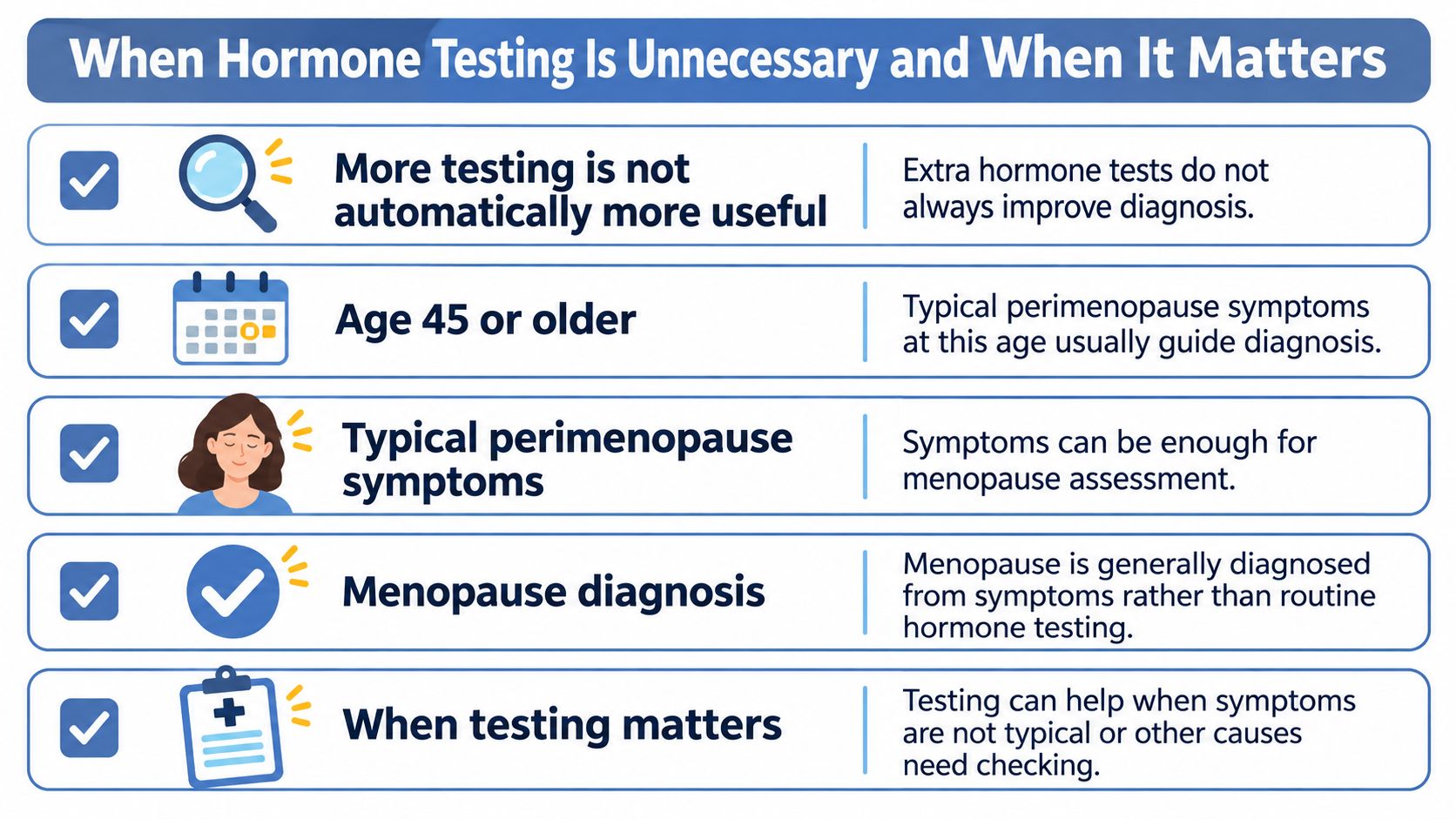
When a hormone test helps and when it usually does not
| Situation | Hormone test useful? | Why |
|---|---|---|
| Irregular or absent periods before age 40 | Yes, FSH and related investigations may help | Can point to premature ovarian insufficiency, alongside assessment for other causes |
| Typical perimenopause symptoms at 45 or older | Usually no routine hormone testing | Age, history and symptoms generally guide assessment |
| Fatigue, weight or heart rate change with suspected thyroid disease | Yes, TSH first | Thyroid investigations should answer a targeted question |
| Symptoms while using hormone therapy or oral contraception | Interpret with caution | Treatment changes hormone concentrations and their meaning |
| Routine androgen panel for every perimenopausal woman | Usually no | It may add cost without resolving the clinical question |
| Symptoms of androgen deficiency in men | Yes, fasting morning testosterone | An appropriately collected result can guide further assessment |
Avoid testing without a plan
Repeated testing isn't necessarily more revealing. During perimenopause, results taken on different occasions can look inconsistent because ovarian activity changes, not because the laboratory has made a mistake.
Menopausal hormone therapy and oral contraception also change the context. A clinician needs to know what you're taking before deciding whether a measurement can answer the intended question. Don't stop prescribed treatment to obtain an untreated result without discussing the consequences.
Before ordering, settle these questions:
- Will it change care? Identify what you and the clinician would do differently after the result.
- Is the timing suitable? Confirm whether cycle timing or treatment makes the result difficult to interpret.
- Have other causes been considered? Don't assume a symptom is hormonal just because it occurs around menopause.
Choosing not to order an unhelpful hormone panel isn't the same as dismissing symptoms. It should leave room for a more useful assessment.
How to Get and Prepare for a Hormone Test
You can access hormone testing through a GP request, a specialist-led investigation, or private self-funded testing. These routes differ in how the investigation is arranged and paid for, not in whether the findings need clinical interpretation.
The Department of Health's pathology guidance states that Medicare benefits require a clinically relevant service requested by a doctor or another eligible health professional, performed by or on behalf of an approved pathology practitioner in an accredited laboratory. A requested test isn't automatically eligible for a Medicare benefit.
Private testing separates access from the initial GP appointment. If you're considering private blood tests, decide who will review the findings before you order, particularly if you're investigating persistent symptoms.
Confirm the laboratory and the request
We use NATA-accredited laboratories, and all our collection centres are NATA accredited. Accreditation addresses laboratory quality, but it doesn't determine whether a particular panel is appropriate for your symptoms.
Read the request before collection. Check that it names the intended tests and that any instructions about fasting, collection time or menstrual timing are clear.
Also ask for the assay-specific reference interval to remain with the report. A number copied into a phone note without its units or laboratory range is much harder to interpret safely.
Prepare in a way that preserves the result's meaning
Confirm the question first.
Tell the requesting clinician whether you're investigating absent periods, suspected thyroid disease, sexual symptoms or another concern. The common slip is ordering a broad panel before identifying what it needs to establish.Book the right collection time.
For suspected male androgen deficiency, the Royal Australian College of General Practitioners' guidance recommends fasting morning total testosterone, ideally close to 8:00 am, and notes that food can acutely reduce measured total testosterone by up to 25%. A convenient late appointment after breakfast may therefore produce a misleadingly low result.Record fasting status and illness.
Write down when you last ate and tell the collector if you're acutely unwell. Don't conceal a preparation mistake to avoid rescheduling. The clinician needs to know whether the result represents your usual circumstances.List medicines and supplements by name.
Include prescribed hormones, contraception, non-prescription products and supplements containing biotin. Biotin can interfere with some laboratory immunoassays, so ask the laboratory or clinician whether any preparation changes are needed. Don't invent your own supplement washout period or stop prescribed medicines without advice.Document menstrual timing.
For oestradiol, LH, FSH or progesterone, record the cycle day and the purpose of testing. If periods are irregular or absent, say so rather than guessing a cycle phase. A correctly measured concentration can be misread when it's compared with the wrong phase.Keep the complete report.
Save the test name, result, units, reference interval and collection details together. Comparing bare numbers from different laboratories can suggest a change that partly reflects different measurement methods.Allow for confirmation when needed.
A low testosterone result doesn't establish androgen deficiency by itself. Arrange the recommended repeat under appropriate conditions rather than starting treatment or supplements based on the initial finding.
A preparation detail isn't a minor administrative note if it changes how the clinician interprets the sample.
What to take to collection
Bring your pathology request, an up-to-date medicine and supplement list, and a note of your last meal. Add menstrual information when relevant and keep the collection time with your records.
If the instructions are unclear, clarify them before the blood draw. It's easier to organise a suitable sample than to untangle an unexpected result obtained under the wrong conditions.
Reading Thyroid Results Pattern by Pattern
TSH is usually the starting point, because it reflects pituitary feedback to circulating thyroid hormone. An abnormal result commonly prompts free T4 measurement, with T3 added when clinically indicated, within the staged assessment described in Healthdirect's blood test information.
The important distinction is between the pituitary signal and the circulating thyroid hormone concentration. Their relationship helps a clinician interpret the pattern, but it doesn't replace a clinical assessment.
Thyroid result patterns and what they may suggest
All directions below are relative to the reporting laboratory's reference interval.
| TSH | Free T4 | What it may suggest | Next step |
|---|---|---|---|
| High | Low | Underactive thyroid pattern, compatible with hypothyroidism | Clinical review, symptom assessment and confirmation or further testing as appropriate |
| Low | High | Overactive thyroid pattern, compatible with hyperthyroidism | Clinical review; check medicines and other possible causes |
| Low | Normal | Possible early or subclinical pattern, or a medicine or illness effect | Review with a clinician; repeat testing or T3 may be appropriate |
| High | Normal | Possible subclinical hypothyroidism, or a temporary or assay-related finding | Confirm the reference interval and consider repeat testing |
| Normal | Normal | Usually no thyroid hormone imbalance demonstrated by these tests | Consider other explanations if symptoms persist |
A high TSH with low free T4 is compatible with a thyroid gland that isn't producing enough hormone despite increased stimulation. A suppressed TSH with raised free T4 or T3 supports thyroid hormone excess.
Not every result follows those straightforward combinations. If values don't fit the expected feedback relationship, the clinician may need to investigate pituitary function, medication effects or a measurement problem rather than force the result into a familiar category.
Why a borderline flag isn't a treatment instruction
Say your TSH is slightly above the laboratory range, but free T4 is within range. That finding doesn't establish the same situation as clearly raised TSH accompanied by low free T4.
Your GP may review recent illness, symptoms, pregnancy status and medicines, then decide whether repeat testing is appropriate. Illness, pregnancy, medicines and assay interference can all complicate interpretation.
The report may also show that only TSH was measured. That isn't necessarily an incomplete investigation: a laboratory may perform additional thyroid tests only when the initial result or clinical request justifies them.
Before changing treatment: Establish whether the abnormality is persistent, clinically consistent and measured under suitable conditions.
Useful questions for your appointment include:
- Which hormones were measured? Distinguish TSH from free T4 and any additional T3 testing.
- Which reference interval applies? Use the range printed by the laboratory, not a generic online chart.
- Does this need confirmation? Ask whether repeat testing or another investigation would change the decision.
Don't adjust thyroid medicine solely because a result has been highlighted on a report. The direction, degree and context of the abnormality all matter.
Reading Non-Thyroid Hormone Results
A non-thyroid hormone result needs its collection context and laboratory reference interval, not just a high or low flag. Similar-looking results can require different follow-up depending on symptoms, treatment and reproductive status.
Testosterone and its accompanying signals
For a symptomatic man with a low total testosterone result, the clinician first considers whether the finding has been confirmed under suitable conditions. Once low testosterone is established, LH and FSH help distinguish the source of the problem.
Raised pituitary signals alongside low testosterone can point towards primary testicular dysfunction. Low or inappropriately normal signals may instead suggest a hypothalamic or pituitary cause, although the full history and other investigations remain important.
A fertility concern also needs a distinct question. Testosterone concentrations don't directly measure sperm production, so someone trying to conceive may need a discussion about a sperm count test, rather than assuming a hormone panel establishes fertility.
Read each remaining hormone in context
| Test | What to check before interpreting it |
|---|---|
| Oestradiol, LH and FSH | Menstrual phase, menopausal status, contraception and hormone treatment |
| Cortisol | Collection time, the investigation requested and whether the laboratory protocol was followed |
| Prolactin | Collection-related stress, rest beforehand, medicines and pregnancy possibility |
An unexpected cortisol result may require a different confirmatory investigation, not another random blood sample. The clinician chooses the next test according to whether adrenal excess or deficiency is suspected.
Prolactin can rise around stress, including the collection itself. An unexpected elevation therefore needs review before it's treated as evidence of pituitary disease.
Don't compare your result with another person's number. Medicines, pregnancy status, cycle phase and measurement methods can make that comparison misleading, even when the test names match.
Why a Normal Testosterone Result Does Not Settle Women's Symptoms
A testosterone result inside the laboratory range doesn't mean fatigue, low libido or reduced exercise recovery should be ignored. It means that this measurement, taken in those circumstances, hasn't supplied a complete explanation.
A clinical conversation should connect the report with what you're experiencing.

The RACGP's menopause consultation guidance describes testosterone therapy in Australia as licensed for postmenopausal women with distressing hypoactive sexual desire disorder, after other causes have been considered. It also explains that there's no accepted lower testosterone cut-off for diagnosing that condition and that women's reference ranges aren't standardised across testing contexts.
That separates analytical measurement from diagnosis. A laboratory measures a concentration, while a clinician assesses the nature of the symptoms, their impact and possible causes. A low value doesn't automatically establish a need for testosterone, and an in-range value doesn't invalidate sexual symptoms.
Investigate the symptom rather than chase a target
Describe whether low desire is new, persistent, distressing or associated with pain. Include changes in sleep, mood, relationships, medicines and menstrual status, because these details may be more useful than repeating the same hormone measurement.
Potential explanations to consider include:
- Sleep disorders: Poor sleep can affect energy, recovery and sexual interest.
- Medicine effects: Symptoms may follow a new prescription or a dose change.
- Depression and other mood difficulties: These deserve assessment without assuming they explain everything.
- Anaemia or thyroid disease: Targeted investigations may be appropriate when the history suggests them.
- Pain and relationship factors: These can affect sexual desire and need their own discussion.
This video can accompany, but shouldn't replace, a personalised consultation.
When to ask for more help
Ask your GP about specialist review when symptoms remain distressing, the diagnosis is uncertain, results are persistently abnormal or treatment decisions are complex. The appropriate referral depends on the concern, rather than on testosterone alone.
Routine androgen panels for every perimenopausal woman can add expense without clarifying care. A more useful outcome is a plan that addresses the symptom, identifies what still needs investigation and sets a point for review.
Take Your Results to a Clinician Before You Act
Start by checking whether the test answered the question you intended to investigate. Confirm that the report includes the collection details needed to interpret it, particularly fasting status, medicines and menstrual timing.
Then book a GP review rather than acting on a highlighted value alone. Your clinician can connect the findings with your history and decide whether you need confirmation, a different investigation or treatment.
Bring a short, useful record
- Symptom timeline: Note when symptoms began, whether they fluctuate and what has changed.
- Medicines and supplements: Include names, doses and recent changes.
- Complete reports: Bring reference intervals, collection details and previous results where available.
- Your main question: Explain what you hoped testing would help you decide.
If fatigue remains unexplained, discuss broader possibilities rather than assuming another hormone panel is the answer. Nutritional investigations such as a B12 blood test may be relevant when the clinical history supports them.
Arrange interpretation alongside access
Private blood tests are available in Australia without a GP referral. Through our online process, customers choose from 41 pathology panels, attend a NATA-accredited collection centre and receive results within 24 to 72 hours.
We also offer telehealth GP consultations, where partnered GPs review findings, answer questions and recommend next steps from home. Keep that clinical discussion separate from the convenience of ordering: access to a test isn't the same as a diagnosis, and continuing symptoms still deserve attention after an in-range result.
Vital iQ Health offers private hormone testing through accredited laboratories, with partnered telehealth GPs available to help interpret the findings. Visit Vital iQ Health to explore testing options and arrange a clinical review so your next step is guided by your symptoms as well as your results.