Thyrotropin Receptor Antibody Test: What a Result Means
Thyrotropin receptor antibody test explained: when doctors order it, what TRAb results mean for Graves disease, and why context matters.
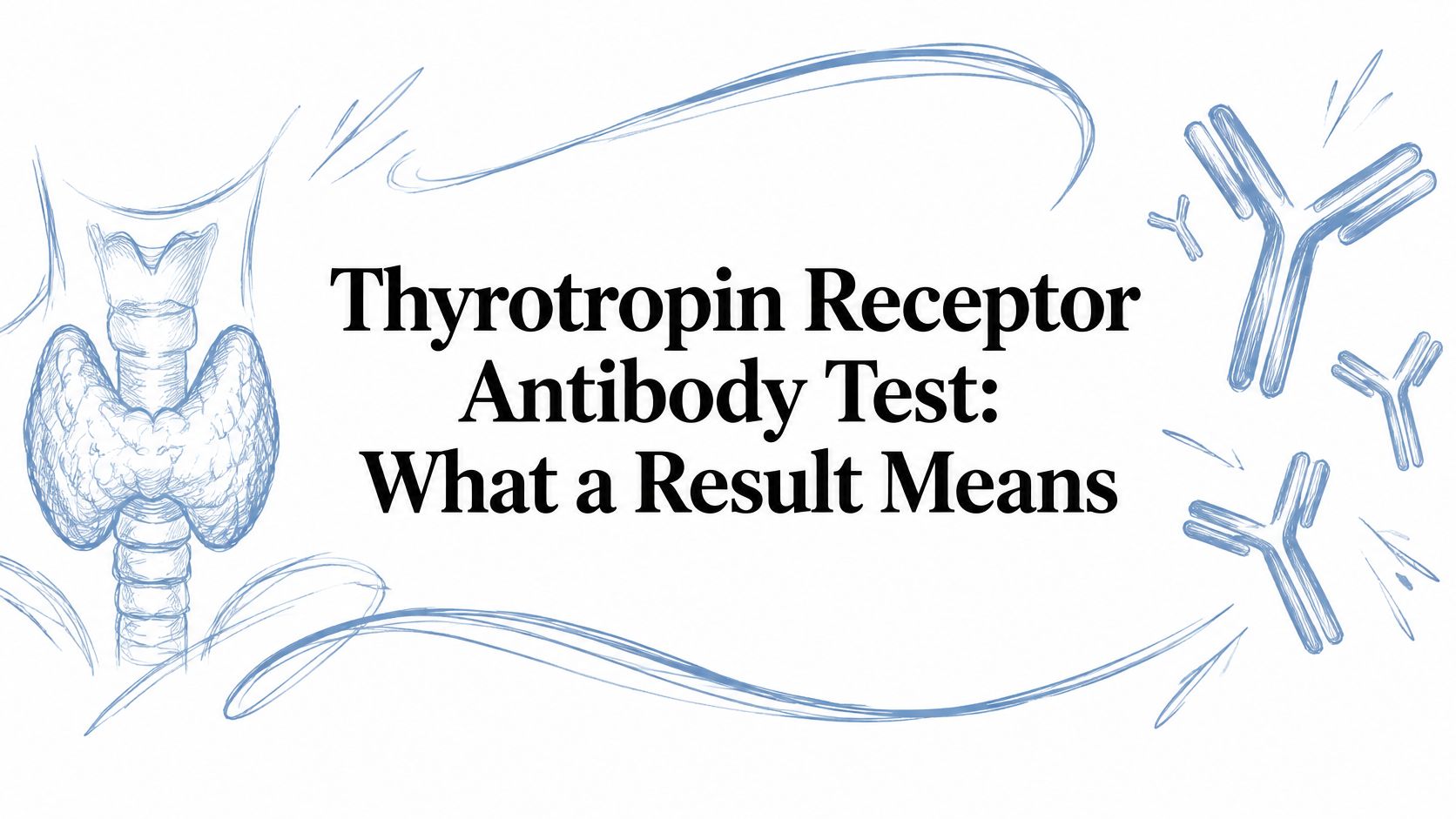
Thyrotropin receptor antibody testing is a blood test for antibodies that act on the TSH receptor, and a positive result supports Graves disease only when the thyroid hormone results show the gland is overactive. In established Graves disease about 90 to 99% of people test positive on a second-generation assay, while roughly 1 to 2% of the general population carries the same antibodies with no thyroid disease at all.
So why can one number, 2.4 IU/L for instance, sit comfortably inside the reference range on one Australian report and above the line on another?
Because the antibody is a clue, not a verdict. Its meaning is set by the laboratory that ran the assay, by the TSH and free T4 printed beside it on the same page, and by the symptoms and treatment history of the person holding the paper. Read alone, the figure invites either expensive worry or false reassurance. Read in context, it answers one narrow and useful question: is this overactive thyroid being driven by an antibody?
What a Thyrotropin Receptor Antibody Test Measures
Picture the thyrotropin receptor as a lock on the surface of a thyroid cell. Thyroid-stimulating hormone, released by the pituitary, is the key that turns it and tells the gland to make and release hormone. In Graves disease, the immune system builds an antibody that fits the same lock and holds it turned.
The illustration below shows that binding at the cell surface.
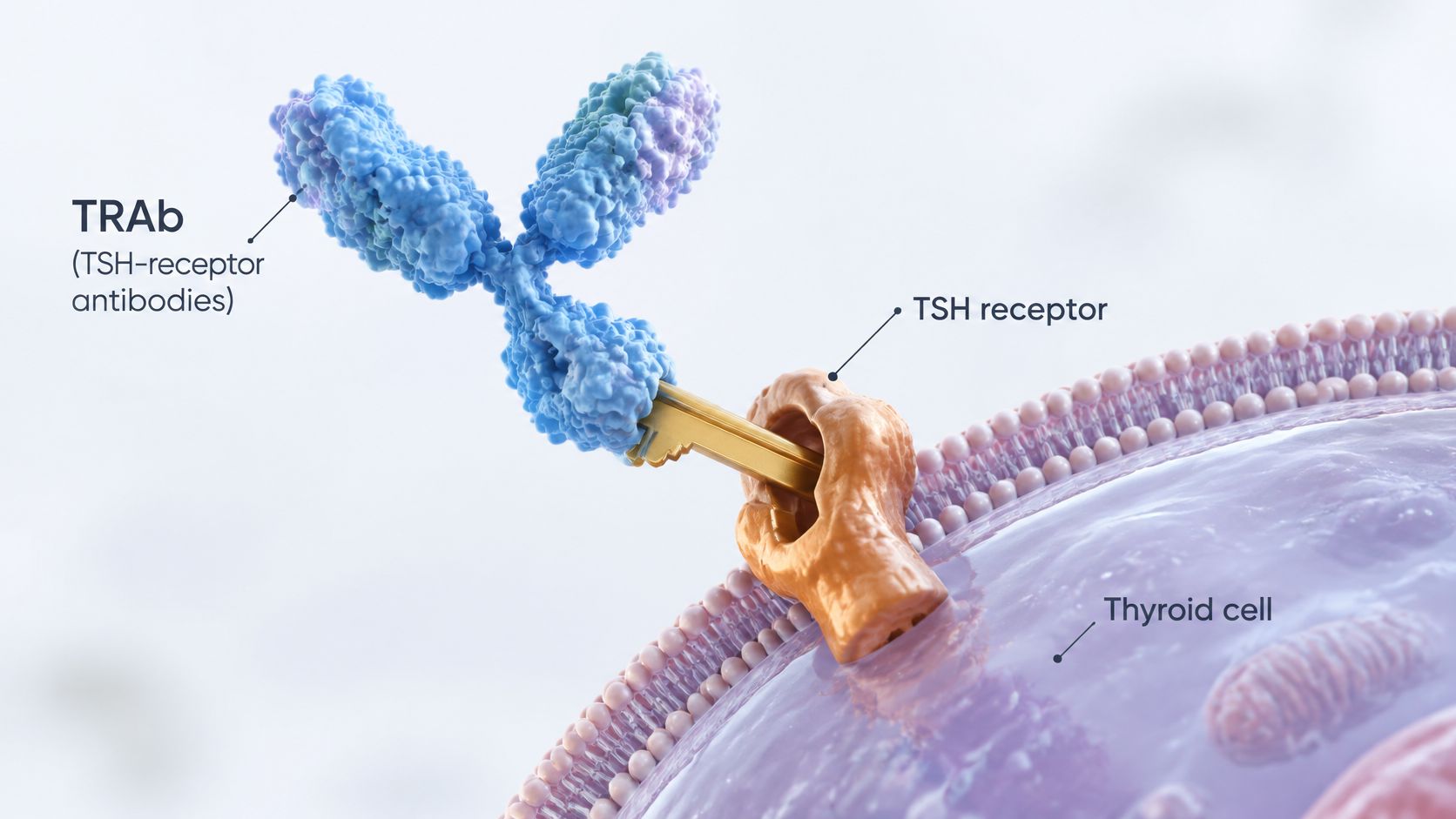
Australian pathology guidance describes thyrotropin receptor antibodies, also called TSH-receptor antibodies, as antibodies that stimulate or otherwise interact with the TSH receptor, producing the thyroid overactivity characteristic of Graves disease, and lists the test for both diagnosis and monitoring of Graves hyperthyroidism and Graves orbitopathy (RCPA Manual). The mechanism explains the blood results that follow it. The pituitary senses abundant thyroid hormone and shuts down its own TSH, so TSH falls, often below the detectable limit, while free T4 and free T3 climb. The gland is being driven by an antibody rather than by the brain.
The names on your request form. You may see TRAb, TSH-receptor antibody, TSHR-Ab or TSI (thyroid stimulating immunoglobulin). They aren't identical tests, and the label tells you which question the laboratory asked. A result is only interpretable against the assay named on the report.
Why thyroid antibodies turn up in healthy people. In Australia, TRAb is found in approximately 1 to 2% of the general population, and the Australian Busselton Thyroid Study reported that 11% of participants without a history of thyroid disease had thyroid peroxidase antibodies, a different antibody entirely (RACGP AFP clinical focus). Antibodies are common; Graves disease is not. In established Graves disease, by contrast, TRAb prevalence rises to approximately 90 to 99% with second-generation assays, which is why a positive result carries real weight when the hormones already show thyrotoxicosis.
A number on its own can't separate a harmless background antibody from an active autoimmune driver. That separation happens when TSH, free T4 and free T3 are read beside it, and when the laboratory's own range is applied rather than a remembered cutoff.
Reading Your TRAb Result Against the Lab Range
The same antibody number can be called negative by one laboratory and flagged by another, because each assay draws its own line between normal and raised. The Royal Melbourne Hospital, for example, reports a reference interval below 3.1 IU/L on the Abbott Architect immunoassay it introduced in July 2022, and its handbook is explicit that TRAb results are method- and laboratory-dependent (Royal Melbourne Hospital pathology handbook). Other Australian laboratories running different methods publish their own intervals, so the range printed beside your result is the only one that applies to it.
| Laboratory | Assay | Reference interval | What to check |
|---|---|---|---|
| Royal Melbourne Hospital | Abbott Architect immunoassay (introduced July 2022) | below 3.1 IU/L | Read the result against this lab's own range |
A cutoff from one method can't be treated as a decision threshold for another. A result sitting comfortably inside one laboratory's interval can land above a different laboratory's line, which is why the number and the range have to be read as a pair rather than separately.
Three steps for reading any TRAb report
- Find the reference range and units printed by the laboratory that performed the test. If the report doesn't show them, ask the ordering doctor or the laboratory for a copy that does.
- Decide where the result sits relative to that cutoff: clearly above, clearly below, or close to it. Close is a different clinical situation from clearly above.
- Note the assay name on the report. Results from different methods aren't directly comparable, so a value from one laboratory can't be plotted against a range from another.
When the result sits near the cutoff
A borderline number is the point where the arithmetic stops helping. Two people can carry the same borderline result and need completely different responses: someone whose TSH is suppressed and who feels unwell is being pointed toward one set of questions, while someone with normal hormones, no symptoms and the identical number is being pointed toward another. The clinician weighs why the test was ordered, what the TSH and free hormones show, whether there are eye signs or a family history, and whether treatment has already started. The number supplies a clue. The rest of the picture decides what that clue means.
Reading a repeat result
TRAb is commonly raised in untreated Graves hyperthyroidism and in thyroid-associated ophthalmopathy. Antithyroid medication or thyroidectomy often lowers the concentration, while radioiodine treatment can exacerbate thyroid autoimmunity instead. A repeat value is therefore meaningful only against an earlier result from the same laboratory, ideally the same assay, so any change reflects the treatment rather than a change of method.
Practical rule: if you move laboratories between tests, ask for the earlier numerical result and its range to travel with you. A new range can make a falling antibody look like a rising one.
Context also changes the weight of a result. In pregnancy, these antibodies can cross the placenta and cause fetal or neonatal thyrotoxicosis, including in women previously treated with radioiodine or surgery who are now hypothyroid. When a repeat measurement is needed during pregnancy, its timing is set by the obstetric and endocrine team caring for that pregnancy rather than by a fixed week on the calendar.
Pairing TRAb With TSH and Thyroid Hormone Results
The antibody answers "is this autoimmune?" The thyroid function tests answer "is the gland overactive?" Both questions have to be live for the result to mean much.
| TSH | TRAb | Usual interpretation | Typical next step |
|---|---|---|---|
| Persistently below 0.1 mIU/L | Positive | Supports Graves disease when thyrotoxicosis is established | Specialist review and treatment planning |
| Persistently below 0.1 mIU/L | Negative | Does not fully exclude Graves disease | Thyroid scintigraphy or imaging to find the cause |
| Normal | Positive | Antibodies present without clear overactivity, not diagnostic alone | Clinical review and repeat testing as directed |
| Normal | Negative | Makes Graves disease less likely if symptoms are absent | GP review if symptoms continue |
Australian primary care guidance recommends considering TRAb when TSH is persistently below 0.1 mIU/L, and is careful to frame the test as an aid to determining the cause of hyperthyroidism rather than a measure of symptom severity, hormone control or treatment response (RACGP thyroid disease diagnostic tools).
What each hormone adds
TSH is the pituitary's report on the thyroid, not a thyroid measurement in its own right. It stays suppressed for weeks after hormone levels normalise, so a low TSH during treatment doesn't automatically mean the disease is still active.
Free T4 is the main output of the gland and the number most treatment decisions are titrated against. Free T3 is the active hormone at the tissue level and the one that explains a patient who feels frankly thyrotoxic with a free T4 only mildly raised.
Medication history changes everything. Levothyroxine lowers TSH and raises free T4 by design. Carbimazole and propylthiouracil do the reverse. Read a panel without knowing what the person takes and you can misread a well-controlled thyroid as an active one.
Four results, four different pictures
Palpitations, weight loss, suppressed TSH, positive TRAb. This is the classic picture. The clinician confirms Graves disease, discusses treatment options and screens for eye involvement.
The same symptoms, suppressed TSH, negative TRAb. The clinician doesn't stop at the antibody. Scintigraphy or imaging comes next to separate Graves disease from thyroiditis and other causes.
Normal TSH, positive TRAb in someone with a past diagnosis. Often a treated or monitored Graves patient whose antibody is clearing slowly. The clinician reviews the dose and the trend rather than reacting to the antibody alone.
Raised TRAb, no symptoms, normal thyroid tests. Little changes without clinical review. A repeat panel in a few months and a conversation about eye symptoms is a reasonable plan.
If you're arranging hormone testing in Australia yourself, ask for TSH, free T4 and free T3 to be drawn on the same sample as the antibody. Splitting them across weeks makes the comparison harder than it needs to be.
Why a Negative Result Does Not Rule Out Graves
The reassuring misreading goes like this: the antibody is negative, so it isn't Graves disease. That conclusion is not safe on its own. In Australian clinical practice, TRAb is a high-specificity immunological marker for Graves disease and is particularly useful when radioactive iodine scanning is unsuitable, such as during pregnancy or lactation, or when the presentation is atypical, including euthyroid Graves orbitopathy. Second-generation assays using human TSH-receptor antigen reach approximately 90 to 99% sensitivity and 95 to 100% specificity for Graves disease, which still leaves a real minority undetected: up to 10% of patients with Graves disease may have undetectable TRAb because of assay-sensitivity limitations (RACGP AFP, evaluating and managing thyrotoxicosis).
The reasons a negative can mislead
- Assay sensitivity has a floor. A low concentration of antibody can fall below what the method reliably detects.
- Binding assays can't tell direction. Most routine methods can't distinguish stimulating antibodies from blocking ones, so the reading isn't a direct measure of activity.
- Timing matters. A sample taken when antibody levels are low, including after treatment has started, can read negative in someone who was positive months earlier.
- Treatment changes the result. Antithyroid drugs and thyroidectomy lower concentrations over time.
Eye disease is the clearest example of why the antibody is worth measuring even when the thyroid looks quiet. Thyroid eye disease can progress in someone whose thyroid tests are normal, and a positive TRAb in that setting supports the diagnosis when a scan would be difficult or unhelpful.
A negative antibody is evidence, not an exclusion. It shifts probability; it doesn't close the file.
When a negative TRAb sits beside a persistently suppressed TSH, the next move is thyroid scintigraphy or imaging, plus a considered look at other causes of thyrotoxicosis such as thyroiditis, which behaves very differently and isn't treated with antithyroid drugs in the same way.
Three questions worth asking the doctor
Which assay was used, and what is this laboratory's range? The answer tells you how much weight the result can carry.
Would a repeat test help? If the sample was taken early, after treatment started, or during pregnancy, repeating it later may be more informative.
Which test would settle the question if this one doesn't? Usually scintigraphy or a specialist ultrasound assessment, and knowing that in advance saves a second round of uncertainty.
TRAb Results in Pregnancy
In pregnancy, the antibody can matter more than the mother's current thyroid status. Women with current or previous Graves disease who carry TRAb face a 1 to 5% risk of fetal hyperthyroidism, because these antibodies cross the placenta and act on the fetal thyroid (RACGP goitre guidance).
That risk doesn't disappear once the mother's own thyroid has been dealt with. Someone treated with radioiodine or surgery may now be hypothyroid on levothyroxine, with normal-looking thyroid function tests, while antibody-mediated risk to the fetus continues. Maternal hormone results and fetal risk are two separate questions, and a reassuring TSH answers only one of them.
Antibodies are generally checked early in pregnancy and repeated when clinically indicated, with the timing set by the obstetric and endocrine team. High levels may prompt serial fetal ultrasound and neonatal or postnatal monitoring. Schedules differ between guidelines and laboratories, so no single timetable applies to everyone.
The question that matters more than positive or negative
The useful question is whether this result changes your pregnancy monitoring, and at what threshold. A number without gestational age, prior Graves treatment, current thyroid function results and specialist interpretation can't answer that.
Context shifts meaning in both directions. Each assay carries its own reference range, so the same value can sit above one laboratory's cut-off and below another's. A result one lab calls strongly positive may read as borderline elsewhere, and that difference can change how closely the pregnancy is watched.
A privately ordered result should never be presented as a pregnancy risk assessment on its own. It's one input into a decision that involves a maternity team, and the timing of the next check depends on where in the pregnancy you are.
Graves disease versus hCG-mediated hyperthyroidism
Early pregnancy can produce biochemical hyperthyroidism driven by human chorionic gonadotropin rather than by antibodies. The two carry different implications for the fetus and different management, and TRAb is one of the tools that helps separate them. The antibody result is weighed alongside the suppressed TSH, the free T4 and free T3 pattern, and any symptoms before either diagnosis is settled.
For someone who is pregnant or planning a pregnancy with current or past Graves disease, TRAb is not a routine wellness marker. The women's health hub covers the wider set of tests that usually sit alongside it, but the meaning of the number belongs with your maternity and endocrine team, who read it against the laboratory's own range and your treatment history.
Signs That Need Prompt Medical Review
Most TRAb results can wait for a scheduled appointment. Some can't. The checklist below pairs each situation with the action it deserves, so you're not left deciding at 11pm whether a symptom is worth a phone call.
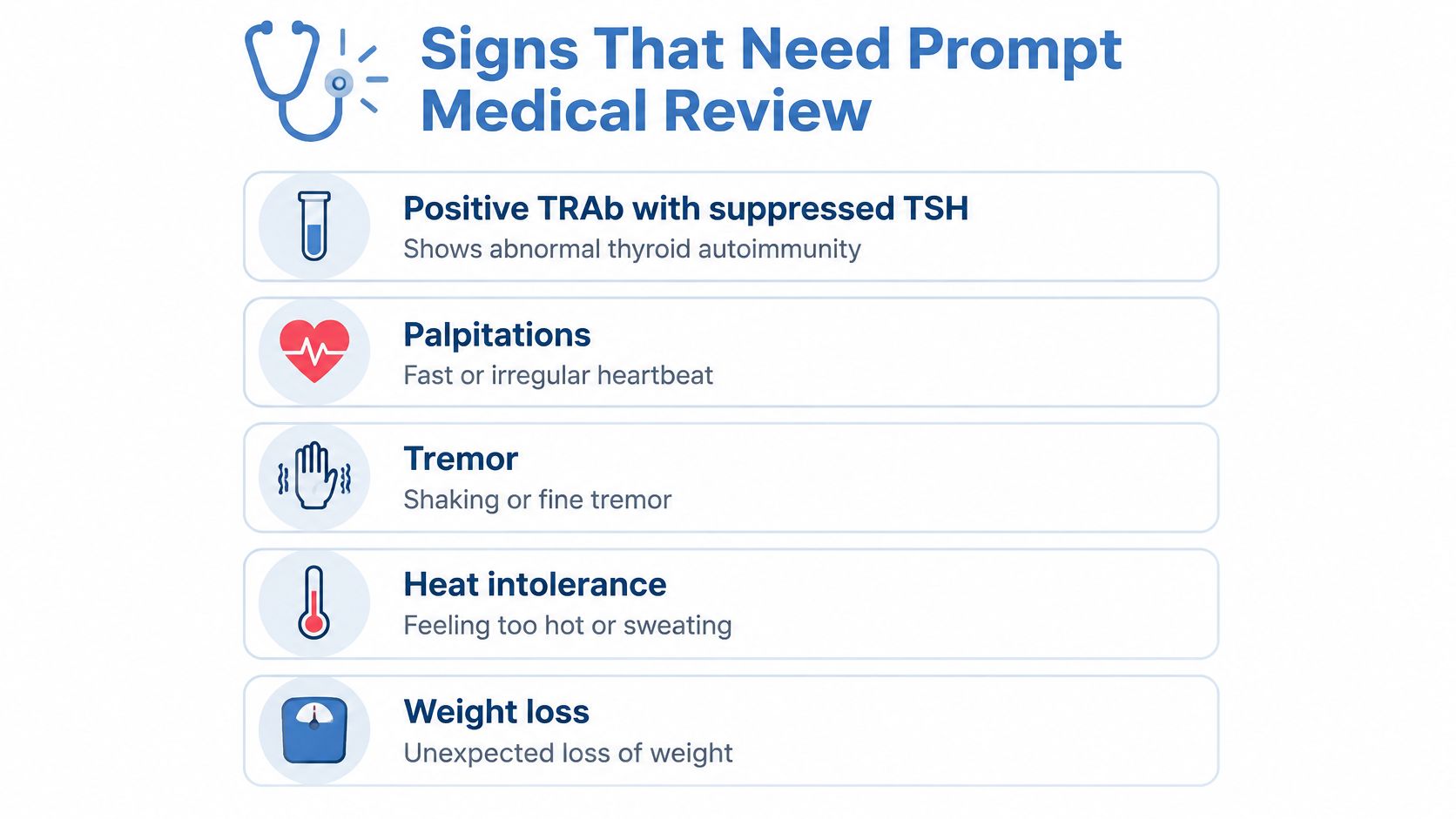
- Positive TRAb with a suppressed TSH and symptoms such as palpitations, tremor, heat intolerance, unexplained weight loss or anxiety. Book a GP appointment within days and ask about an endocrinology referral.
- Eye changes. Bulging, grittiness, double vision or pain on eye movement. See a GP promptly and mention the antibody result and any Graves diagnosis.
- Current or past Graves disease plus pregnancy, or planning a pregnancy. Arrange specialist review before or early in pregnancy, not after the first trimester bloods.
- A TRAb result with no TSH or free T4 beside it. Don't act on the number. Get the full thyroid panel drawn and interpreted together.
- A fast or irregular heartbeat with chest pain, fainting or breathlessness. Call emergency services. This is not a wait-for-the-GP situation.
A single antibody result is never a reason to start, stop or change thyroid medicine on your own.
The video below walks through how thyroid antibodies are discussed in a clinical setting, which helps when you're preparing questions for an appointment.
Book a Specialist Review With Your Result
The useful next step is a conversation, not more searching. Take the report to a GP or endocrinologist and ask for the antibody to be read alongside TSH, free T4, free T3, your symptoms and your medication history. That combination is what turns a number into a diagnosis or rules one out.
Bring these with you: the full report showing the reference range and the assay name, the date the sample was collected, any earlier TRAb or thyroid results so a trend can be seen, your current medicines and doses including levothyroxine or antithyroid drugs, and your pregnancy status or plans if either applies.
The usual pathway runs from GP review to a repeat thyroid panel if the picture is unclear, then an endocrinology referral to confirm or exclude Graves disease. If the biochemistry and the antibody disagree, imaging or scintigraphy comes next. Results ordered privately still need a clinician to interpret them, and that step isn't optional.
Collection itself is the quick part. After ordering a test, you visit any of our NATA accredited pathology collection centres near you, and the sample goes to an accredited laboratory. If you'd like to see what's available before you book, our private blood tests page sets out the panels and the process.
The antibody is one clue among several, and the diagnosis belongs to whoever can see the whole picture: the hormones, the trend over time, the examination and the history. A result you don't fully understand yet is a reason to book that review, not a reason to reach a conclusion on your own.
If you're ready to stop guessing about a thyroid result, Vital iQ Health makes the testing step straightforward: order a panel online, then visit any of our NATA accredited pathology collection centres near you for the sample. Our thyroid and hormone panels give you the TSH, free T4 and free T3 results that make a thyrotropin receptor antibody result readable, and our partnered telehealth GPs can talk you through what the numbers mean before you see your specialist. Visit Vital iQ Health to see the panels and book your collection.