Womens Health Only: Women's Health Only
Womens health only - Women's Health Only: learn which screening tests suit your age and symptoms, how often to get them, and how to discuss results with your

Have you ever asked for a thorough check and left with a request slip for a single test, or been told your results were normal while the symptom that sent you there was still there?
Both experiences come from the same confusion. Screening, testing and diagnosis are three separate jobs, and blending them is why so many women either ask for too little or pay for panels that nobody can act on. Type Women's Health Only into a search bar and you'll get flat lists of tests with no order, no intervals, and no explanation of which result would change a decision.
This is a schedule, not a checklist. It shifts with your age, your symptoms and your family history, and one normal result rarely closes the question on its own.
What Women's Health Screening Covers and Why It Matters
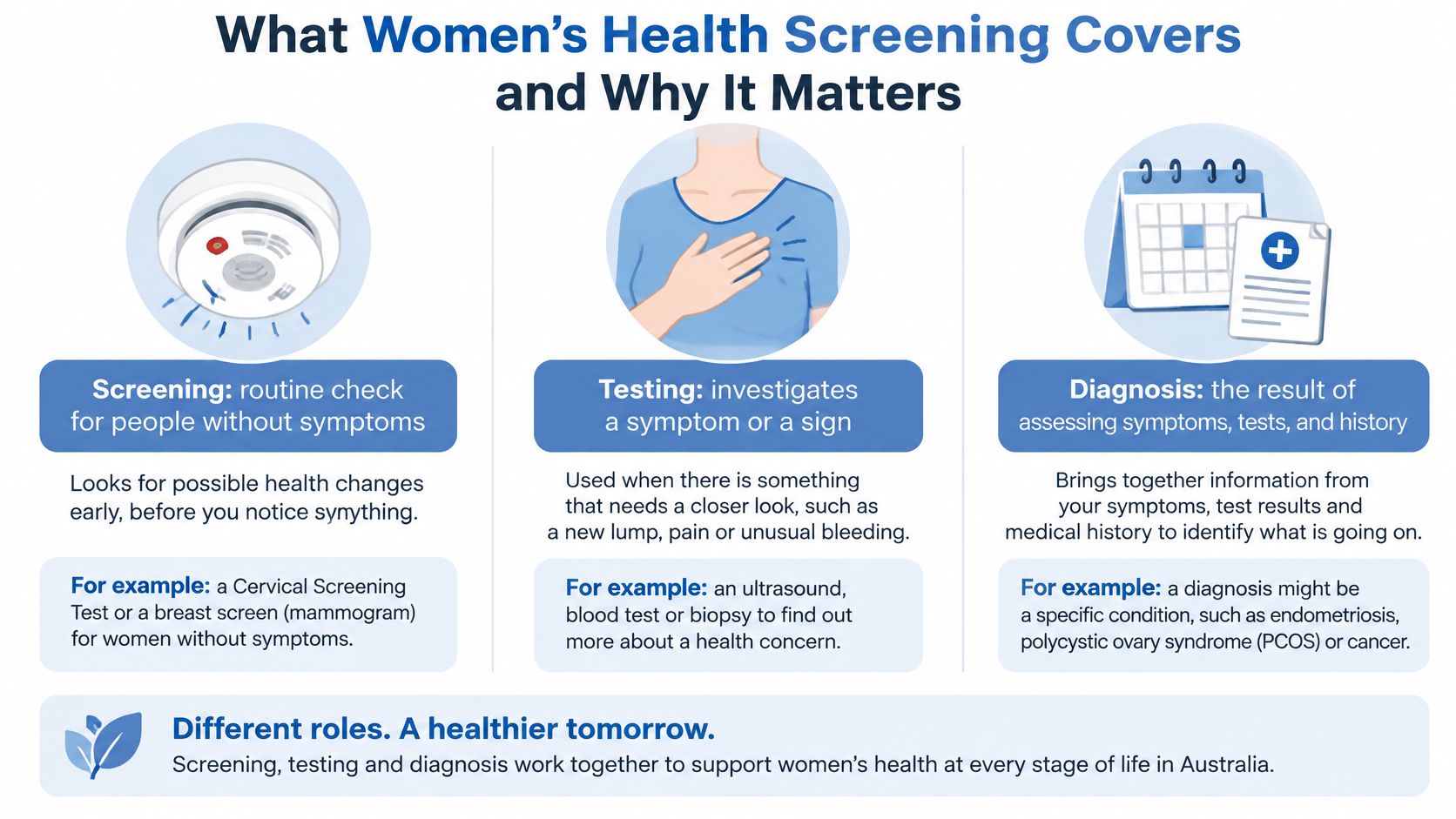
Think of a smoke alarm. You test it on a schedule, when nothing is burning, because that's cheaper and safer than waiting to smell smoke.
Screening works the same way. It's a routine check offered to people without symptoms, chosen because your age or risk profile puts a condition in range. Testing is different: it investigates a specific symptom or a known risk, like walking through the house to find where the smoke is coming from. Diagnosis is the clinician's conclusion, assembled from your history, examination and results together.
This distinction isn't pedantry. In 2020-21, 56% of Australian females had at least one of 10 selected chronic conditions, and the Australian Institute of Health and Welfare estimated that 34% of female disease burden could have been prevented by reducing or avoiding exposure to selected risk factors. That burden sits across mental health, cardiovascular risk, thyroid and metabolic function, bone health and reproductive conditions, not only pregnancy and contraception.
Before you book anything: write down your age, your family history, every symptom that's still present, and the date of your last abnormal result. That one page decides which tests are worth ordering.
Screening Tests at a Glance by Age and Risk
Find your row before you read anything else. These are the screens that come up most often in Australian general practice, with the interval that usually applies and what each one is looking for. Your GP sets the final plan, because family history and previous results can pull a date forward.
| Test or screen | Who it suits | Typical interval | What it looks for |
|---|---|---|---|
| Cervical screening (HPV test) | Everyone with a cervix aged 25 to 74 | Every 5 years if previous results were normal | Human papillomavirus linked to cervical cell changes |
| Breast screening (mammogram) | Women aged 50 to 74, with women aged 40 to 49 able to self-refer | Every 2 years | Early breast cancer changes on X-ray |
| Blood pressure check | All adults | At each GP visit, or as advised | Hypertension and cardiovascular risk |
| Cholesterol and blood glucose | Adults from 45, or earlier with risk factors | As advised by GP, depending on earlier results | Lipid levels and diabetes risk |
| Bone density scan (DXA) | Women 65 and over, or younger after menopause with risk factors | Baseline, then as advised | Bone thinning and osteoporosis |
| Iron studies and full blood count | Heavy periods, persistent fatigue, or planning pregnancy | When symptoms arise or as advised | Anaemia and low iron stores |
| Thyroid function (TSH) | Tiredness, weight change, feeling hot or cold, palpitations | When symptoms arise | Over- or under-active thyroid |
| Sexually transmitted infection testing | Anyone sexually active, more often with new or multiple partners | Based on risk, as advised | Chlamydia, gonorrhoea and other infections |
| Mental health questionnaire | Anyone, especially after major life changes | At each visit or when mood changes | Anxiety and depression symptoms |
The two program screens
Cervical screening runs from 25 to 74 on a five-yearly cycle once your results are normal, and it now looks for the virus rather than the cells, which is why the interval stretched. A self-collected swab is an option at many clinics if a speculum examination has been the thing putting you off.
Breast screening runs every two years from 50 to 74, and women aged 40 to 49 can refer themselves. Both programs send reminders, and both are worth marking in your own calendar the day after you're screened.
The rows that depend on your history
Blood pressure is the cheapest test you'll ever have and it belongs at every visit, whatever your age. Cholesterol and blood glucose checks usually start at 45, or earlier when diabetes, early heart disease or high cholesterol runs in the family. Bone density sits at 65 for most women, earlier if you've been through menopause and carry risk factors such as long-term steroid use or a fracture from a minor fall.
Fertility questions arrive with their own confusion. What an AMH result actually measures is ovarian reserve, not a verdict on whether you can conceive, and it doesn't replace the age-based rows above.
A screen is chosen for you by a population rule. A test is chosen for you by what's happening in your body right now.
Participation matters as much as the schedule. 1.7 million females took part in breast screening in 2020-21, a 10% decline from 2018-19 that the AIHW's access and healthcare analysis linked likely to pandemic restrictions. Missed rounds delay detection, which is why the reminder texts exist.
Circle the rows that apply to you and write the next due date for each one somewhere you'll see it.
How to Match Tests to Your Own Needs
Six steps, in order, before you sit down with a GP. Each one exists to prevent a specific problem.
- Confirm your age band against the schedule. Start with the sex-specific program screens, because those are the ones with a fixed due date and a national reminder system behind them. Everything else is discretionary.
- Write out your family history. Breast, ovarian and bowel cancer, early heart disease, diabetes, thyroid disease and endometriosis all change what's worth checking and when. Note the relative and the age they were diagnosed, since a mother with breast cancer at 42 means something different from a grandmother at 74.
- Log every current symptom with how long it's lasted. Heavy bleeding, pelvic pain, fatigue, weight change, hair thinning, low mood, sleep disruption. A symptom you've had for six weeks is a clinical question. One you noticed yesterday usually isn't.
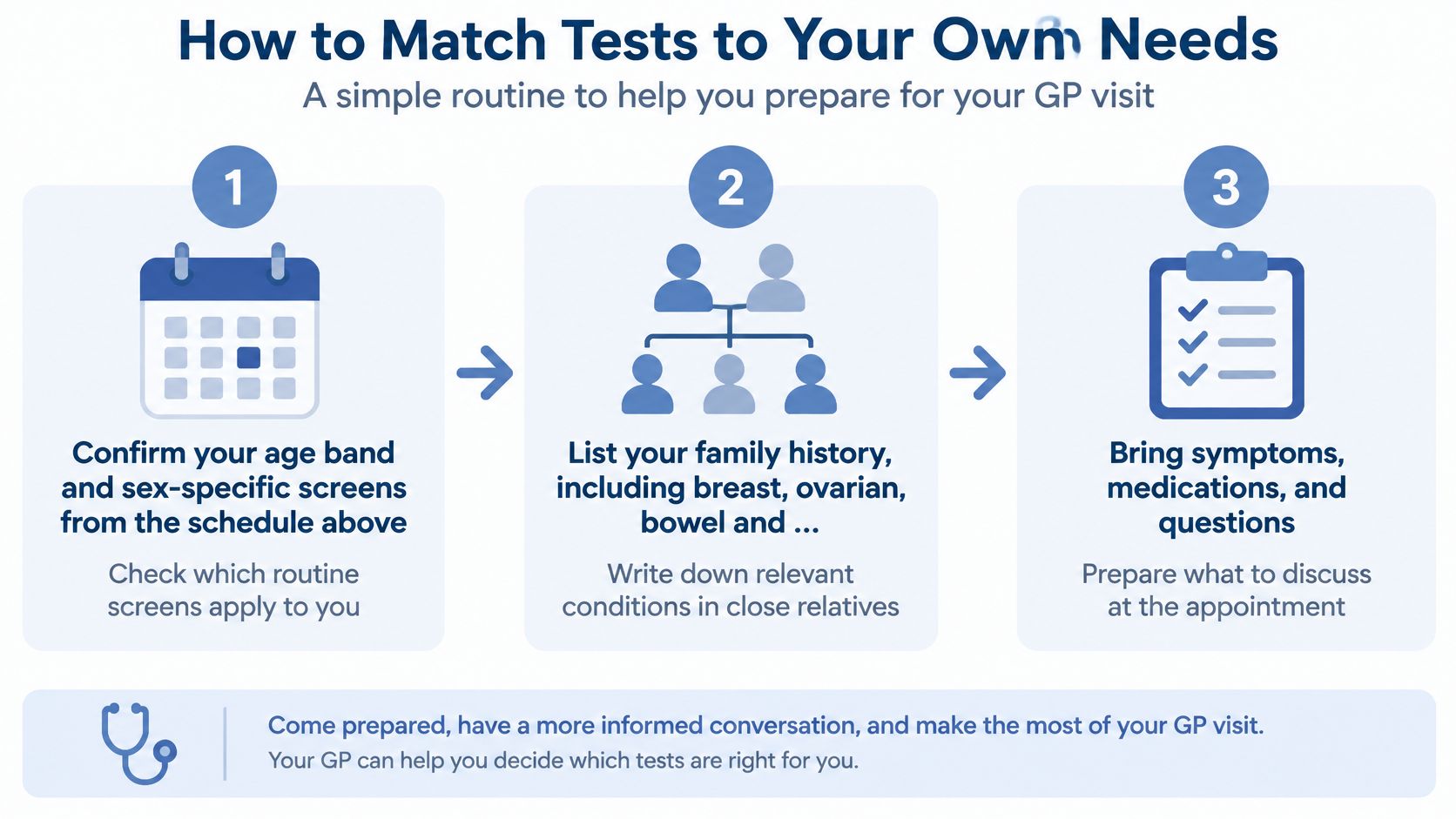
- Check your last results and dates. Repeat testing too early produces a number that can't be compared with anything, and it wastes your money. If you had a full blood count eight weeks ago, that result still counts.
- Sort your list into three piles. Screens due now, symptom-led tests to discuss, and things you've seen online but can't attach to a symptom. The third pile is usually the largest and the least useful.
- Take the page to a GP or a telehealth consultation. Ask which items are needed now, which can wait, and what the result would change. A test that won't alter the plan is a test you don't need yet.
The reason for that discipline is simple. Repeat testing without a question in front of it tends to produce mildly abnormal results that lead to more testing rather than to an answer.
A sensible plan looks short: two or three screens that are due, one or two symptom checks, and a review date written down.
If you'd rather have the routine walked through out loud, this short video covers the same ground.
Symptoms That Call for a Targeted Test
A symptom becomes worth testing when it changes what happens next: the treatment plan, the referral, the monitoring interval or the questions asked at a GP appointment. Period pain is a common example because it is easy to live with for years and easy to dismiss. The Australian figures show how often endometriosis reaches hospital care. There were approximately 40,500 endometriosis-related hospitalisations in 2021-22, or 312 per 100,000 females, and about 82% of those occurred in females aged 15 to 44, according to the Australian Institute of Health and Welfare's women's health report.
That concentration in reproductive-age women shapes how symptoms should be assessed. Pelvic pain, painful periods, abnormal bleeding, infertility and fatigue do not sit neatly in one biomarker. A full blood count and iron studies can show consequences such as anaemia or depleted iron stores. A normal result can still leave the main question open, because endometriosis is largely diagnosed through clinical assessment and may need imaging or specialist referral.
| Symptom | Test or review to discuss | What a normal result does not rule out |
|---|---|---|
| Heavy or prolonged periods, tiredness | Full blood count and iron studies | Endometriosis, fibroids or other causes of pelvic pain |
| Persistent pelvic pain or painful periods | Clinical review, with imaging or specialist referral as advised | Endometriosis, because diagnosis is largely clinical |
| Hot flushes, cycle changes or night sweats in the 40s or later | Thyroid and hormone tests as advised | Hormone levels shift across a cycle, so one result can mislead |
| Weight change, feeling hot or cold, palpitations | Thyroid function (TSH) | Other causes that need separate investigation |
| Unusual discharge or pain during sex | Sexually transmitted infection and swab testing | Causes that need a physical examination |
| Low mood, anxiety or sleep change | Mental health questionnaire and clinical review | Mental health conditions, which blood tests do not diagnose |
A targeted test works like a torch aimed at one part of a dark room. It can make one area clearer, while leaving the rest of the room unchanged. That is why symptom-led testing starts with a question, then chooses the test that could answer it. For heavy bleeding and tiredness, the question may be whether blood loss has affected iron stores. For persistent pelvic pain, the question may be what kind of clinical review or imaging is needed. For cycle changes in the 40s or later, the question may be whether thyroid function, female hormones or both need assessment within Vital iQ Health's Women's Health Panel.
Thyroid symptoms are often self-managed for years because they can look like stress, ageing or a busy season of life. If a TSH result comes back borderline, thyroid antibody testing is a more useful next question than repeating the same test soon after with no new information. A repeat result only helps when it is timed well and interpreted against symptoms, cycle timing and the earlier number.
Where you live can change how quickly symptoms are assessed. Remoteness differences in endometriosis hospitalisation rates point to differences in access and diagnostic pathways rather than differences in how much pain people feel. This is the practical reason a symptom diary can help: dates, pain scores, bleeding patterns, missed work and what relieved the pain give a GP more to work with than a single sentence at the end of a consultation.
The rule of thumb: a symptom that's lasted more than a few weeks, or is affecting work or sleep, needs a clinical review, not a shopping cart of unrelated tests.
Reading Results and Avoiding Common Misreadings
A result is a snapshot of one moment, not a verdict on your health. The number means something only in the context of your symptoms, your age, your cycle and the last result you had.
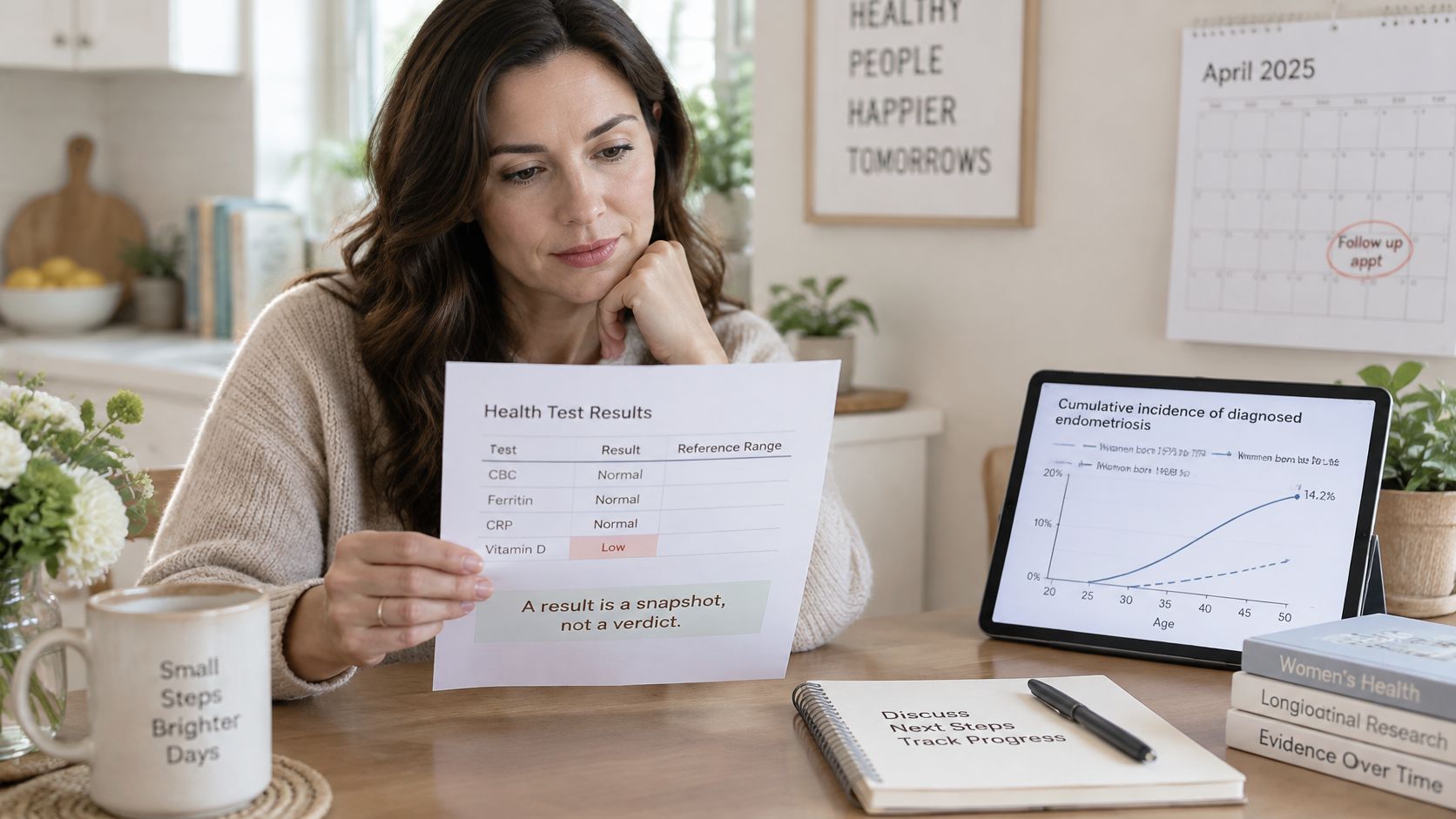
Longitudinal data shows why timing matters as much as the result. Among women born in 1973-78, an estimated 14.2% had diagnosed endometriosis by ages 44 to 49, while in the younger 1989-95 cohort, 8.8% had been diagnosed by ages 26 to 31, according to the AIHW's endometriosis prevalence analysis. Earlier diagnosis in the younger group may reflect awareness, access and diagnostic practice as much as biology.
Reference ranges deserve a plain explanation. They're built from the middle of a population, so a result sitting slightly outside the range often means nothing on its own, particularly across a menstrual cycle when hormone levels move by design. Accuracy is a separate question from interpretation: our laboratories and collection centres are NATA accredited, so the number you receive is measured to a standard even when its meaning still needs a clinician.
Four misreadings worth correcting
- A broad hormone panel can't diagnose the cause of a symptom. A woman with heavy periods and fatigue needs iron studies and a clinical review, not eight hormones and a shrug.
- More tests don't mean better health. Unsupervised repeats generate results nobody can act on, and each one creates an appointment.
- A normal result doesn't end the search. Persistent or function-limiting symptoms in adolescents and young adults still need escalation.
- Conditions aren't separate topics. Endometriosis, menstrual symptoms and menopause interact, which is why treating them as unrelated articles in a magazine misses the point.
That last point has hard numbers behind it. Endometriosis affects at least 1 in 7 Australian women and carries an average seven-year diagnostic delay, and Australian-led research covering nearly 280,000 women found those with endometriosis reached natural menopause about five months earlier on average, according to the Australian Government's 2025 Status of Women report card.
Bring three questions to every results conversation. What does this mean alongside my symptoms? Does it need repeating, and when? Which result would change the plan?
Access, Cost and Where to Get Screened
Choosing a test is half the job. The other half is knowing where to have it and what it will cost, because the same blood draw can be bulk billed at one pathology provider and charged at another.
- Start with the national programs. BreastScreen Australia mammograms are free for eligible women, and cervical screening happens at a GP clinic or a community health centre, where a self-collected swab may be offered.
- Ask about billing before the needle goes in. A test covered by Medicare costs you nothing, while a privately ordered one is charged. How pathology pricing works in Australia is worth understanding before you compare quotes.
- If you're outside a major city, raise distance early. Endometriosis hospitalisations are unevenly distributed across remoteness areas, so the diagnostic pathway can be slower where specialist services are far away. Ask about telehealth and referral options at the first appointment rather than the fourth.
- Keep a dated copy of every result. A clinician who can see your history makes better decisions than one starting from scratch, and it stops the same test being ordered twice.
- Say it if cost is the barrier. A GP who knows your limit can rank what matters now instead of handing you everything at once.
A paid panel can sit alongside a clinical plan. It can't replace one, and it won't answer a question nobody asked.
Book Your Next Women's Health Conversation
Ready to turn a page of notes into an actual decision? Bring your sorted symptom diary, your three questions and your screening due dates to a GP or telehealth consultation. Settle one point before the appointment ends: does a targeted test come first, or does the pattern need clinical review before anything is ordered?
Vital iQ Health offers a Women's Health Panel covering female hormones, thyroid function, metabolic health and overall wellbeing. You can order it online, attend a collection centre, then have a partnered GP review the results and discuss next steps. Dr Bronwyn Gock is a partnered GP with a focus on women's health. She holds an MBBS from the University of Sydney and FRACGP, with availability Monday and Tuesday from 7pm to 9pm and Saturday and Sunday from 11am to 3pm. Telehealth consultations give you options outside standard weekday clinic hours, including listed weekday evenings and weekends.
The panel works like one lens in a wider health check. It can measure hormone, thyroid, metabolic and wellbeing markers, but it cannot decide what those markers mean without your symptoms, history and screening schedule. A normal result can be reassuring. It still does not close the question if heavy periods, fatigue, pain, cycle changes or other symptoms continue. Screening is a schedule that changes with age, symptoms and family history, and results need to be read against that full picture.
Book the results conversation before you order anything. That way, the blood test has a purpose and the review has context. Your three questions give the appointment structure. Your symptom diary gives the GP the timeline that a single result cannot show.
Vital iQ Health gives you a practical starting point: 41 pathology panels, over 300 individual biomarkers, NATA-accredited laboratories and pathology partners covering every state and territory, with collection centres in Queensland, New South Wales, Victoria, Western Australia, South Australia, Tasmania and the Australian Capital Territory. If you have been putting off a women's health conversation, choose the panel that matches the question you want answered, then book the review that follows. Visit Vital iQ Health to see the panels and choose where to begin.