Why Am I Always Tired? Causes and When to See a Doctor
Why am I always tired? Learn the common causes, from poor sleep and stress to anaemia and thyroid problems, and when to see a GP.
You sleep eight hours, your blood tests came back within range, and by mid afternoon you're running on nothing. So why are you always tired?
That question sits behind a huge share of GP visits, and the standard answers only cover part of it. Time in bed tells you nothing about whether sleep is continuous or restorative. A normal pathology result rules out only the handful of conditions that particular panel measured. Neither one closes the case.
What does close it is pattern. When the tiredness started, what makes it worse, what happens when you stand up, whether activity flares your symptoms a day later, and which other complaints travel with it. This guide works through the common causes, shows what each one tends to look like, and explains where testing helps and where it doesn't.
Common Causes of Constant Tiredness at a Glance
Tiredness is a symptom, not a diagnosis, and it rarely has a single cause. What separates a vague complaint from a useful clinical clue is the pattern around it. When did it start, what makes it worse, and what else is happening at the same time?
Use the table below as a lookup, not a checklist. Read the middle column first and find the clue that matches something you've noticed. Then look at the third column for the first step a GP would usually consider. The feeling of tiredness alone points nowhere. A clue does.
Common causes of persistent tiredness, clues and first checks
| Possible cause | Typical clue | First check |
|---|---|---|
| Poor sleep quality or sleep apnoea | Loud snoring, witnessed breathing pauses, unrefreshing sleep | Sleep log, then GP review for a sleep study |
| Insufficient sleep | Under 7 hours most nights, weekend catch-up sleep | Two-week sleep and symptom log |
| Anaemia or iron deficiency | Heavy periods, pale skin, breathlessness on exertion | Full blood count and ferritin |
| Thyroid dysfunction | Weight change, feeling cold or hot, dry skin | Thyroid-stimulating hormone (TSH) |
| Blood sugar problems | Thirst, frequent urination, weight change | Fasting glucose or HbA1c |
| Low mood, anxiety or stress | Loss of interest, worry, poor concentration | GP mood screen |
| Medication side effects | Tiredness began after a new or changed prescription | Medication review with GP |
| Post-infection fatigue | Symptoms after COVID-19 or another infection | Clinical assessment and symptom timing |
Several rows can apply at once, and often do. Iron deficiency and an underactive thyroid can coexist. Poor sleep makes almost every other cause on that list worse, which is why it sits at the top. Shift workers and parents of young children frequently carry two or three contributors at the same time and assume the answer is their schedule.
A useful rule: treat the first check as a starting point, not a verdict. A normal full blood count doesn't exclude low iron stores, and a normal TSH doesn't explain away a year of unrefreshing sleep.
If one row fits and the tiredness has lasted several weeks, book a GP appointment rather than waiting for it to pass on its own. Bring two things: a record of your sleep and symptoms across a fortnight, and a complete list of medicines and supplements, including anything bought over the counter. Those two documents answer the questions a GP would otherwise spend the appointment asking, which leaves more time for the examination and the decision about testing.
Why Enough Sleep Still Leaves You Tired
More sleep is the standard advice, and for some people it works. For plenty of others it changes nothing, because the number of hours was never the problem. The reasons people sleep enough and still wake unrefreshed cluster into a handful of recognisable patterns.
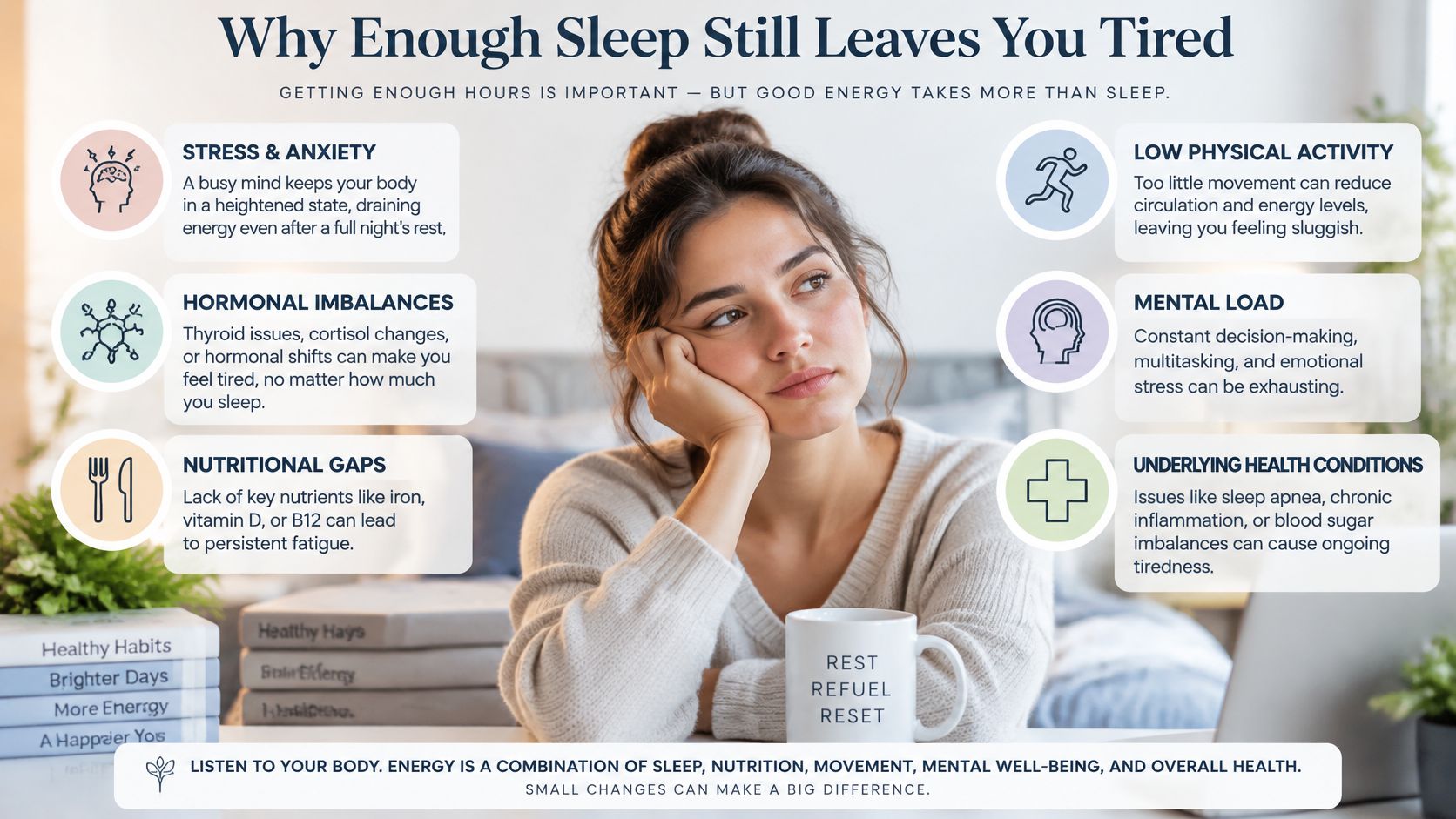
The scale of this is easy to underestimate. The Australian Institute of Health and Welfare reports that 66% of Australian adults have at least one sleep problem and 48% have at least two. Those problems include trouble falling asleep, repeated waking, and symptoms consistent with sleep-disordered breathing. They also impair the slow-wave sleep that restores you, which is why someone can log eight hours and still feel wrecked.
Duration, continuity and quality
These are three separate things, and only the first one is easy to count. Duration is time asleep, not time in bed. Continuity is whether you stay asleep, because six awakenings fragment a night as effectively as a late bedtime. Quality is the proportion of deep, restorative sleep you reach, and it drops with pain, alcohol, breathing problems and a busy mind.
A person who falls asleep at 11pm, wakes at 2am and 4am, and gets up at 7am has spent eight hours in bed and slept much less than that. Their problem isn't insufficient time. It's continuity.
The arousal problem
Cognitive arousal means lying awake with your mind working, and it's one of the most common reasons sleep doesn't arrive. A survey reported in the Australian Journal of Psychology found that rumination was a frequent sleep disruptor among young adults, who were 2.57 times more likely than middle-aged adults to report technology affecting their sleep. The same survey found 26.9% of Australian adults reporting fewer than seven hours of sleep.
Circadian misalignment belongs in the same conversation. Rotating rosters, early starts, late screens and weekend lie-ins that shift your body clock by three hours all produce a body that is asleep at the wrong biological time. The hours exist. The timing doesn't.
When the clue points to a breathing problem
Sleep apnoea is the cause most often missed by people who insist they sleep fine. The giveaway isn't how long you sleep, it's what happens during it. Loud snoring, a partner witnessing breathing pauses, waking with a dry mouth or morning headache, and heavy daytime sleepiness together justify a GP review for a sleep study.
If a partner has seen you stop breathing in the night, say so at the appointment. That single detail redirects the whole investigation.
Restless legs and chronic pain are the other two disruptors worth naming, because both fragment sleep without shortening it.
What a two-week log should record
- Bed and wake times, including weekends, so the pattern is visible
- Number of awakenings and what woke you
- Snoring or gasping, noticed by you or your partner
- Alcohol, caffeine and the timing of both
- Shift work or roster changes during the fortnight
- Daytime sleepiness scored 0 to 10, noted at the same time each day
- Morning headaches or a dry mouth on waking
That log gives a GP more to work with than a general description of being tired, and it shows quickly whether the problem is quantity, continuity or timing. If the answer turns out to be quality, adding more time in bed won't fix it.
How Stress and Low Mood Drain Your Energy
Tiredness that doesn't respond to sleep is often treated as a puzzle about the body. Sometimes the answer sits with mood, and the numbers say that's common rather than unusual. The Australian Bureau of Statistics National Study of Mental Health and Wellbeing found that 21.5% of Australians aged 16 to 85 experienced a mental disorder in the 12 months before the survey, with anxiety disorders affecting 17.2%.
You don't need a diagnosis for mood to drain you. Plenty of people carry ongoing worry, broken sleep and a flatness that never reaches the threshold of a mental illness, and their fatigue is just as real. This also explains why a normal set of blood results doesn't close the case: stress and low mood leave no marker on a standard panel, so the pattern in your week tells you more than any single result will.
The mechanism is straightforward once you see it. A nervous system stuck on alert works like an engine left idling: it burns fuel even when the car isn't moving. Anxiety keeps that engine running at 11pm when you want to sleep. Rumination hands the brain a task at exactly the wrong hour. Low mood makes ordinary effort feel heavier, and the appetite and sleep changes that come with it add another layer. Sleep and mood pull on each other too, because short or broken sleep tends to lower mood, which then makes sleep harder.
Clues worth noticing
- Loss of interest in things you normally look forward to
- Irritability that's out of character for you
- Poor concentration, especially reading or following a conversation
- Feeling flat most of the day, rather than in short bursts
- Tiredness that spikes on particular days or in particular situations, such as Sunday night or before a work deadline
That last clue matters. Fatigue that tracks your calendar is telling you something different from fatigue that never lifts.
Three questions to ask yourself
- Have I felt down, worried or flat for two weeks or more? Duration is the threshold that separates a rough patch from something worth treating.
- Has my interest in usual activities dropped? Losing pleasure is more informative than feeling sad.
- Does the tiredness hit hardest when I'm under pressure? If yes, mood is a reasonable place to start.
A GP will typically use a short questionnaire for depression and anxiety, review stressors and sleep, and talk through support options. Mood and fatigue feed each other in both directions, which is why treating one often lifts the other.
How a Clinician Narrows Down the Cause
Most of the diagnostic work happens in conversation, before a single tube is filled. A GP weighs probabilities across your history, your examination and a small number of targeted tests, and the history usually eliminates more possibilities than the pathology does.
Here's the sequence a careful clinician works through.
- Establish the timeline. Onset, duration and whether the tiredness is constant or episodic. A clear start after an infection or a new prescription narrows things immediately.
- Measure the functional impact. What has changed at work, in study, in exercise, in household tasks. Impact tells you how aggressively to investigate.
- Interrogate sleep. Pattern, snoring, breathing pauses, unrefreshing sleep. A sleep disorder may surface or be ruled out.
- Screen mood and stress. Anxiety and depression are among the most common non-physical diagnoses behind persistent fatigue, so this isn't a formality.
- Review every medicine and supplement. Tiredness that began after a new or changed prescription is a medication question until proven otherwise. Never stop a medicine abruptly without discussing it with the prescriber.
- Ask about diet, weight change and blood loss. Menstrual pattern, heavy periods, restricted eating and recent weight change all point in specific directions.
- Examine for physical signs. Pulse, blood pressure, weight, pallor, thyroid, heart and lungs, because the examination sometimes reframes the whole story.
- Check for red flags. Fever, night sweats, unexplained weight loss or neurological symptoms move the timetable forward sharply.
- Order tests only where they answer a question. If thyroid disease is plausible, the first test is usually thyroid-stimulating hormone, and a thyrotropin receptor antibody test can clarify whether an overactive thyroid is autoimmune. If the pattern suggests disordered breathing, the next step is a sleep study rather than more blood work.
- Review the results together. Findings need interpreting as a set, and the plan gets adjusted if symptoms persist.
What speeds this up: the specificity of your account. "Tired all the time" gives a clinician nothing to work with. "Exhausted since March, worse after exercise, waking at 3am, snoring according to my partner" gives them three directions in one sentence.
Occupational patterns deserve their own line in the history. Shift work, long commutes and caring responsibilities change both sleep timing and total sleep, and they're easy to leave out because they feel like ordinary life rather than a medical fact.
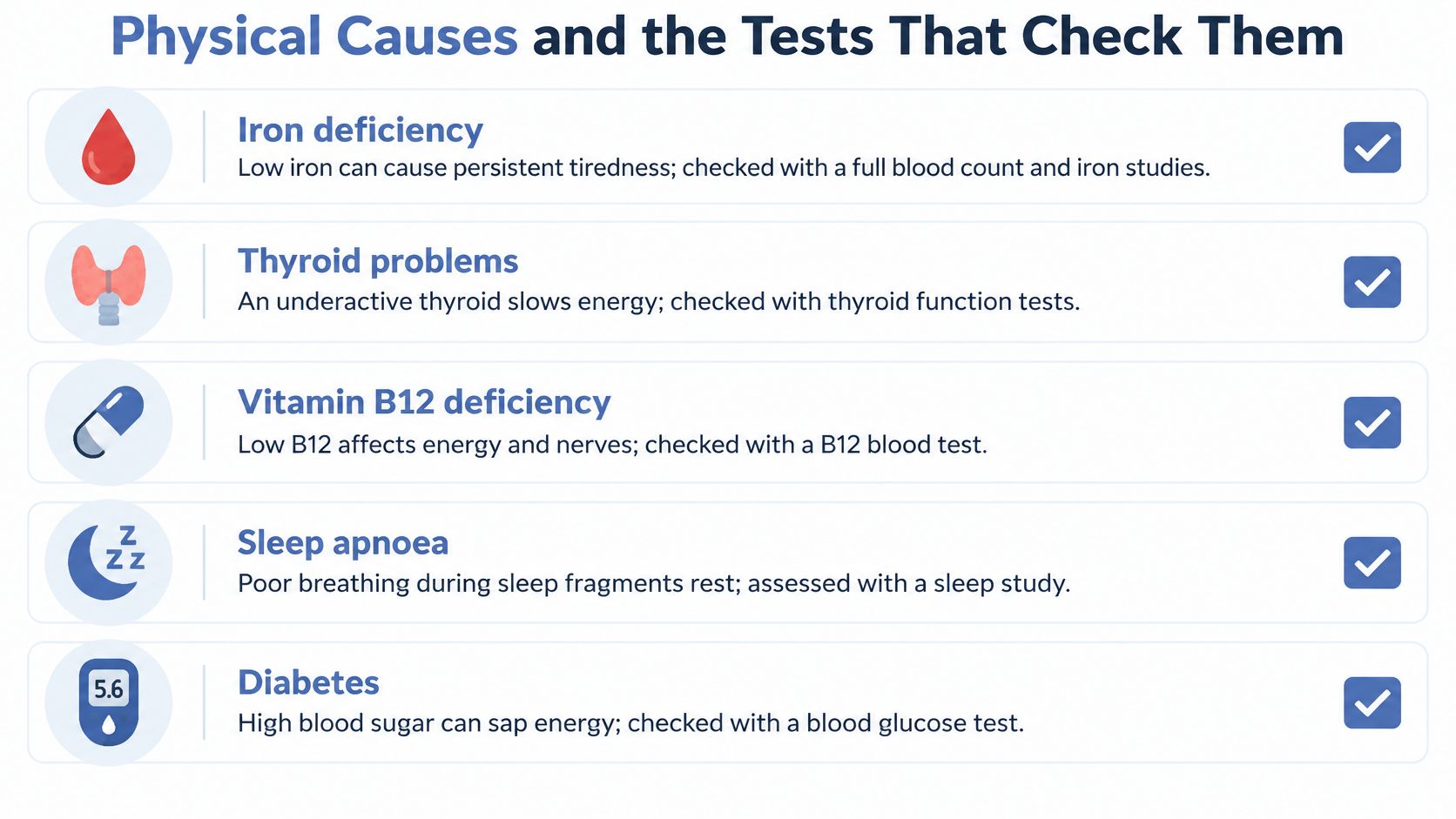
Physical Causes and the Tests That Check Them
There's no single blood test for tiredness, and a broad panel ordered without a clinical question usually produces more numbers rather than more answers. Australian general practice guidance treats ongoing fatigue as a symptom to assess by probability, not as a reason to order everything at once. The RACGP's guidance on fatigue recommends defining onset, duration, functional impact, sleep, mood, medicines and red flags first, then using a baseline screen when fatigue is unexplained and investigation is clinically indicated.
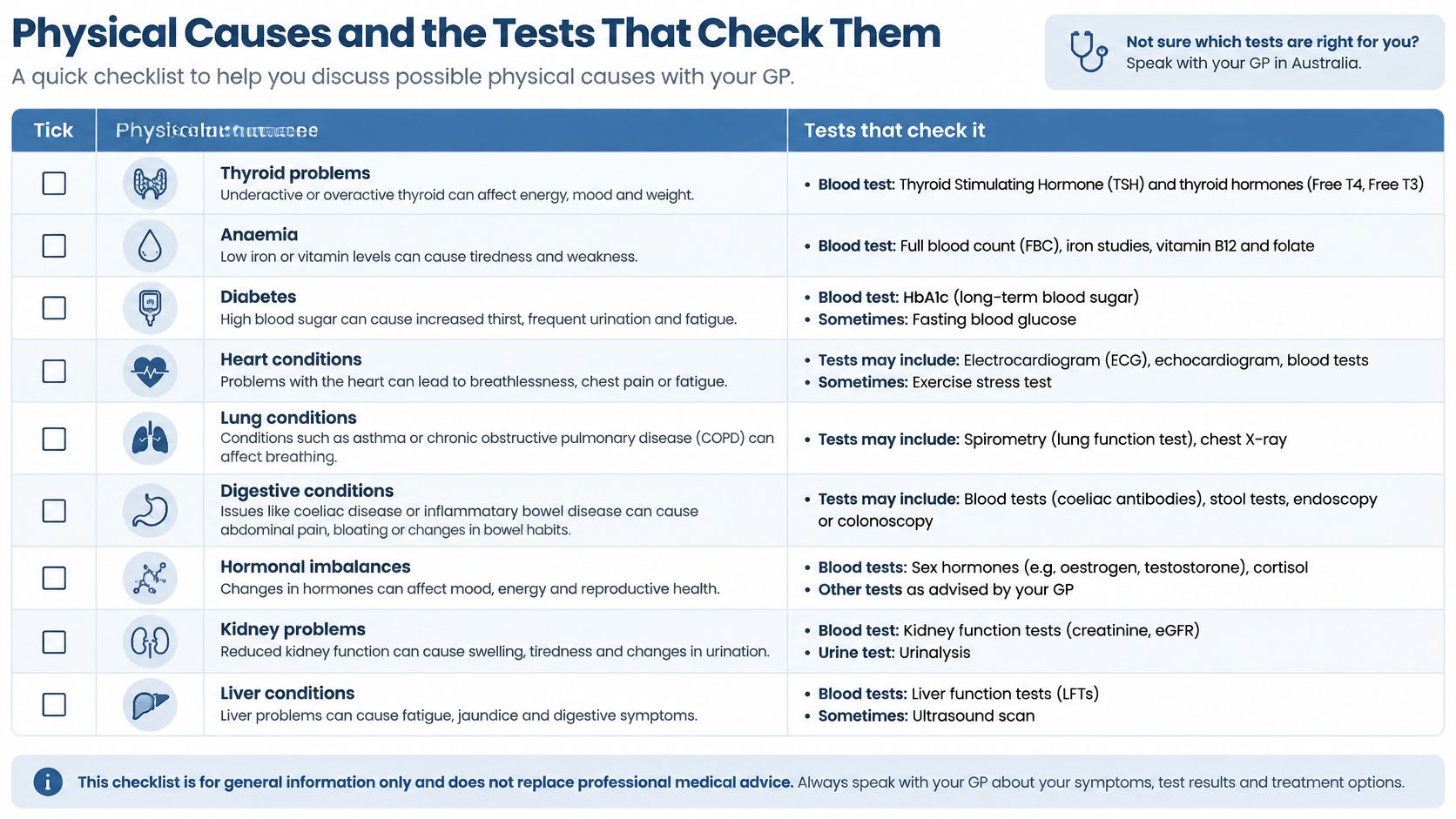
Each test in that baseline screen maps to a distinct mechanism, which is the point. You're not collecting data. You're testing specific explanations.
Core blood tests for persistent fatigue and what they check
| Test | What it measures | Cause it helps find |
|---|---|---|
| Full blood examination | Red cells, haemoglobin and white cells | Anaemia and other blood abnormalities |
| Fasting blood glucose | Blood sugar after fasting | Glucose dysregulation such as diabetes |
| Thyroid-stimulating hormone (TSH) | Signal controlling thyroid hormone output | Hypothyroidism or hyperthyroidism |
| Electrolytes and renal function | Salts and kidney filtration | Kidney disease |
| Liver function tests | Liver enzymes and proteins | Liver disease |
| ESR or C-reactive protein | Markers of inflammation | Systemic inflammation |
Ferritin is worth adding when there's a reason to suspect iron loss, such as heavy periods or a restricted diet, because stored iron can run low while haemoglobin still looks normal. Similarly, if your diet is plant-based or limited, or you've taken metformin or a long-term proton pump inhibitor, a B12 blood test is a sensible addition. Low B12 causes fatigue, brain fog and tingling in the hands and feet, and it's easily missed because it doesn't always show up as anaemia on a routine count.
A normal result rules out only the thing it measured. It doesn't rule out sleep disorders, mood, medication effects or post-infection fatigue. If your results come back unremarkable and the tiredness hasn't budged, the right move is a review appointment to reconsider the pattern, not a repeat of the same tests.
Medicines deserve their own mention because they're frequently the answer and rarely the first suspect. Blood pressure drugs, antihistamines, antidepressants, beta blockers and some pain relievers can all leave you flat. Bring the full list, including supplements and anything bought online.
If you'd like to see how this assessment is approached in practice, this walkthrough covers the reasoning behind targeted testing.
Fatigue After Infection and Long COVID
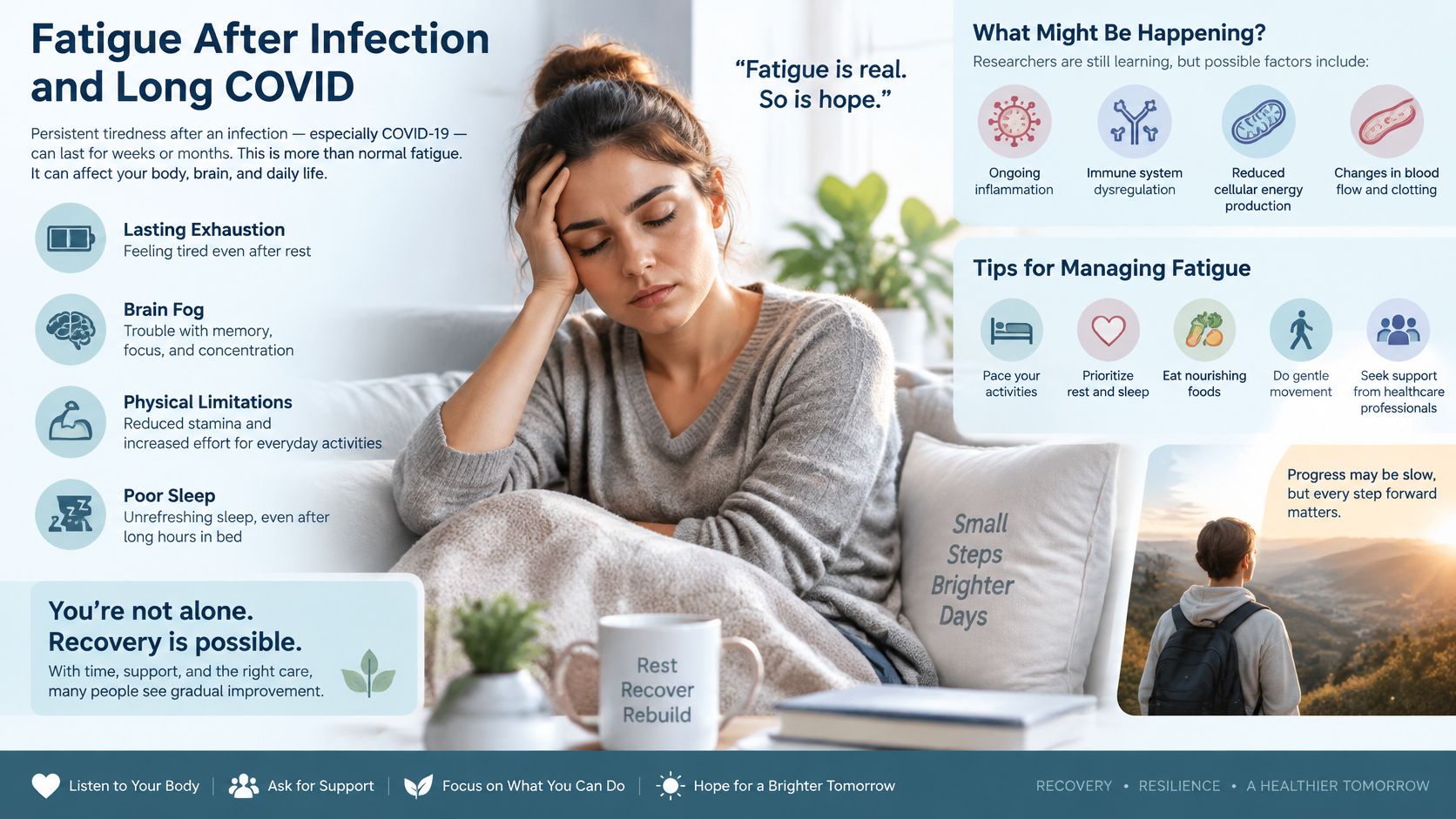
A normal blood test feels like proof that nothing is wrong. It isn't. That's especially true when tiredness began during or after an infection, where standard pathology often comes back clean while the person remains substantially impaired. The Australian Institute of Health and Welfare reports that approximately 5 to 10% of Australian COVID-19 cases involved symptoms persisting beyond three months.
The typical picture includes fatigue, cognitive difficulty, breathlessness, disturbed sleep and autonomic symptoms such as dizziness on standing or a racing heart. None of those appear on a full blood count.
Post-exertional malaise, explained
This is the pattern that separates post-infectious fatigue from ordinary deconditioning. You do something manageable, and a day or two later the fatigue and other symptoms flare beyond what the activity should have cost. The flare can outlast the activity itself, sometimes by days.
If that sounds familiar, pushing harder makes it worse, not better. The useful move is pacing: keep activity under the threshold that triggers a flare, then increase gradually rather than training through it.
Two separate tasks
Ruling out common contributors and confirming long COVID are different jobs, and mixing them up creates most of the confusion.
- Ruling out contributors is what blood tests do well. Anaemia, iron status, thyroid function, inflammation, liver and kidney abnormalities are all worth checking, and a raised inflammatory marker is worth discussing. If a high C-reactive protein result shows up, it tells you inflammation is present, not what is causing it.
- Confirming long COVID is a clinical judgement based on timing, symptoms and their pattern. No single routine biomarker establishes it.
Pacing rule: if a walk you used to do easily now costs you two days, cut the distance rather than the frequency, and build back slowly.
Younger adults and athletes are the group most likely to misread this. A post-exertional flare gets interpreted as poor conditioning or a nutritional gap, and the response is to train harder, which deepens the hole. If fatigue arrived after an infection and worsens after effort, say so explicitly at your appointment.
Decide When to See a Doctor Soon
Sort the decision by urgency rather than by how worried you feel. Some symptoms can't wait, some shouldn't wait long, and some can be watched for a few weeks.
See someone today, through emergency services or a same-day appointment, for:
- Chest pain, severe breathlessness or fainting
- Neurological symptoms such as sudden weakness, numbness, facial droop or confusion
- Symptoms getting worse quickly, rather than drifting
Book a GP within days to a couple of weeks for:
- Tiredness lasting several weeks with no clear cause
- Unexplained weight loss, fever or night sweats
- Loud snoring with witnessed breathing pauses
- Persistent low mood or loss of interest
Watch for a few weeks if:
- The tiredness is mild and clearly linked to a short-term change such as a new job, a newborn or a long flight
- It's improving rather than plateauing, and you can name when it's worst
Then do the groundwork. Keep the two-week sleep and symptom log, write out every medicine and supplement, note what was happening when the tiredness started, and book the appointment. Ask your GP which tests suit your pattern before ordering any yourself, because results only mean something to a clinician who knows your history. If you do want to look at thyroid and metabolic markers, our Thyroid & Metabolic Panel assesses thyroid hormones, metabolic markers and adrenal function to evaluate energy and overall health, and it works best alongside a GP conversation rather than instead of one.
Persistent tiredness is information, not a character flaw. Act on it rather than waiting for it to resolve by itself.
Fatigue that's lasted weeks deserves a proper look rather than another guess. Vital iQ Health offers private pathology panels covering iron studies, full blood counts, thyroid and metabolic function, and inflammation markers, with online ordering, collection through accredited laboratory networks across Australia, and a telehealth GP consultation to talk through what your results mean. Start with your symptoms and your sleep log, then visit Vital iQ Health to choose the panel that matches the pattern you've identified.