Renal Function Test Explained: eGFR, ACR and Results
Renal function test explained: what eGFR and urine ACR measure, why one abnormal result is not a diagnosis, and how to read results alongside health history.
Could a normal filtration number on a renal function test still hide early kidney damage? Yes. Many reports treat the blood result as the whole story, and that is where people get false reassurance.
A renal function test is really two checks. One estimates how much blood the kidney filters clear. The other looks for albumin leaking into urine. A blood-only panel can leave the urine half out. Albumin can leak while filtration still looks ordinary, especially if you live with diabetes or high blood pressure.
Blood pressure belongs in the same check, because pressure and kidney injury feed each other. The pages below cover the markers on a report, why a doctor orders them, how the two halves fit, what common patterns suggest, what can shift a number without disease, and when one abnormal result becomes a diagnosis.
Kidney Markers a Renal Function Test Reports
| Marker | What it measures | Reference category or threshold |
|---|---|---|
| Serum creatinine | Waste product cleared by the kidneys | Reported by laboratory; varies by age, sex and laboratory |
| eGFR | Estimated filtration rate from serum creatinine, in mL/min/1.73 m² | G1 at 90 or above; G2 60 to 89; G3a 45 to 59; G3b 30 to 44; G4 15 to 29; G5 below 15 |
| Urine ACR | Albumin leaking into urine | A1 below 3; A2 3 to 30; A3 above 30 mg/mmol |
| Cystatin C | Alternative filtration marker used when creatinine may mislead | Reported when used; category set by laboratory |
Serum creatinine is the waste left from everyday muscle turnover. Healthy kidneys clear it continuously, so a higher blood level can mean slower clearance. The raw number is hard to compare between people, because a muscular adult produces more creatinine than someone with little muscle.
eGFR (estimated glomerular filtration rate) turns creatinine, age and sex into an estimate of filtration, in millilitres per minute per 1.73 square metres. Categories run from G1 (90 or above) down to G5 (below 15). The estimate is a label for discussion with your doctor, not a disease name printed on the page.
Urine ACR (albumin-to-creatinine ratio) compares albumin in a spot urine sample with creatinine in that same sample, so dilution sways the result less. A1 sits below 3 mg/mmol, A2 covers 3 to 30, and A3 is above 30. This is the line a blood-only renal function test often leaves off.
Cystatin C is released at a fairly steady rate by most cells. Laboratories add it when muscle mass or diet may distort creatinine, and the report sets the category when the marker is used.
How to read the page in front of you
Laboratory reference ranges differ. Most Australian reports flag a value that sits outside their own range. Use the flag as a prompt to look closer.
Practical rule: Find the eGFR, find the ACR, and check whether the laboratory names the equation it used.
- Find the eGFR: It is usually printed beside creatinine, in mL/min/1.73 m².
- Find the ACR: If the page has no urine result, the renal function test is incomplete.
- Find the equation: CKD-EPI and the older MDRD equation can give different numbers from the same creatinine.
That checklist takes a minute. It stops you treating one creatinine line as the whole kidney story.
Why Doctors Order Renal Function Tests
A request for a renal function test usually starts with a reason already in the notes: diabetes, blood pressure that stays high, cardiovascular disease, a family history of kidney disease, or long-term use of medicines that can stress the kidneys, including regular anti-inflammatory tablets. Doctors also order it when a symptom needs an explanation, such as swelling, a change in how often you pass urine, or fatigue with no clear cause.
A renal function test is really two checks: how well blood is filtered, and whether albumin is leaking into urine. Surveys that use blood and urine measures rather than self-report alone tend to find more kidney disease than people say they have. That gap matters because feeling well does not clear the kidneys, and a normal filtration number can reassure too early if the urine side was never checked.
The age gradient and the awareness gap
Signs of kidney disease become much more common with age, and many older adults with measurable kidney changes do not know they have them. Risk is uneven, so "I feel fine" is a weak reason to skip a check when diabetes or treated blood pressure is already in the picture.
A renal function test is a screening tool. Your doctor decides whether a repeat test or a referral follows.
If a request form includes only creatinine and eGFR, ask whether a urine albumin result is part of the work-up or needs a separate sample. Men arranging broader screening can fold kidney markers into a men's health check rather than waiting for swelling or fatigue to appear.
Complete Kidney Check and How eGFR and ACR Combine
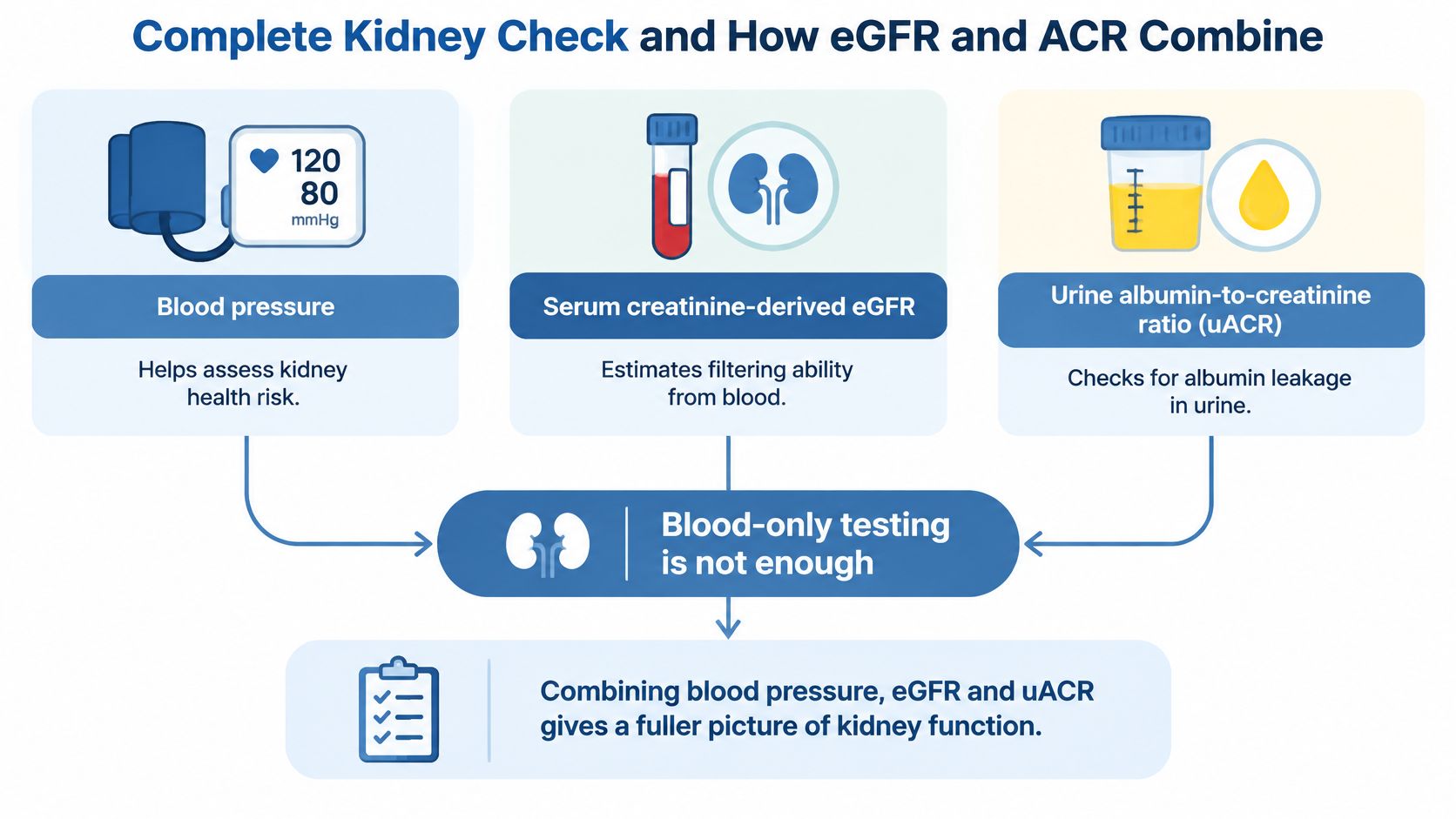
Australian guidance defines a complete Kidney Health Check as three parts: a blood pressure reading, serum creatinine-derived eGFR, and a urine albumin-to-creatinine ratio (uACR). The RACGP diabetes guidance sets out that combination. It is the standard a private blood panel should be measured against.
A renal function test is really two tests. A blood-only panel can miss early damage, because albuminuria can show kidney injury while eGFR isn't reduced. Urine testing and blood pressure may need to be arranged separately, and extra blood biomarkers don't repair a missing urine marker. Screening resources also use sex-specific albuminuria thresholds, so one universal cutoff isn't the Australian approach.
Collecting the urine sample
- Collect the first urine of the day. A first-void sample is preferred when you are confirming a positive uACR, because albumin excretion varies through the day.
- Avoid heavy exercise beforehand. A hard session can push albumin into the urine for a short time.
- Tell the collector about fever or infection. Both can raise albumin excretion and make one sample look worse than your usual state.
Confirm a positive uACR with repeat first-void samples. Albumin excretion varies, and the meaningful finding is a persistent abnormality, not one isolated rise.
Filter throughput versus a leaking mesh
The glomeruli work like a fine mesh with a set throughput. eGFR estimates that throughput. ACR checks whether the mesh is letting albumin through. A comfortable filtration number doesn't prove the mesh is intact, and you can have a strong flow and a leak at the same time.
The KDIGO 2012 CKD guideline notes that the CKD-EPI equation has generally shown better accuracy than the older MDRD equation, particularly when GFR is relatively high. Australian laboratories commonly report eGFR with serum creatinine. Check which equation the report names before you compare results from two laboratories.
An eGFR below 60 mL/min/1.73 m² should be flagged as low, but one abnormal result doesn't establish chronic kidney disease. Repeat an incidental low result. Where cystatin C is available, combining it with creatinine can improve the GFR category when muscle mass, diet or other factors distort creatinine.
Read the named equation and the trend, not one creatinine value. A falling eGFR, even while it stays above 60, is a reason to review blood pressure, diabetes, medicines, hydration and the urine finding. For people already identified as having CKD, both GFR and albuminuria need regular reassessment, and more often when progression risk is higher.
What Result Patterns Suggest
A result pattern is a combination, not a single number. Read from the most reassuring row to the ones that need a clinician soon.
| Result pattern | What it may suggest | Next step |
|---|---|---|
| eGFR 60 or above, ACR below 3 | Filtration and albumin within typical range | Routine review on your doctor's schedule |
| eGFR 60 or above, ACR 3 to 30 | Albuminuria despite preserved filtration | Repeat first-morning ACR; review blood pressure and diabetes control |
| eGFR 60 or above, ACR above 30 | Significant albumin leak despite preserved filtration | Prompt clinician review |
| eGFR below 60, ACR above 30 | Reduced filtration with significant albumin leak | Prompt clinician review |
| eGFR below 15 | Severe filtration loss | Urgent clinician assessment |
Why a preserved eGFR can still mean disease
The KDIGO 2024 CKD guideline classifies risk with both the GFR category and the albuminuria category. A1 is ACR below 3 mg/mmol, A2 is 3 to 30 mg/mmol, and A3 is above 30 mg/mmol. Persistent ACR above 3 mg/mmol is clinically meaningful albuminuria once confirmed.
Increased urinary albumin reflects abnormal glomerular permeability. It tracks with higher kidney-disease and cardiovascular risk even when eGFR is preserved. Someone with eGFR above 60 and persistent A2 or A3 albuminuria may have significant kidney disease. Don't let a filtration estimate in the usual range close the file.
A mildly reduced eGFR with A1 albuminuria can carry a different risk. It needs age, a repeat test, and a check for structural or urinary abnormalities before anyone names a disease.
When the urine number is a false alarm
Collect a spot urine ACR under stable conditions, and repeat an unexpected elevation. Exercise, infection, menstruation, fever and short-lived changes in blood flow can increase albumin excretion without a lasting leak.
Cause, GFR category and ACR category are read together. That CGA frame sets how closely you are monitored, and whether a nephrology referral is appropriate.
An eGFR below 15 is a reason for urgent clinical assessment. It isn't a result to park until the next routine blood test.
What Shifts a Renal Function Result
A renal function test can move for reasons that have nothing to do with chronic disease. Ask that question before you assume the number means lasting damage.
Temporary shifts
- Dehydration: Less fluid concentrates creatinine and can lower the estimated filtration rate for a day or two.
- Acute illness and fever: Infection changes blood flow through the kidneys and can lift albumin excretion.
- Strenuous exercise: A hard workout can raise urine albumin until you have rested.
- Menstruation: Blood in the sample can distort a urine ACR.
- Day-to-day variation: Creatinine and albumin both wobble in healthy people.
Muscle, diet and medicines
Serum creatinine comes from muscle. Very high muscle mass can push it up and make filtration look worse than it is. Very low muscle mass, or an unusual diet, can do the opposite and make filtration look better. That is why an extreme build or a big change in eating belongs in the notes you take to the repeat test.
Some medicines change kidney function. Others change the test without a matching change in the filters. List every prescribed tablet, anti-inflammatory and supplement before a flagged value is interpreted. Don't stop a prescribed medicine because a private report looks off.
An unexpected abnormal value is a prompt to repeat the test under stable conditions. It isn't a reason to change treatment or to assume disease.
Your own history decides which factor applies. Someone who trained hard the evening before a private blood test has a different explanation to weigh than someone who has had swelling for weeks. Write exercise, illness, periods, fluid intake and medicines beside the result so the repeat is read in context.
From One Abnormal Result to Confirmed Kidney Disease
Say a direct-access report comes back with an eGFR of 55. The number sits under the usual flag, and it's easy to assume you already have chronic kidney disease. You don't, not from that single line. Many people take a result like this into a clinic still unsure what it means.

The Australian Institute of Health and Welfare overview describes CKD as an eGFR below 60 mL/min/1.73 m² that persists for at least 3 months, or evidence of kidney damage persisting for the same period. In the relevant Australian classification, an eGFR between 60 and 90 mL/min/1.73 m² is considered indicative of CKD when ACR is at least 2.5 mg/mmol in males or 3.5 mg/mmol in females. Sex and the urine marker both matter. Creatinine estimates filtration. Urine testing detects protein loss that a filtration estimate can miss.
That second point is where a blood-only panel can leave a gap. A normal eGFR alongside a raised urine albumin can still signal kidney damage, so a clean filtration number alone is not the reassurance it looks like. Confirmation needs both halves of the test.
The scale behind those definitions is large. AIHW reported approximately 2 million Australian hospitalisations with CKD recorded as a principal or additional diagnosis in 2021-22, representing 18% of all hospitalisations. In 2022, about 29,000 Australians with kidney failure received kidney replacement therapy, and CKD contributed to around 22,000 deaths, equal to 11% of deaths nationally. Early biomarker changes are repeated and read with your risks. They aren't treated as a final label, and they aren't ignored.
What to do with one abnormal result
CKD can't be diagnosed from one abnormal eGFR or uACR. The AIHW definition requires the abnormality to persist, so a flagged result is repeated promptly and then confirmed over the following months rather than accepted on a single draw.
- If eGFR is below 60, repeat it promptly. A quick recheck helps separate a temporary dip, such as acute kidney injury, from something that will persist.
- Repeat the urine ACR. Preferably on first-morning urine, repeated across the following months.
- If the abnormalities persist, book a clinician review. Take the new results, earlier tests and your health history.
- Seek urgent assessment for sudden swelling, much reduced urine output or severe fatigue. Those aren't "wait three months" symptoms.
A flagged result needs confirmation. It doesn't need an immediate CKD label.
If you arranged the first test without a referral, you can still order a blood test without a referral in Australia for the repeat, then take both reports to a GP or a telehealth consultation. Customers order private blood tests online without a GP referral, choose from 41 pathology panels, visit a NATA-accredited collection centre near them, and receive results within 24 to 72 hours. Vital iQ Health uses NATA-accredited laboratories, and all collection centres are NATA accredited. That pathway gets you the repeat sample. The clinical decision about what the pair of results means still belongs to a doctor.
A short explainer on why one low filtration number is repeated before anyone uses the word chronic:
If you want a renal function test that includes the urine albumin check, not only a creatinine line, arrange a kidney-focused panel and a collection centre near you. Vital iQ Health provides private pathology through NATA-accredited laboratories, with results you can take to your own GP or a telehealth consult. Visit Vital iQ Health to order your check and book the sample.