C-Reactive Protein High Means: What It Can Tell You
C-reactive protein high means inflammation is present somewhere in the body, not where or why. Learn what the numbers show and when to see a doctor.
In Australia, a CRP result above 10 mg/L is classed as high. It signals inflammation, infection, or tissue injury somewhere in the body, without naming the place or the cause.
A flagged result can seem to say the test has already decided the illness. It hasn't. The number is an alarm, not a verdict, and two people with the same figure can be in completely different situations. What changes the meaning is how you feel, what else is on the report, and whether the next result climbs or falls.
If you've searched c-reactive protein high means late at night, the useful question isn't "how bad is this number?" It's "what should we look at next?"
What a High CRP Result Actually Tells You
A high CRP result means inflammation, infection, or tissue injury is underway somewhere in your body. The figure doesn't point to an organ, and it doesn't name the trigger.
A smoke alarm works the same way. It tells you there is smoke in the building. It doesn't tell you the kitchen, the bedroom, or whether the cause was burnt toast or a real fire. C-reactive protein (CRP) is that alarm in the blood. Your liver makes it during the acute-phase immune response, and the level can climb fast once the trigger starts.
The Australian Bureau of Statistics National Health Measures Survey used a conservative threshold of more than 10 mg/L to define high CRP, while the usual reference range is below 5 mg/L, and CRP can increase rapidly, often within 24 to 48 hours.
How the bands are read
The space between those two cut-offs is where people get stuck. A result from 5 to 10 mg/L isn't classed as high, yet it isn't a clean baseline either. A mild or settling process can sit there, and so can everyday drivers that nudge the resting level up. That band needs your symptoms and the reason the test was ordered before anyone treats it as a problem or dismisses it.
| Result | Label | What it usually suggests |
|---|---|---|
| Below 5 mg/L | Usual reference range | Acute inflammation unlikely in most people |
| 5 to 10 mg/L | Grey zone, not classed as elevated | Mild or resolving inflammation possible; check symptoms |
| Above 10 mg/L | Elevated | Active inflammation, infection or tissue injury; cause not identified |
Laboratories print their own reference range on the report, and units matter. Compare your value with the range beside it, not with a chart you found online. A result that looks ordinary on one assay can be flagged on another if the units differ.
Practical rule: Read three things on any report before you decide what the number means: the value, the flagged range printed beside it, and the date the sample was taken. One result is a snapshot, not a story.
The degree of elevation gives useful context. It still can't diagnose a condition on its own. A persistently raised or unexpectedly high result belongs in a conversation with a clinician, not in a self-made label.
What Pushes CRP Up and How Causes Differ
Clinicians don't start with the number. They start with the kind of process that could have switched the liver on. Four groups cover most of what you'll meet: infections, physical injury or surgery, immune and inflammatory conditions, and steady low-grade drivers such as smoking, excess body weight, poor sleep, and gum disease.
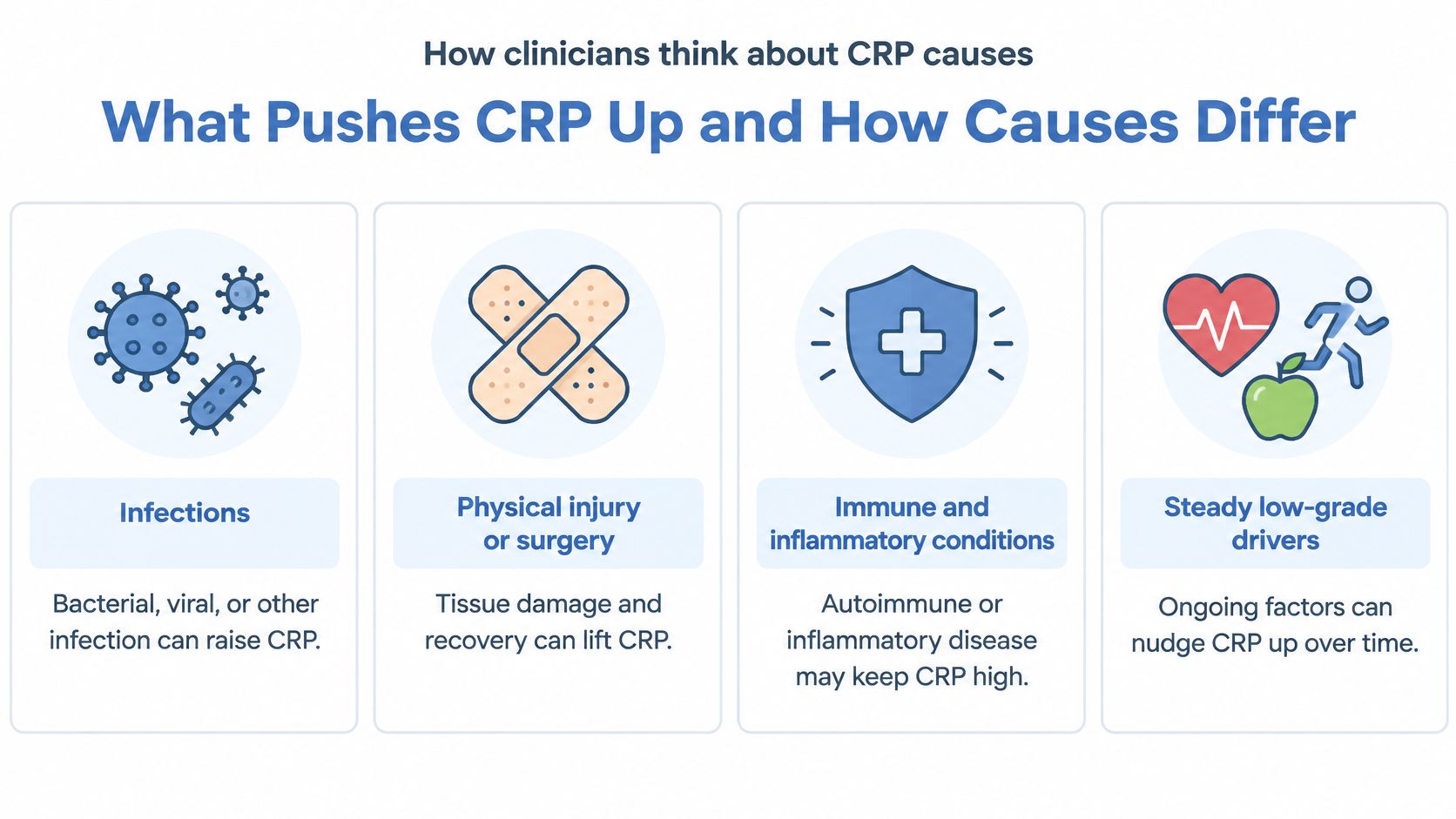
Patterns, not proof
Bacterial infection often pushes CRP up sharply. Viral illness more often produces a modest rise, with cold or flu symptoms and widespread aches rather than one hot, painful spot. Injury and surgery are different again. Tissue damage lifts CRP within about a day or two, then the level should fall as healing moves along. A spike after an operation can be expected. A level that refuses to fall is the result that needs another look.
Autoimmune and inflammatory disease tends to leave a raised or swinging value beside joint stiffness, a rash, or bowel symptoms. Antibody tests aimed at a specific condition, such as a thyrotropin receptor antibody test in thyroid autoimmunity, answer a different question from CRP. They look for a named immune target. CRP only says the inflammatory response is active.
| Influence | Typical CRP pattern | Clues that help |
|---|---|---|
| Bacterial infection | Often rises sharply, sometimes above 100 mg/L | Fever, localised pain, pus or discharge |
| Viral infection | Usually a more modest rise, rarely above 100 mg/L | Cold or flu symptoms, widespread aches |
| Tissue injury or surgery | Rises within 24 to 48 hours, then falls as healing progresses | Recent fall, fracture, operation or procedure |
| Autoimmune or inflammatory disease | Persistently raised or fluctuating | Joint stiffness or swelling, rash, bowel symptoms |
| Low-grade long-term drivers | Mild, steady elevation | Smoking, excess weight, poor sleep, gum disease |
Say one reader has a sore throat, a fever, and a CRP of 60 mg/L. That sits with an active infection that needs a proper look. Another reader has a steady 6 mg/L, feels well, smokes, and sleeps badly. Same test, different story. The second result may be a resting nudge, not an acute illness.
The rows describe patterns, not diagnoses. The same number can come from different causes, and the clues beside it are what separate them.
Why One CRP Number Is Never the Whole Story
A single CRP can't settle whether you have a serious infection. People often want it to, because a number feels more decisive than a list of symptoms. It isn't.

Three lenses, not one figure
Symptoms and examination come first. A raised CRP with fever and pain in one place points toward a focal infection. The same value in someone who feels well calls for a calmer plan, often a repeat once any recent cold, hard exercise, or dental flare has passed.
The trend matters more than the snapshot. A falling CRP after treatment supports recovery. A rising or stubbornly high value means the cause needs another look, even if you felt a bit better yesterday.
Other tests fill the gaps CRP can't. A full blood count, kidney and liver results, and, when the symptoms call for them, imaging or cultures, locate a process that CRP only announces.
A 2023 Australian study of 1,716 adults with suspected sepsis at Townsville University Hospital defined CRP above normal as at least 10 mg/L, and CRP had an area under the curve of 0.58 for detecting culture-positive bacteraemia. That is only slightly better than chance. CRP couldn't confirm bloodstream infection, and it couldn't rule it out.
Two trends, side by side
Say a CRP is 120 mg/L on day one, 70 on day three, and 30 on day six. Read as a series, that looks like a response to treatment. Now take 15, then 22, then 35 across a fortnight, with symptoms that haven't settled. The numbers are smaller, yet the direction is the problem. Bring the series to the appointment, not the latest figure on its own.
A normal result doesn't guarantee you're well either. Early in an illness the level may not have risen yet, and some conditions inflame tissue without a big CRP move. Persistent symptoms still deserve a clinician, whatever this one marker shows.
High-Sensitivity CRP and Heart Risk Explained
Standard CRP and high-sensitivity CRP (hs-CRP) measure the same protein, yet they answer different questions. Mixing them up is one of the fastest ways to frighten yourself with a harmless decimal.
Standard CRP works like a loud alarm. It is built for acute illness, and its useful territory is the higher range where infection and tissue injury show up. hs-CRP is closer to a quiet gauge: it measures within a lower range, so it can separate small differences a standard assay may not report. That precision serves long-term cardiovascular risk in people who feel well.
The two are not interchangeable.
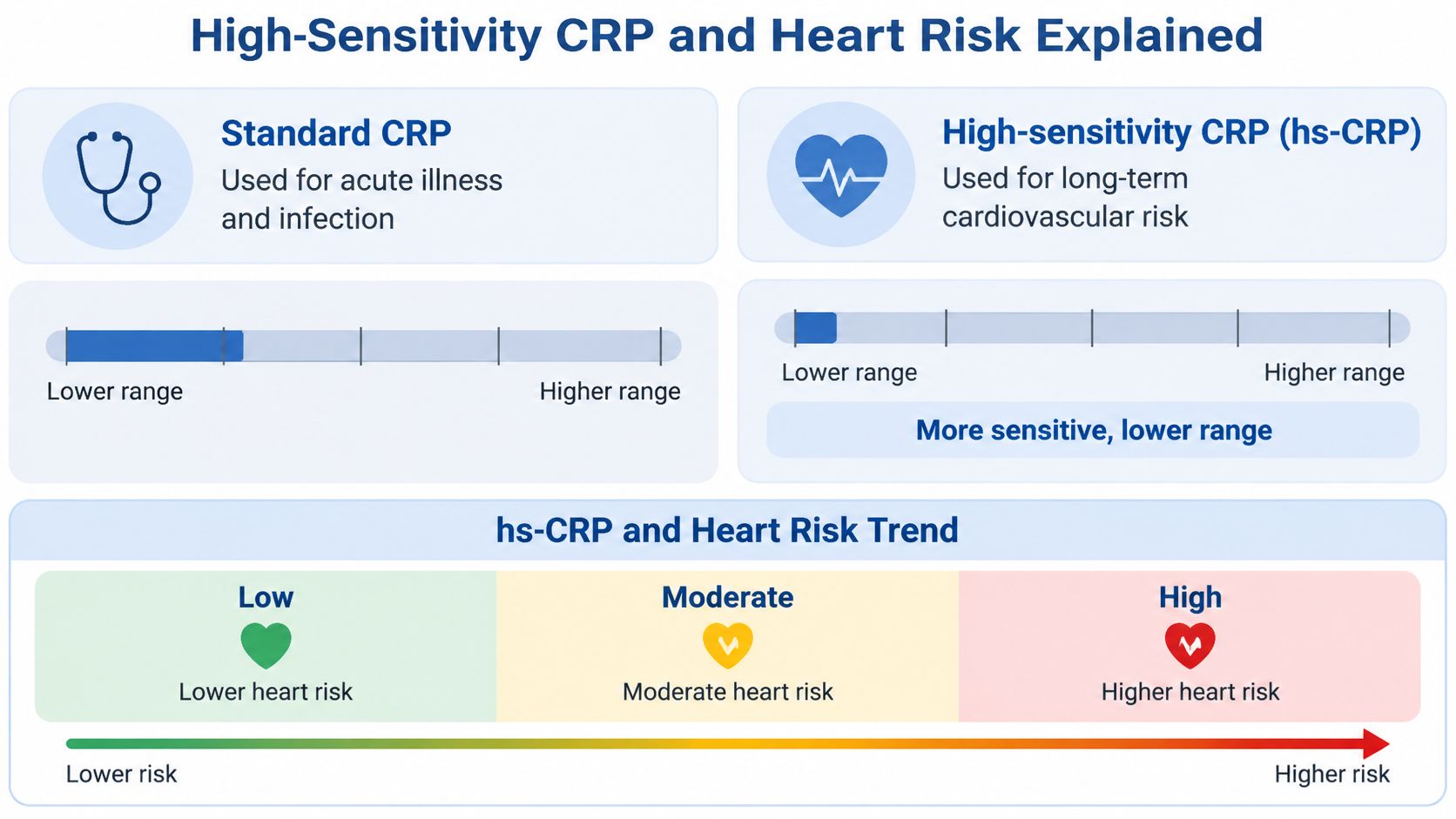
The Royal College of Pathologists of Australasia classifies hs-CRP below 1.0 mg/L as low cardiovascular inflammatory risk and 1.0 to 3.0 mg/L as average risk, with values above 3.0 mg/L commonly treated as higher risk once acute illness and other inflammation are excluded.
Why 4 mg/L isn't 40 mg/L
Those bands explain why 4 mg/L can matter in an hs-CRP conversation while having nothing in common with a markedly high standard CRP during an infection. A result of 4 mg/L sits just above the average band. It is a prompt to look at the rest of your risk, not evidence of an acute illness.
| hs-CRP (mg/L) | Cardiovascular risk category | How to read it |
|---|---|---|
| Below 1.0 | Low inflammatory risk | Favourable; still read alongside other risk factors |
| 1.0 to 3.0 | Average risk | Common; review cholesterol, blood pressure and lifestyle |
| Above 3.0 | Higher risk once acute illness is excluded | Repeat after recovery before drawing conclusions |
| Standard CRP above 10 mg/L | Not used for heart risk | Reflects active illness; retest after recovery |
hs-CRP sits beside cholesterol levels, including LDL, blood pressure, smoking, diabetes, and family history. It doesn't replace them, and a single reading isn't a verdict either. If the blood was drawn while you were unwell, that result says little about heart risk. Plan the hs-CRP for after you have recovered, then read it as one voice in a larger conversation rather than the final word.
When a High CRP Needs Urgent Medical Attention
Timing is the decision, not the size of the number alone. Scan the tier that matches how you feel right now.
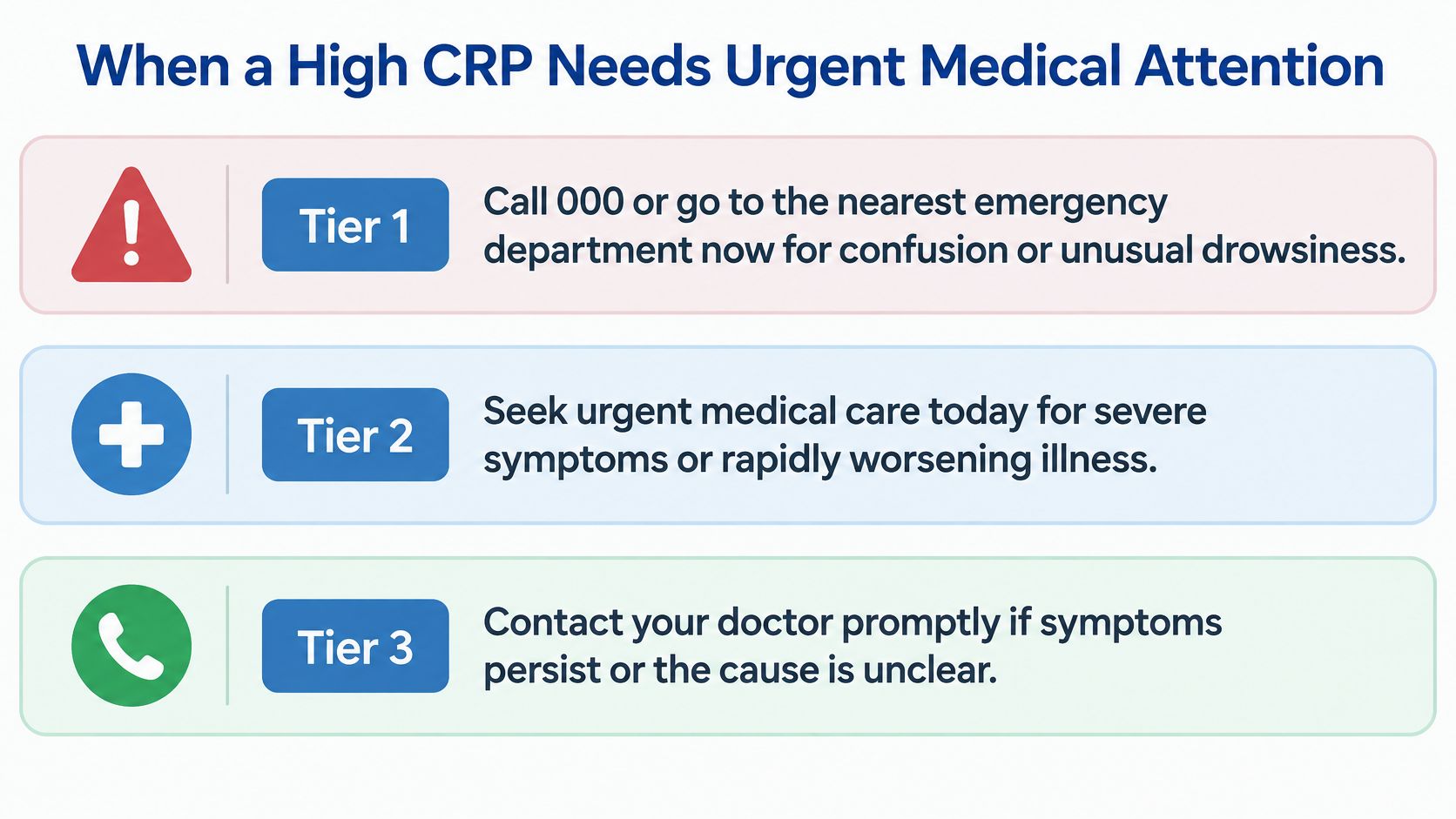
Call 000 or go to emergency now
- Confusion or unusual drowsiness: Don't wait to see if it passes.
- Breathlessness or chest pain: Treat these as emergency symptoms, with or without a blood result in hand.
- Fever with shaking chills and a racing heartbeat: This combination can mark serious infection, where hours matter.
- A stiff neck with a severe headache: Get emergency care rather than a routine slot.
- Signs of severe dehydration: Very little urine, dizziness, or an inability to keep fluids down belongs in the same tier.
Book a GP within a day or two
- Fever lasting more than two or three days with a raised CRP: A short viral illness can lift CRP, but fever that keeps going needs a review.
- Spreading pain, swelling, or a hot red patch of skin: Local signs plus a raised value narrow the search.
- Unexplained weight loss or drenching night sweats: These aren't explained by a mild cold.
- Blood in urine or stool, or a new rash with joint swelling: Bring these to a GP promptly, along with the report.
Arrange same-day review for a very high result with symptoms
Australian clinical guidance treats levels above 100 mg/L as more likely in bacterial than viral infection, though that isn't an absolute rule. A result above 100 mg/L together with any symptoms should be reviewed the same day, because that range is linked more often with severe infection. It still isn't proof of a named illness.
The checklist times the visit. It doesn't replace an assessment, and a raised value without symptoms still goes to a clinician rather than being ignored.
Confirm Your Result With a Clinician
A high CRP works like a smoke alarm: it tells you something deserves attention, while the location of the fire still needs finding. Book a clinician review for any raised result, keep any current treatment unchanged unless a clinician advises otherwise, and treat a private printout as the start of the conversation.
Healthdirect advises that a high CRP should not be interpreted in isolation and should be discussed with a doctor. The trend often carries more meaning than one value: a falling CRP supports resolution, while a result that stays up or keeps rising needs the cause reassessed.
- Note the value, the reference range, and the sample date. The date shows whether the blood was taken early in an illness, after surgery, or on a routine day when you felt fine.
- Write down symptoms, when they started, medicines, recent surgery or travel, and known conditions. Those notes separate infection from injury and from inflammatory disease before anyone orders more tests.
- Book a GP appointment and bring the report, the notes, and earlier results. A private blood test printout is most useful when the clinician can see the trend, not a single page.
- Ask whether a repeat is needed, when to take it, and whether a full blood count or imaging belongs in the plan. A repeat too soon, while you're still unwell, can muddy a later heart-risk reading.
- Ask which future result would change the plan. That question turns a snapshot into something you can watch.
We offer preventative health screening and pathology panels, including 41 pathology panels and over 300 individual biomarkers you can choose from or build into a custom blood test. A CRP on one of those panels is still a prompt to look further. The right next step depends on your symptoms, the trend, and the rest of the clinical picture.
If you want CRP considered as part of a wider check rather than a one-off worry, Vital iQ Health offers preventative screening and pathology panels you can order online, with results you can take to a clinician. A high result is a reason to look further, and a planned panel makes that conversation more specific. Visit Vital iQ Health to see the panels and arrange a test.