Thyroid Antibody Testing Explained: What Results Mean
Thyroid antibody testing explained: what TPO, thyroglobulin and TRAb results mean, and why they need TSH and free T4 to read.
Most of the advice online about thyroid antibody testing follows one script: ask for every antibody test you can get, as early as you can get it, because catching autoimmune thyroid disease before it develops is always the smarter move. That advice is popular, sounds cautious, and is often wrong. The most useful question isn't how many antibodies you can measure. It's whether the result will change what happens next.
Here's the part that gets lost. A positive thyroid antibody result is common in people whose thyroid is working perfectly well. The numbers that tell you whether your thyroid is functioning right now are thyroid-stimulating hormone (TSH) and free T4, and they answer a different question from the one antibodies answer. Antibodies tell you your immune system has taken an interest in your thyroid tissue. They don't tell you your thyroid is failing, that your symptoms are caused by it, or that you need a prescription.
That distinction runs through every sensible decision about thyroid antibody testing: which test to order, how to read the report in your hand, and when a result redirects your care.
Thyroid Antibody Tests at a Glance
The lab form never just says "thyroid antibodies." Four tests sit behind that phrase, and each one targets a different molecule on or inside your thyroid cells. Knowing which one you're looking at is the difference between a useful result and a number you can't act on.
Thyroid antibody tests and the conditions they point to
| Test | Main Target | Linked Condition and Detection Rate | Typical Use |
|---|---|---|---|
| Anti-TPO (thyroid peroxidase) antibodies | Thyroid peroxidase enzyme | Hashimoto's about 90-100%; Graves' about 50-80% | Confirming autoimmune thyroid disease and assessing autoimmune risk |
| Anti-thyroglobulin antibodies | Thyroglobulin protein | Hashimoto's about 80-90% | Usually ordered with anti-TPO for a fuller autoimmune picture |
| TSH-receptor antibodies (TRAb) | TSH receptor on thyroid cells | Graves' disease about 90-99% | Suspected Graves' disease, especially when TSH is persistently below 0.1 mIU/L |
| Thyroid-stimulating immunoglobulin (TSI) | TSH receptor (stimulating activity) | Graves' disease, stimulating antibodies specifically | Functional assay for Graves' disease where the laboratory offers it |
The RACGP guidance on using thyroid diagnostic tools effectively supplies the detection rates in that table, and they explain why the choice matters. In chronic autoimmune thyroiditis, the condition known as Hashimoto's disease, TPO antibodies turn up in roughly 90-100% of cases and thyroglobulin antibodies in about 80-90%. For Graves' disease, TRAb is present in roughly 90-99% of cases, and second-generation TRAb assays report sensitivity of 90-99% with specificity of 95-100%.
Notice the overlap. TPO antibodies are also present in around 50-80% of Graves' disease cases, so a positive TPO can't tell you which direction your thyroid is heading. Only the receptor antibodies do that job. That's why the same guidance recommends TRAb when TSH stays suppressed below 0.1 mIU/L, and why it notes that once TPO or thyroglobulin positivity is confirmed, repeating the measurement generally doesn't change management.
TPO and thyroglobulin tell you an autoimmune process exists. TRAb and TSI tell you what that process is doing to the gland's control switch. Order the test that matches the pattern in your blood, and most of the confusion around thyroid antibody testing dissolves before the results arrive.
What a Positive Antibody Result Actually Means
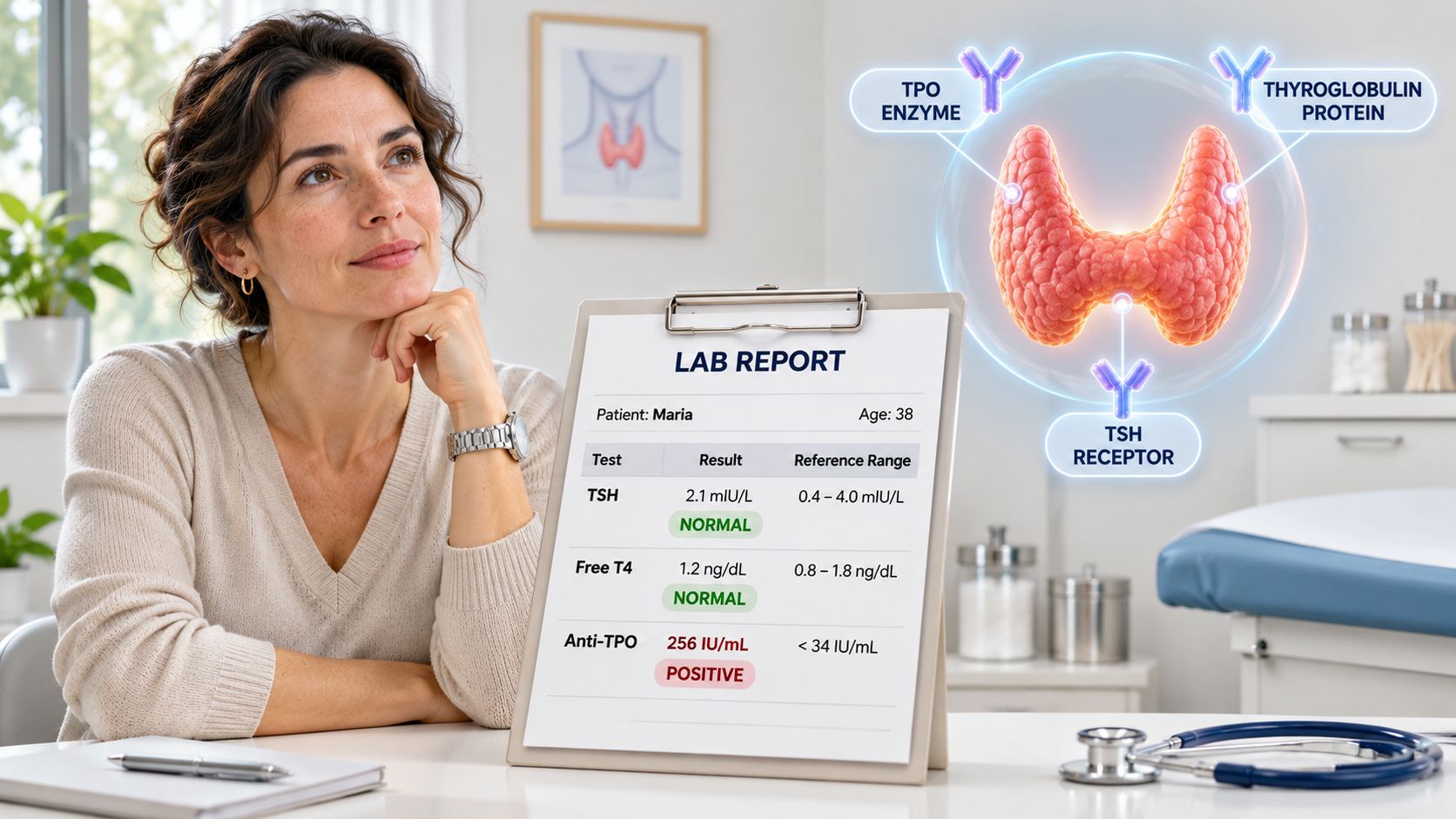
Maria is 38 and has been exhausted for a year. Her GP orders thyroid function tests. Her TSH is normal, her free T4 sits mid-range, and her anti-TPO comes back positive. She opens the report expecting a diagnosis and finds a word she didn't order: autoimmune.
What she has is a marker. The immune system can tag the peroxidase enzyme your thyroid uses to build hormone, the thyroglobulin protein that stores it, or the receptor that receives the pituitary's signal. The blood test counts those tags. What it can't tell you is whether the tags have done any harm, because tagging tissue and damaging it are two different events. Antibodies can circulate for years while hormone levels stay put.
An antibody result works like a smoke alarm. It confirms that something set it off. It says nothing about whether there's a fire, how large it might be, or whether anyone needs to respond. TSH and free T4 describe what your gland is producing today. Antibodies describe whether your immune system has the gland in its sights.
How common is a positive result in healthy people
Thyroid antibodies occur more often than generally anticipated, and considerably more often in women. Australian research on thyroid hormones and antibodies reports that approximately 10-15% of the Australian population carries them. In one Australian cohort, TPO antibodies appeared in about 11% of people with no prior thyroid disease history and thyroglobulin antibodies in about 5%.
Background thyroid antibody prevalence in Australia
| Group | Antibody | Reported Prevalence |
|---|---|---|
| General Australian population | Any thyroid antibodies | About 10-15% |
| People with no thyroid-disease history (cohort) | Anti-TPO | About 11% |
| People with no thyroid-disease history (cohort) | Antithyroglobulin | About 5% |
| Euthyroid individuals (normal hormone levels) | TPO or thyroglobulin | A substantial minority |
Australian clinical guidance adds the context that matters most here: in people whose hormone levels are entirely normal, positive antibodies generally don't require treatment. A positive result alongside a normal TSH and free T4 usually leads to monitoring, and monitoring is often the entire plan. That single fact should reframe how a report like Maria's gets read.
Three things a positive result doesn't mean
- It doesn't mean you have Hashimoto's. It means your immune system is targeting thyroid tissue. Hashimoto's is a clinical and biochemical diagnosis built from hormone results, symptoms and examination, and a positive TPO alone can't deliver it.
- The number doesn't measure how bad you feel. Antibody titres aren't a stand-in for symptom severity. Someone with a modest result can feel dreadful; someone with a high one can feel fine. Fatigue has a long list of causes, and the antibody figure ranks none of them.
- A bigger number doesn't mean faster treatment. Treatment decisions rest on hormone levels and clinical context. No antibody value, however high, triggers a prescription on its own.
What a positive result does change
It changes your monitoring schedule, because autoimmune risk means hormone levels deserve periodic rechecks rather than a once-in-a-decade glance. It changes the conversation if you're planning a pregnancy. And it should prompt a proper symptom review. If the antibodies aren't behind Maria's fatigue, something else is, and that something is worth finding.
Practical rule: an antibody result means something in the company of TSH, free T4, your symptoms, your medications and your pregnancy status. Read alone, it misleads.
One more caution. Reference ranges differ between laboratories and between assay methods, so a number that looks alarming on one report can be unremarkable on another. Read yours against the range printed on the same page.
Matching the Test to Your Blood Pattern
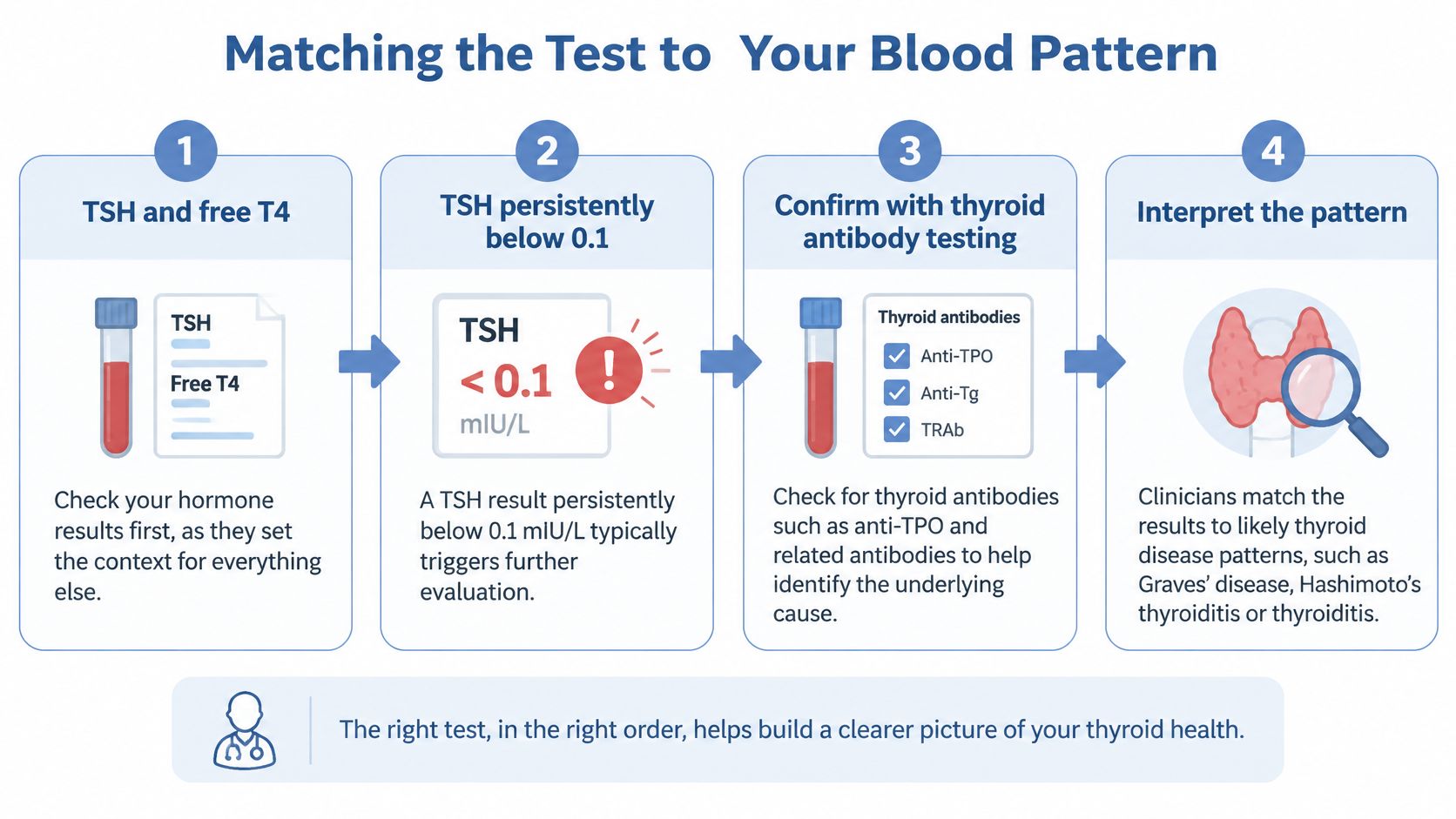
Clinicians don't order antibodies first and hormones second. They work from the hormone pattern outward, because that's the only sequence where each result has a question attached to it. Here's the order, and the reason for each step.
- Start with TSH and free T4. These set the context for everything else. TSH moves before free T4 does when the gland starts to drift, so an in-range TSH makes significant dysfunction unlikely and an abnormal one tells you where to look next.
- If TSH is persistently below 0.1 mIU/L, consider TRAb. A suppressed TSH with a high free T4 is the classic overactive pattern, and the receptor antibody is the test that separates Graves' disease from a hot nodule or a bout of thyroiditis. It's also the test that avoids radiation, which matters in pregnancy.
- If TSH is raised with a low or low-normal free T4, test anti-TPO and anti-thyroglobulin. This is the underactive pattern, where you're checking whether an autoimmune process explains it. Both antibodies are usually requested together as a single "thyroid antibodies" order.
- If TSH and free T4 are both normal, antibodies are optional. They rarely change management on their own. If one comes back positive, it's a risk marker to monitor, not a diagnosis to treat.
That sequence matters more when you order testing yourself. A direct-access order arrives at the laboratory as an instruction, not a conversation, so the question you're asking has to be the right one before the blood is drawn. If you don't know which pattern you're checking, you can't interpret the answer.
Which antibody to consider for each hormone pattern
| Hormone Pattern | Antibody to Consider | What the Result Suggests |
|---|---|---|
| TSH persistently below 0.1 mIU/L | TRAb (TSH-receptor antibodies) | Elevated result supports Graves' disease; a negative result does not fully exclude it |
| TSH raised with low or low-normal free T4 | Anti-TPO and anti-thyroglobulin | Supports autoimmune hypothyroidism such as Hashimoto's |
| TSH and free T4 both normal, no clear symptoms | Usually none | Antibodies alone rarely change management |
| TSH and free T4 both normal, positive antibodies found | No treatment based on antibodies alone | Autoimmune risk marker; follow-up depends on clinical review |
Watching how the picture is assembled helps. The video below follows the same logic from symptoms to laboratory findings.
A positive TRAb earns its place because it does something no other test does as cleanly. It confirms an autoimmune stimulatory cause for thyrotoxicosis, which means the diagnosis can often be settled from blood rather than from a radioactive iodine uptake scan.
When a Negative TRAb Result Is Not Enough
TRAb testing earns its keep in two situations that come up more often than the textbook implies. The first is when Graves' disease is suspected but a radioactive iodine scan is unsuitable, as in pregnancy or breastfeeding. The second is an atypical presentation, including euthyroid Graves' ophthalmopathy, where the eyes show the disease while the hormone levels stay normal.
In both, the blood test does the work of imaging without the radiation. The Australian Family Physician review of evaluating and managing thyrotoxicosis reports that second-generation TRAb assays, using human TSH-receptor-coated tubes, achieve sensitivity of approximately 90-99% and specificity of 95-100% for Graves' disease. A positive result is therefore strong evidence of an autoimmune stimulatory cause, and it can reduce reliance on scans.
Then comes the part that trips people up. A negative result does not exclude Graves' disease. Up to 10% of affected patients have undetectable TRAb, most likely because the assay can't detect antibody at the concentrations present. The test is excellent at confirming. It's imperfect at excluding.
A negative TRAb is a closed door, not a locked one. It changes the route of the investigation; it doesn't end it.
For the mechanism behind the receptor test itself, this explanation of what TSH receptor antibodies measure and why the pattern matters is worth reading before your next appointment.
What to do while the picture is still open
When the antibody is negative and the clinical story still points to Graves' disease, the answer isn't to accept the negative and stop. It's to widen the evidence base.
- Line up the whole biochemical set. Read the result alongside TSH, free T4 and free T3 rather than in isolation, plus the symptoms and examination findings that made someone suspect Graves' in the first place.
- Ask whether the sample matched the moment. A result drawn at a different time from the hormone tests can leave gaps that get filled with guesswork rather than data.
- Move to imaging if uncertainty persists. Thyroid scintigraphy or specialist assessment is the appropriate next step, not a shrug.
- Repeat the test only if it changes the plan. A second draw at a later interval is reasonable when the diagnosis is unresolved; it's wasted effort when it's only reassurance.
A persistently suppressed TSH is a strong context in which to measure TRAb in the first place, so a negative result in that setting deserves scrutiny rather than acceptance. The rule is simple and it holds in both directions: a negative antibody result with ongoing diagnostic uncertainty calls for further investigation, never for automatic exclusion.
Thyroid Antibody Testing During Pregnancy
Pregnancy is where antibody interpretation becomes least forgiving of shortcuts, because the reference intervals themselves move. TSH and free T4 ranges shift with gestational physiology, and they differ between laboratories and between assay methods. A free T4 that looks low against a non-pregnant range can be entirely normal at 28 weeks.
That's why an isolated positive anti-TPO has to be separated from biochemical dysfunction. The Thyroid Foundation's guidance on pregnancy and thyroid health makes the point plainly: a positive TPO alone, with TSH and free T4 in the normal range for the trimester, is not by itself an indication for levothyroxine. The antibody is more valuable as an autoimmune-risk marker, particularly when clinicians are weighing suspected Hashimoto's, a borderline TSH elevation, or the chance of progression later.
Here's how to make the result usable rather than alarming.
- Record pregnancy status and trimester on the request. Without it, the laboratory can't apply the correct reference interval, and you'll be comparing your result to the wrong ruler.
- Pair anti-TPO with TSH and free T4 every time. The antibody describes risk; the hormones describe function. Treatment decisions hang on the second pair, not the first.
- Use the same accredited laboratory for serial monitoring. Methods and ranges differ between laboratories, so consistency keeps a trend readable and a change meaningful.
- Let hormone results and pregnancy-specific thresholds decide treatment. Symptoms matter, and so does specialist or GP review. Antibody status on its own doesn't settle it.
If you're planning a pregnancy or already pregnant and sorting out what to test, the women's health testing hub covers the panels that group these markers together so nothing gets ordered in isolation.
A positive TPO in pregnancy is a reason to book follow-up and keep it. It isn't a reason to start medication on antibody status alone.
Confirm the Next Step Before You Order
Every question about thyroid antibody testing collapses into one: will this result change your follow-up or your management? If the answer is no, the test adds cost and anxiety without adding information. Broader antibody testing isn't automatically better screening, and more biomarkers don't produce better answers when nobody has decided what would be done with them.
Healthdirect's explanation of thyroid function tests separates function testing from antibody testing for exactly this reason. Antibodies indicate an autoimmune process; thyroid status still depends on hormone results and clinical assessment. That gap is where patients with a normal TSH and a positive anti-TPO end up stuck, holding a result that signals increased autoimmune risk but doesn't prove treatment is needed or explain every symptom. Our guide to hormone testing in Australia sets out which markers belong together on one request.
Work through these before you order or repeat anything.
- Bring the reports together. The antibody page, the TSH and the free T4 belong in one conversation. Separate appointments produce separate, partial readings.
- Check which antibody was ordered. A routine "thyroid antibodies" request usually means anti-TPO plus anti-thyroglobulin. TRAb is a separate add-on used when Graves' disease is specifically suspected, and consumer explanations rarely make that distinction.
- Write down symptoms, medications and pregnancy status. These are the context that turns a number into a clinical picture, and they're the first things forgotten in a short appointment.
- Before repeating an antibody test, ask what would change. Once TPO or thyroglobulin positivity is confirmed, repeat measurement generally doesn't alter management.
A negative antibody result doesn't rule out thyroid problems either. Hormone results and symptoms still guide follow-up, and undetectable antibodies show up in people who nonetheless have disease.
Private testing is one route among several, and it's a legitimate one. At Vital iQ Health, you can order a private blood test online without a GP referral, choose from 41 pathology panels, attend a NATA-accredited collection centre near you, and receive results within 24 to 72 hours. Our laboratories are NATA accredited, and telehealth GP consultations are available to talk through what the numbers mean before you act on them.
Whatever route you take, an antibody result is one piece of a clinical picture. It isn't a diagnosis, and it was never designed to be read alone.
If you've been putting off testing because booking a GP appointment first feels like a hurdle, Vital iQ Health lets you order thyroid and hormone panels online without a referral and attend a NATA-accredited collection centre near you, with results back in 24 to 72 hours. Our panels include thyroid peroxidase and thyroglobulin antibody testing alongside TSH and free T4, so the antibody result arrives with the hormone context it needs. Visit Vital iQ Health to see the panels and arrange a telehealth GP consultation to interpret your results properly.