Blood Test Prices in Australia: What You'll Really Pay
Blood test prices in Australia depend on Medicare eligibility, bulk billing and test choice. See typical costs and how to avoid surprise bills.

Try to answer one simple question before you book a blood test: what will it cost? Most price pages give you a figure and stop. That figure is usually real, but it's rarely the whole bill, and often it isn't the amount you'll pay at all.
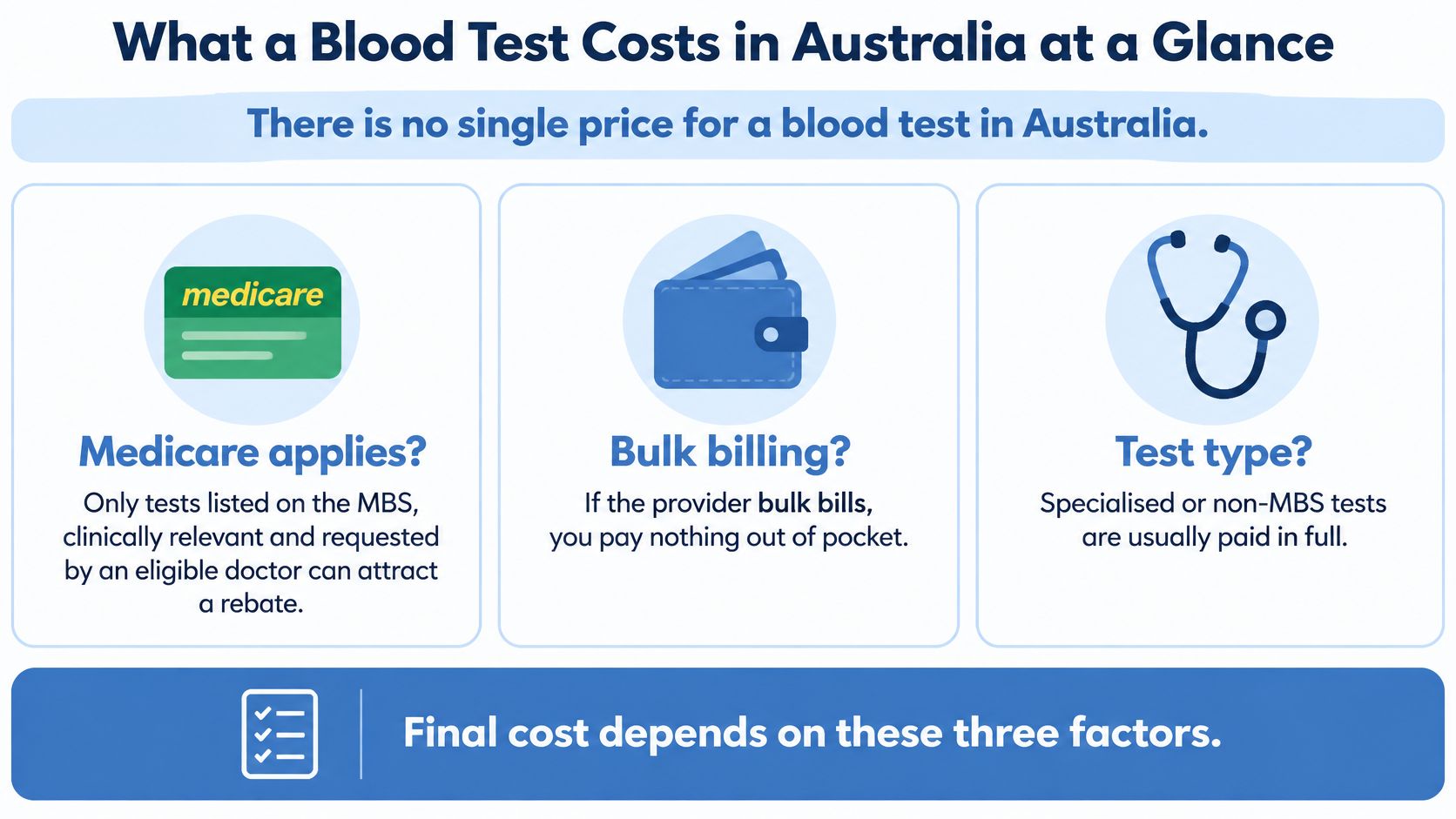
The same test can cost nothing, a small gap, or a few hundred dollars depending on three things that have nothing to do with the vial of blood. Whether the test sits on the Medicare Benefits Schedule. Whether the collection centre bulk bills. Whether you're buying a bundled private panel instead of a test your GP requested.
Two people can be tested for the same marker in the same suburb and be billed differently, and neither invoice is wrong. This guide unpacks each step so you can predict your own total before you commit, and spot a quote that leaves something out.
What a Blood Test Costs in Australia at a Glance
A blood test bill works like a dinner split between two payers. Medicare covers its share according to a fixed rule, and you pay whatever is left. How much lands on your side of the table comes down to three things: whether the test is Medicare eligible, whether the laboratory you attend bulk bills, and whether you are buying one GP-requested test or a bundled private panel.
The national figures show how uneven that split usually is. Between July 2025 and March 2026, total spending on Medicare-subsidised pathology, imaging and other diagnostic services reached A$9.8 billion, according to the Medicare statistics year-to-date dashboard. The Australian Government paid A$8.7 billion of that in Medicare benefits, while private patients paid A$1.1 billion out of pocket. Pathology alone accounted for roughly A$3.8 billion of subsidised expenditure, against A$5.3 billion for diagnostic imaging.
Read that as a ratio and the system makes sense. Roughly nine dollars in every ten spent on those services came from Medicare rather than from patients. For a routine test your doctor requested, most of the cost is settled between the laboratory and the government long before you are asked for a card. An out-of-pocket amount appears only when the laboratory does not bulk bill, or sets a charge above the Medicare benefit for that item.
The three ways a blood test gets billed
Every pathology purchase lands in one of three buckets, and the bucket decides who pays.
| Billing scenario | Medicare benefit | Typical patient cost | Key check before booking |
|---|---|---|---|
| Eligible and bulk billed | Full benefit paid to the provider | Nil | Confirm the collection centre bulk bills |
| Eligible but not bulk billed | Benefit paid to the provider | Difference between the provider's charge and the benefit | Ask for an itemised account and expected gap |
| Not Medicare eligible (private, self-funded) | None | Full charge for the test or panel | Ask for the total including collection and interpretation |
The middle row is where most confusion lives. A provider can bulk bill one item and privately bill another, so a "no gap" sign in the waiting room applies to the tests that provider bulk bills, not to every line on your request form. The same visit can produce a nil amount on one line and a gap on the next.
A price on a website answers a different question than the one you're asking. It tells you what that business charges. It doesn't tell you what Medicare will contribute, or what's left for you.
A 30-second check before you book
Run these in order and a wide price range collapses into one scenario.
- Is the test MBS-listed and requested by an eligible doctor? If yes, a rebate exists and the question becomes who receives it.
- Does this collection centre bulk bill this specific test? Ask about the item, not for a general assurance.
- Is anything bundled in? Collection, interpretation and a follow-up consultation can sit outside the headline test price.
Get those three answers and a written quote starts to mean something. Until then, a headline price tells you what a business charges and nothing about what you will pay.
MBS Fees for Common Blood Tests Explained
Medicare does not set a retail price for a blood test. It publishes a schedule fee for every listed item, and pathology items follow the same pattern as every other service on the register: the fee is the benchmark, the benefit is the payable portion, and laboratories remain free to charge above either figure. Two confirmed items show how the arithmetic works.
| MBS item | Schedule fee | Listed benefit (75% / 85%) | What it covers |
|---|---|---|---|
| 65060 | $8.25 | $6.20 / $7.05 | Haemoglobin, erythrocyte sedimentation rate or blood viscosity testing |
| 65070 | $17.80 | $13.35 / $15.15 | Red cell indices, platelets, leucocytes and instrument differential count |
What a schedule fee actually is
The MBS item listing for 65060 sets a schedule fee of $8.25 for haemoglobin, erythrocyte sedimentation rate or blood-viscosity testing, with listed benefits of $6.20 at the 75% rate or $7.05 at the 85% rate. The listing carries two benefit figures because the rate depends on the setting: hospital inpatients attract the lower percentage, while tests performed outside hospital attract the higher one. Either way, the fee is a benchmark for the service. Laboratories can charge above it.
The arithmetic is worth sitting with. A provider who charges exactly the schedule fee and chooses not to bulk bill leaves the patient paying the difference between $8.25 and the applicable benefit, a gap of a dollar or two. A provider charging $20 for the identical item widens that gap while the benefit stays exactly where it was. The benefit is fixed. The charge can climb.
Why a wider test carries a bigger item value
The full blood count falls under item 65070, which covers red cell indices, platelets, leucocytes and an instrument-generated differential count, and its listing sets a schedule fee of $17.80 with benefits of $13.35 or $15.15, roughly double the narrower item.
That is the whole mechanism. Expanding analytical scope raises the item value.
A bundled private panel covering a dozen markers therefore needs to be priced against the combined value of all those items. Holding a panel fee up against a single $8.25 benchmark is like pricing a consultation against a blood count.
How to read these numbers next to a quote
For any analyte outside this table, the same lookup works. Find the item on the MBS online register, note the schedule fee and the listed benefit, and hold both figures beside the quote you have been given. The benefit shows what Medicare contributes. The schedule fee shows what the service is benchmarked at. Whatever the provider charges beyond the benefit is the portion a non-bulk-billed patient carries.
Practical rule: stack the MBS value of every marker inside a private panel before judging its price. A panel fee only has meaning against that combined figure.
If a provider cannot say which MBS items a panel maps to, treat the quote as a single self-funded price and weigh it on that basis.
How Test Choice and Panels Change Your Total Bill
Cost per test and cost per episode are different numbers, and confusing the two is where health budgeting goes wrong.
The Australian Institute of Health and Welfare reported that in 2022-23, pathology patients who incurred costs paid an average of $76 per patient in non-hospital settings, or $23 per test, while hospital patients averaged $167 per patient and $20 per test, according to the AIHW pathology and diagnostic services report. Per test, hospital pathology looks cheaper. Per patient, it costs more than double.
That gap is the whole story. A per-test average flatters broad screening, because collection, consultation, interpretation and repeat testing all attach to the episode rather than to each individual marker. When you compare quotes, compare the episode total, not the per-marker figure.
How each ordering route affects the bill
| Ordering route | What is included | How the bill is set | Question to ask |
|---|---|---|---|
| Single test with GP referral | One clinically requested test | Medicare benefit plus any gap | Is this test bulk billed here? |
| Private panel | Bundled markers such as cholesterol, blood glucose, organ function and iron | Single self-funded price, Medicare may not apply | Does the total include collection and interpretation? |
| Custom biomarker profile | Chosen from more than 300 individual biomarkers | Total depends on the markers selected | Which markers do I need, and what is the full price in writing? |
| Hospital-based testing | Inpatient or outpatient pathology | Higher average out-of-pocket cost than non-hospital settings | Is this billed as hospital or community pathology? |
Budget by markers, not by price
The Standard Health Panel at Vital iQ Health covers cholesterol, blood glucose, organ function, iron levels and key health markers, a sensible baseline when you do not yet know what you are looking for. From there the catalogue widens to 41 pathology panels and over 300 individual biomarkers, which can be combined into a custom profile rather than bought one at a time.
Because a custom profile has no fixed price, the total depends on which markers you select. Ask for the full cost in writing before you order, so the figure you budget against is the one you will pay. If you are weighing a targeted bundle against a broad screen, a men's health check shows how related markers get grouped into a single panel.
Write your list first. Cholesterol, fasting glucose, ferritin, thyroid function, whatever applies to you. Then match that list to a panel and check nothing you need has been left out. A panel is easier to budget than six separate purchases, provided it covers what you require.
Medicare Eligibility and the Out-of-Pocket Gap
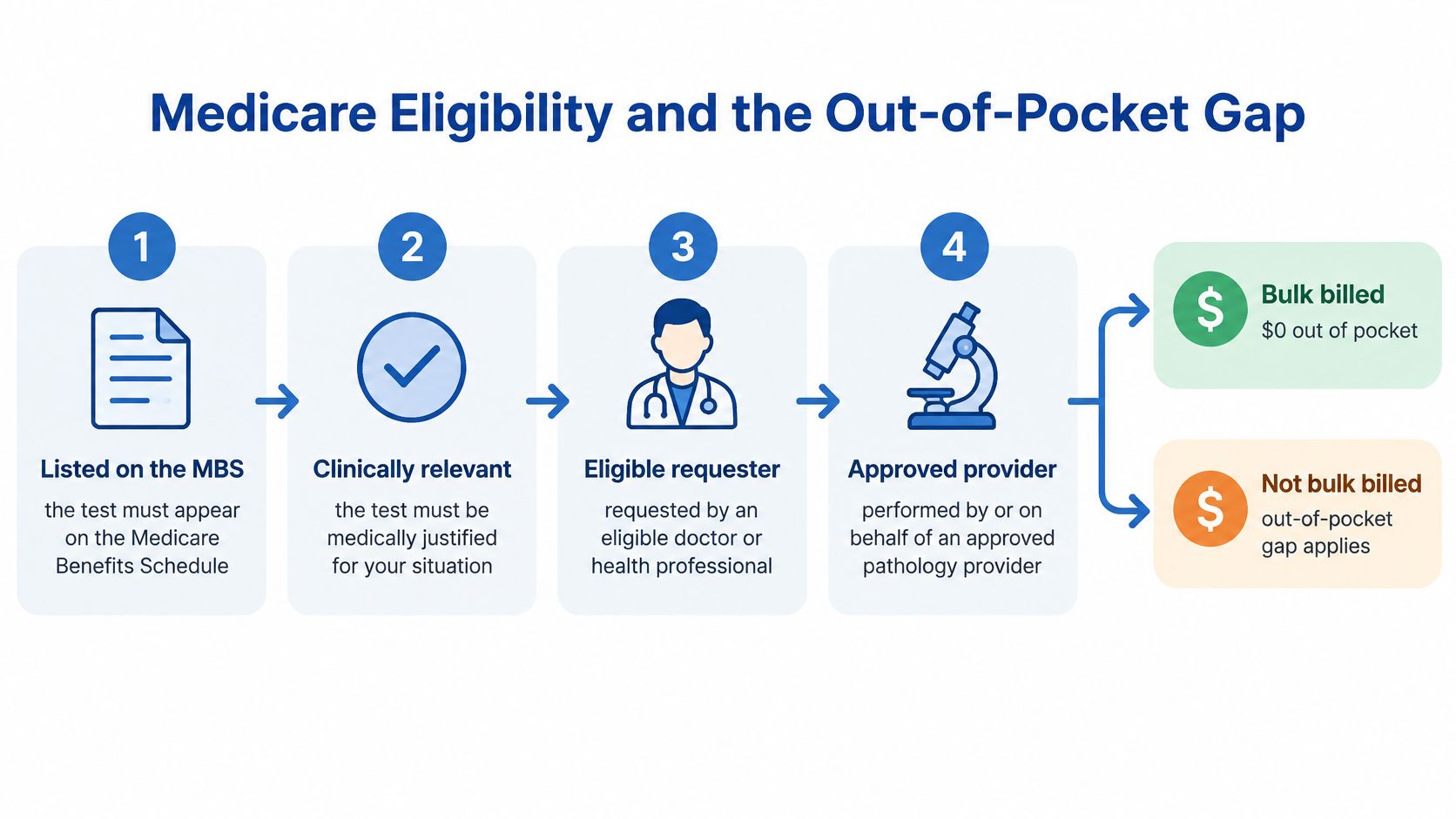
Medicare doesn't attach to a blood test just because a laboratory ran it. The Department of Health's pathology guidance sets out four conditions that must all be met: the service is listed on the MBS, it's clinically relevant, it's requested by an eligible doctor or health professional, and it's performed by or on behalf of an approved pathology practitioner in an accredited laboratory.
Miss any one and the patient can be liable for the full charge. Meet all four and a gap can still appear, because eligibility and bulk billing are separate questions.
Nationally, bulk billing is still the norm. The Medicare statistics collection recorded a bulk-billing rate of 75.6% in the July to March 2025-26 year to date, up from 75.3% in the comparable period, with 269.6 million services bulk billed. That's a national indicator, not a price for your test. It tells you three in four eligible services carry no patient charge, and one in four may.
The four checks that decide your gap
Work through them in this order before the needle comes out.
- Confirm the item exists. Ask which MBS item number applies and check it's listed and appropriate to your circumstances.
- Ask the collection centre directly whether it bulk bills that test for the reason you're having it done.
- Request an itemised account and the expected gap in writing if it doesn't. The Department of Health's guidance on out-of-pocket costs is clear that providers may charge above the Medicare Benefits Schedule fee, and that a patient who isn't bulk billed must be told about the out-of-pocket expense beforehand.
- Treat a non-rebatable test as a full-price purchase. Insurance testing, some genetic tests and tests tied to elective cosmetic procedures may attract no Medicare benefit at all.
That fourth point catches people out. A self-funded panel bought without a referral sits outside the Medicare pathway entirely, so its price has no reason to match the same biomarkers ordered through a GP. Private blood tests are available in Australia without a GP referral, and the cost of that convenience is bearing the full price yourself.
Two more things shift the final amount. Medicare Safety Net assistance can reduce costs once eligible out-of-pocket spending passes the relevant threshold, but it isn't an automatic refund at the counter. And blood tests not covered by Medicare follow their own pricing rules entirely. A headline price that excludes collection, consultation or interpretation is only the first instalment of the answer.
Worked Examples of a Blood Test Bill
Three calculations you can repeat with your own quote.
Example 1: a narrow item, three ways. Haemoglobin, ESR or blood-viscosity testing sits at a schedule fee of $8.25 with a $6.20 benefit at the 75% rate. Bulk billed: you pay nothing. Charged at the schedule fee without bulk billing: you pay $8.25 minus $6.20, which is $2.05. Charged $20 without bulk billing: you pay $20 minus $6.20, which is $13.80.
Example 2: a broader item. The full blood count-type service has a schedule fee of $17.80 and a $13.35 benefit at 75%. A provider charging $25 without bulk billing leaves a gap of $25 minus $13.35, which is $11.65. The gap, not the schedule fee and not the benefit, is what leaves your account.
Example 3: the episode behind the average. An average of $76 per patient against $23 per test implies roughly three to four tests' worth of charges billed per patient. Order one marker and you're near the bottom of that range. Order a broad screen plus a repeat, and you're at the top.
Rebuilding your own total
Add these four lines and you'll usually land within a few dollars of the invoice.
- Charge per marker, multiplied by however many markers the panel contains.
- Collection fee, if the centre charges one separately.
- Consultation or interpretation fee, if a clinician reviews results with you.
- Repeat test cost, which you should assume for any abnormal result before a diagnosis is settled.
If the total can't be put in writing, the quote is incomplete.
A provider who can give you that number has done the work. A provider who can't is quoting a marketing figure, and you'll meet the actual charge at the counter.
Get a Written Quote Before You Book
Five questions to put to any provider, in this order, before you pay anything.
- Is this test or panel Medicare eligible? If the answer is no, stop treating it as a subsidised service.
- Is it bulk billed at the collection centre I'll attend? Eligibility and billing are different questions, and the answer can change by location.
- Does the quoted price include collection, consultation and interpretation? Get the inclusions listed line by line.
- What would a repeat test cost if a result comes back abnormal? This is the most common unplanned cost in pathology.
- When will results be available? Timing affects whether you need to take time off work and whether a follow-up appointment is billed separately.
If you order through Vital iQ Health, the same five apply. Tests are ordered online without a GP referral, you attend a collection centre from any of the major pathology networks near you, and results generally arrive within 24 to 72 hours. All our laboratories and collection centres are NATA accredited, so you can verify accreditation directly rather than taking a website's word for it. Booking privately without a referral is covered in more detail in this guide to a blood test without referral.
One rule to apply today
Buy the smallest thing that answers your question. A single test when one marker settles it. A panel when several markers only make sense read together. And the total payable confirmed in writing before you attend.
That rule protects your wallet in both directions. It stops you paying for twenty markers when two would do, and it stops you buying markers one at a time at a higher cost per episode than the panel would have been.
If you'd rather not wait for a GP appointment to start, Vital iQ Health lets you order private blood tests online, choose from 41 pathology panels or build your own profile from over 300 individual biomarkers, and attend a NATA-accredited collection centre near you. Results generally come back within 24 to 72 hours, with the option of a telehealth GP consultation to talk through what the numbers mean. Compare panels and check the total payable before you book at Vital iQ Health.