Blood Tests Not Covered by Medicare Australia Explained
Blood Tests Not Covered by Medicare Australia: learn the eligibility rules, billing options and what to check before paying privately.
Many assume that if an Australian laboratory can run a blood test, Medicare will fund it. That assumption is the gap. A package title is not what Medicare funds. The individual item on the request is.
Blood tests not covered by Medicare Australia show up more often than the form suggests. An insurance screen, a cosmetic-surgery workup, or a wellness marker added "while you are here" can be a full private fee, even when the test beside it is rebated. The useful skill is sorting each line before anyone draws blood.
Which Blood Tests Medicare Does Not Cover
A blood test is Medicare-funded only when it meets specific rules, so plenty of tests are fully patient-funded. The brochure name is not the test Medicare assesses.
The case the scheme was built for is narrow and practical. A GP or specialist requests a test that is clinically relevant to your treatment, that test has an eligible Medicare Benefits Schedule item, and an approved pathology provider performs it. Hold that baseline, then look for the situations that fall outside it.
Sort the situation on your form
| Situation | Medicare outcome |
|---|---|
| Clinically relevant test requested by a GP or specialist, with an eligible MBS item | Benefit payable, subject to the provider's billing |
| Test requested for insurance purposes | No Medicare benefit; full fee |
| Testing associated with elective cosmetic surgery | No Medicare benefit; full fee |
| Some genetic tests | No Medicare benefit for those tests; full fee |
| Preventative screening test with no MBS item or no valid request | No benefit unless the individual item qualifies |
| Test on a GP request beyond the three most expensive tests in one day | Not rebated; full fee or private charge |
| Same tests requested by a specialist | Benefit payable; no three-test cap |
Insurance testing, testing linked to elective cosmetic surgery, and some genetic tests can carry no Medicare benefit at all. You pay the laboratory's full fee. "Some" is doing real work for genetics. A genetic test is not automatically out, and it is not automatically in. Only the item written on the request settles it.
Preventative screening is where the surprise usually sits. You can feel well and still want a baseline. An individual screening test with no MBS item, or with no valid clinical request, will not qualify, even when the laboratory is glad to run it. Wanting the information is reasonable. It is not, on its own, the request Medicare uses.
One limit hides on a busy GP form. If a GP requests more than three tests on the same day, only the three most expensive sit in line for a benefit. Tests past that point on the same request are not rebated. The same list from a specialist is not subject to that cap.
Practical rule: Check each test on your request, not the name of the package. Mark every line as covered, partly covered, or full fee before you agree to the collection.
How Medicare Decides Whether a Test Qualifies
Treat every blood test as its own schedule item, not as a named package. A panel title works like a set menu. Each analyte is listed separately, and only an item that is on the schedule can attract a benefit.
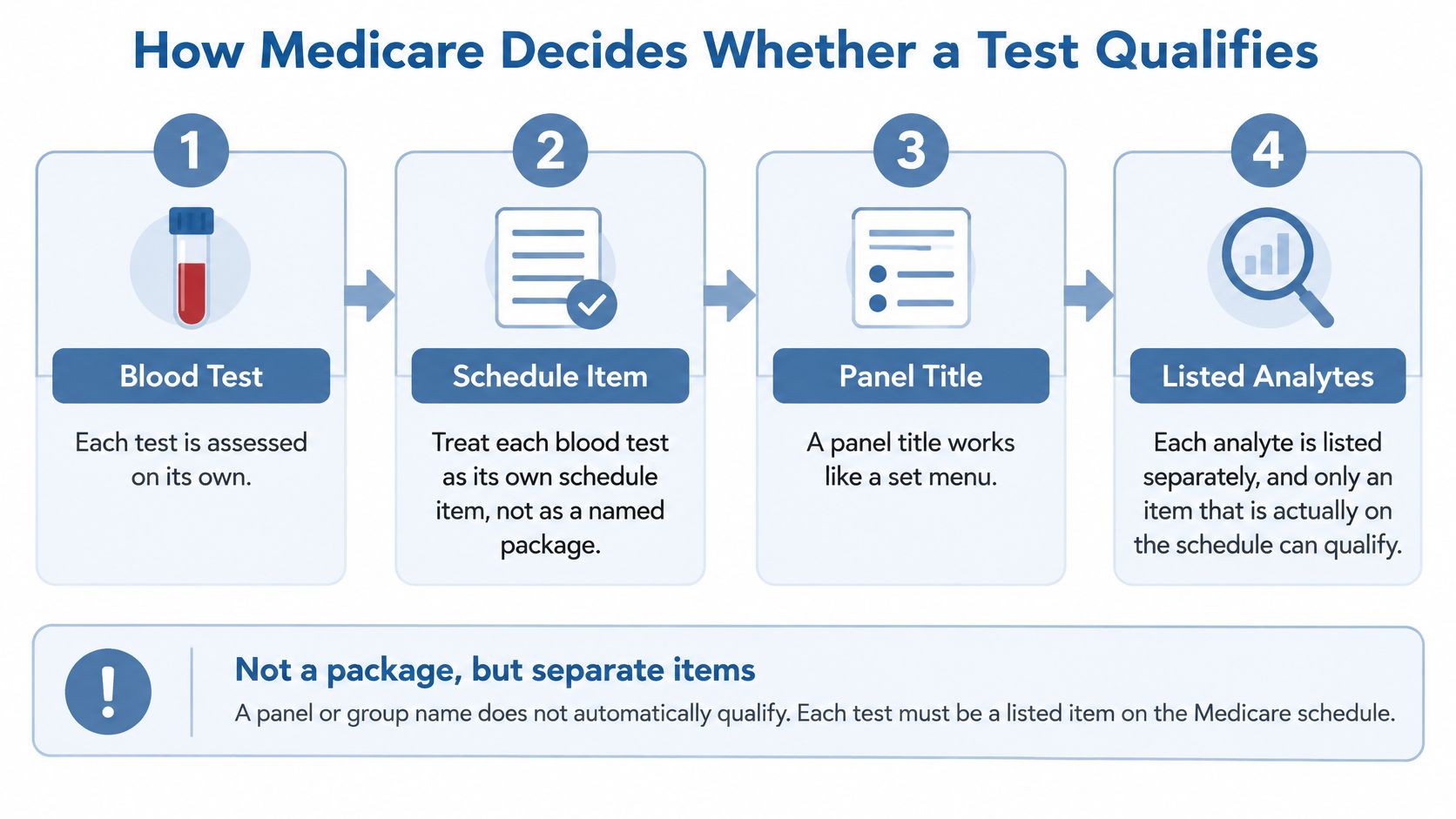
Services Australia is clear that coverage is not automatic. A single test qualifies only when all three conditions are true.
- It is an eligible service in Category 6 of the Medicare Benefits Schedule. If it is not listed there, there is nothing for Medicare to pay.
- An eligible doctor, or another permitted health professional, requests it under the rules for that item, and the request is clinically relevant. Medicare is built to fund services generally accepted as necessary for appropriate treatment, not every biomarker someone can order.
- An approved pathology practitioner performs it, or has it performed, in an accredited laboratory. A collector in a shopping-centre room still has to be tied to that approved provider.
The same analyte can pass or fail
Say your GP requests a thyroid test because you have been exhausted for months, your weight has shifted, and the GP wants to investigate. That request is the clinically relevant care the schedule is designed to fund. If the item is eligible and the laboratory is approved, a benefit can be payable.
Now put the same thyroid test on a general wellness screen that nobody has requested for a clinical reason, with no matching item descriptor. The tube of blood is identical. The Medicare position is not. That test does not qualify, and you fund it yourself.
Run one analyte on your own form through those three conditions before you treat a package name as a rebate. A prostate check is a good rehearsal for this habit, because PSA screening in Australia is often discussed as if the test name alone decided the funding. It doesn't. The item, the request, and the provider still have to line up.
GP and Specialist Requests That Change the Rebate
A blood test is not rebatable just because an accredited laboratory runs it. Under the Medicare Benefits Schedule, payment generally requires a clinically relevant service, requested by an eligible doctor or other permitted health professional, and performed by or on behalf of an approved pathology practitioner in an accredited laboratory. The Australian Government pathology guidance puts the requester at the centre of that rule.
Who is allowed to request the test
| Requested by | Requirement | Medicare effect |
|---|---|---|
| GP | Clinically relevant, eligible MBS item | Benefit payable; only the three most expensive tests on the same day |
| Specialist | Clinically relevant, eligible MBS item | Benefit payable; no three-test cap |
| No eligible doctor or permitted health professional | Request does not meet MBS rules | No Medicare benefit; full fee |
Privately ordered preventative or wellness testing can be fully patient-funded when it misses an item descriptor or a valid clinical request. Rules apply to each pathology item, not to the commercial name printed above the list.
What the three-test cap does to a real form
Even where tests are eligible, Medicare may cover only the three most expensive tests when a GP requests more than three on the same day. A specialist request is not subject to this limit.
Say a GP writes five tests for one day: a cholesterol panel, glucose, iron studies, vitamin D, and a thyroid test. Only the three highest-priced items draw a benefit. The other two are not rebated, even though each one might have qualified on its own. Ask the GP how the request is structured, and which tests the GP considers clinically necessary. Don't try to split the form yourself to get around the rule. The GP is the person who has to stand behind the clinical reason.
Before the GP writes the request, ask:
- Which tests are clinically necessary? Drop anything that is only there because the panel usually includes it.
- How many tests are on this day? If there are more than three, ask which three are the most expensive and what happens to the rest.
- Could a specialist request change the shape? That question matters for a longer hormone testing workup, where several related markers often land on one form.
- Will you note the reason on the request? A clear clinical reason is what the item rules look for.
Bulk Billing, Gap Fees and Full Fees Explained
Eligibility and the bill are separate decisions. A test can qualify and still leave you with a gap, because billing is the provider's choice.
| Billing outcome | What the patient pays | What to confirm |
|---|---|---|
| Bulk billed | Nothing; the Medicare benefit is accepted in full | Confirm the provider bulk bills before collection |
| Gap payment | The difference between the provider's fee and the benefit | Ask for the gap amount per test |
| Full private fee | The entire fee; no Medicare benefit | Ask for a written cost, which the provider must give before testing |
Bulk billing means the collection centre or laboratory accepts the Medicare benefit as full payment. You pay nothing for that service. It is not an entitlement you can demand. One centre bulk bills a thyroid test and the centre two suburbs away privately bills the same item.
A gap payment appears when the provider charges more than the benefit. Medicare pays its share and you pay the difference. Ask for that difference per test, not as one blended figure for the visit. A single total hides which line is expensive.
A full private fee applies when no Medicare benefit attaches to the service. The provider must tell you the out-of-pocket cost before the test is performed. If nobody has named a figure, you have not been given the information the rules require.
Questions worth asking at booking
- Is each test bulk billed? Get a yes or no against each analyte, not against the visit.
- What is the gap on each test that isn't? Write the amount next to the name.
- Is this an eligible request? A polite collector can still process a form that will not attract a benefit.
- Can I have the cost in writing? A written list is what you compare.
Fees differ between collection providers, so the same tests can cost different amounts. Take one written list of analytes and ask two centres to price that exact list. Don't compare a "health check" at one centre with a differently built panel at another.
For any single test, your cost is the provider's fee minus any Medicare benefit. A bulk billed test costs you nothing extra. A test with no benefit costs the entire fee. Add those lines and you have the visit, without guessing.
Private Panels Are Not Always Medicare Items

A panel is a commercial bundle. It is not an MBS item. A general screening panel might include cholesterol, glucose, liver and kidney function, and iron markers. Some of those markers can have their own items. Others don't. Medicare applies at the individual pathology-item level, so a panel with two eligible markers and five ineligible ones is mostly a private fee. One eligible line does not subsidise the rest of the bundle.
A men's health panel, marker by marker
Take a men's health panel covering hormones, heart health, liver and kidney function, and general wellbeing. A liver test requested because the GP is investigating abnormal symptoms, alcohol history, or a medicine that affects the liver can attract a benefit, or a gap if the centre doesn't bulk bill. A wellness hormone profile ordered with no clinical request, and with no matching item, is the full private fee. Heart markers split the same way. A cholesterol test tied to a treatment decision is a different Medicare question from a broad wellbeing add-on.
That split is why preventative screening often sits outside the scheme. Medicare funds services generally accepted as necessary for treatment. A personal baseline is a different purpose, and custom profiles built from many individual markers can hold a larger number of full-fee items than a short clinical request.
Read the item list, then separate likely-eligible markers from likely-private ones before you pay. The panel name will not do that sorting for you.
The same habit helps when you are watching a result over time rather than chasing a diagnosis. A short clinical list and a long private list can both be reasonable. They just should not be priced as if they were the same thing.
What to Check Before You Pay Privately
A surprise bill usually means one question was skipped at the counter. Work through these before you pay, and take the request form, your Medicare card, and a written list of the tests into the appointment.
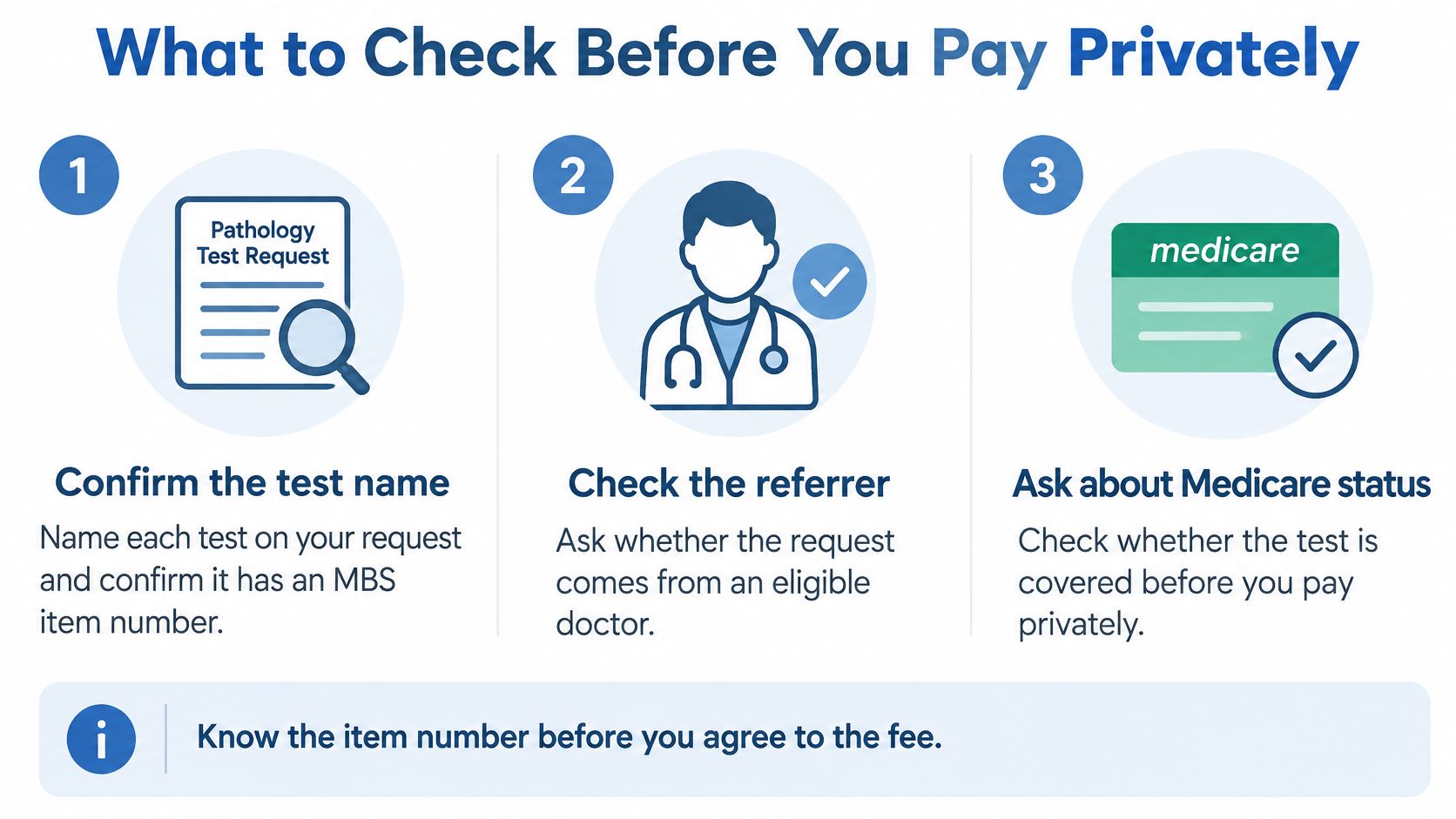
- Name each test and confirm an MBS item number. A package title cannot be billed. Only a listed item can, so an unnamed "screen" is a warning.
- Ask whether an eligible doctor requested it, and whether it is clinically relevant. A form with no permitted requester fails the rules even if every analyte exists on the schedule.
- Count the tests on a same-day GP request. More than three means you should know which lines may be left off the rebate before you sit down.
- Ask whether collection is bulk billed or carries a gap, and the gap for each test. One total for the visit hides the expensive line.
- Request a written cost estimate that lists every test. Verbal "about the usual" is not something you can compare later.
- Confirm the laboratory is NATA accredited and the provider is approved. Accreditation is what makes the result usable in ordinary clinical care, separate from whether a benefit is payable.
- Ask your GP whether a clinically indicated test exists that is eligible. Sometimes the marker you wanted for curiosity has a funded cousin that answers the clinical question.
Each question stops the bill that arrives after the blood is already drawn. That bill looks like a laboratory invoice for analytes you thought were included, with no benefit against the lines that had no item, no valid request, or sat past the GP cap. If you are weighing private blood tests on purpose, the written estimate is the document that tells you the choice was informed.
If the counter cannot name the item number and the cost for each line, don't proceed that day. You can book the same tests once those two facts are on paper.
Decide Whether a Private Blood Test Is Worth It
Use one named test and a simple rule, rather than a general feeling about "getting everything checked".
Start with a GP when the test is clinically needed and has an eligible MBS item. A bulk billing provider accepts the benefit as full payment, so you pay nothing for that service. A private bill means a gap, and that gap has to be stated before collection. This route needs an appointment and a clinical reason. A GP request of more than three tests on the same day can leave the lower-priced items unrebated, so keep the list tight.
Pay privately when the test is a personal wellness check with no MBS item, or when a GP will not request something that is not clinically indicated. Those analytes are the full fee no matter which laboratory runs them. Private blood tests are available in Australia and don't require a GP referral. You can order online without that referral, choose from 41 pathology panels, attend a NATA-accredited collection centre, and receive results within 24 to 72 hours. Our laboratories are NATA accredited, and so are the collection centres.
The decision rule is short. Clinically needed and eligible means use the GP request first. No item and no clinical need means budget for the private fee and get every analyte priced in writing before collection. You can take a private report to a GP afterwards for interpretation. It does not turn an unfunded test into a funded one after the fact.
Your next step is a written cost for each test on the list, then the route the rule selects.
If you already know the test is a personal check rather than a funded clinical request, Vital iQ Health lets you order private pathology online and attend an accredited collection centre, with results you can take to your own GP. That path suits screening and monitoring where Medicare was never going to pay. See the panels and how ordering works at Vital iQ Health.