Mens Health Check: What to Test by Age and Why
A Mens Health Check explained for Australian men: age-based screening, key blood tests, heart and prostate decisions, and GP follow-up.
8.5% of Australian males had known or newly diagnosed diabetes in 2022 to 2024, compared with 4.7% of females, according to the Australian Bureau of Statistics National Health Measures Survey. Measured data like that is why a men's health check is worth doing deliberately rather than quickly.
Most check-up advice online reads as a shopping list of blood tests. A useful check is closer to a set of decisions: which tests your age and risk justify, how each result should be read, and what happens if one comes back abnormal. More markers don't automatically mean better prevention. Fewer, well-chosen tests with a clear follow-up pathway beat a broad panel that turns up something incidental and leaves it hanging.
Screening Schedule for Men by Age
A screening schedule answers three questions: which checks apply at your age, how often each one repeats, and what decision each result feeds into. The bands below set out that sequence for Australian men.
The case for following it sits in the national data. 40% of all deaths among Australian males are premature, meaning before age 75, and males account for 62% of all premature deaths, according to the Australian Institute of Health and Welfare. The institute's figures also show that in 2023, coronary heart disease was the leading underlying cause of male death, at 10,343 deaths, or 11% of all male deaths.
Life expectancy tells the same story in two numbers. The AIHW reports that males born in 2021 to 2023 could expect to live to 81.1 years, against 85.1 years for females, a gap of about four years. Its long view adds context: males born in 2019 to 2021 could expect to live around 30 years longer than males born in 1891 to 1900, which is what a century of consistent prevention and better care looks like.
Government guidance sets Medicare Benefits Schedule health checks for men aged 45 and over, and bowel cancer screening every two years begins at 45 under the National Bowel Cancer Screening Program. The bands fold those programs into the intervals Australian guidance sets for blood pressure, lipids and the prostate discussion.
Reading the Bands
| Age band | Core checks | Repeat interval | Decision to discuss |
|---|---|---|---|
| 18-34 | Blood pressure | Every 2 years | Family history of early heart disease, smoking, weight |
| 35-44 | Blood pressure; lipid check from 35 for Aboriginal and Torres Strait Islander men | Blood pressure every 2 years | Earlier lipid check if at higher risk |
| 45-49 | Heart Health Check (MBS); lipids; blood glucose; bowel screening eligibility | Lipids every 3 years; bowel test every 2 years | Five-year heart risk and family history |
| 50-69 | Bowel screening; PSA only after informed discussion | Bowel every 2 years; PSA every 2 years if chosen | PSA benefits and harms, life expectancy |
| 70-74 | Bowel screening; blood pressure and cardiovascular review | Bowel every 2 years; blood pressure every 2 years | Whether PSA is still worth discussing |
| 75 and over | Blood pressure and cardiovascular review; symptom-led bowel assessment | Blood pressure every 2 years | Symptoms, other conditions and life expectancy |
The last column is where the schedule earns its keep. Every band ends in a decision to make with a GP, and the right answer changes with age and risk. One point trips people up here: screening is for men without symptoms. Once a symptom exists, the question shifts to assessment, which is why the oldest band is symptom-led instead of another routine test. Past 75, life expectancy and other conditions weigh more heavily in each choice.
Practical rule: if a row doesn't apply to you, ask why not. A check that deliberately rules things out is worth more than one that adds tests by default.
Use the table as a prompt rather than a prescription. Find your band, then note anything that moves you earlier: a first-degree relative diagnosed with heart disease young, a father or brother with prostate cancer, or a symptom that is new and unexplained. Take it to the appointment and ask the GP to mark which rows apply, which don't, and when each repeat is due.
Core Blood Tests and What They Show
A men's health check isn't a fixed bundle at a fixed price. It's a set of tests chosen for the man in the room, and the choosing is the clinical work. Two men of the same age can leave with different panels, and that's a feature rather than a failure of consistency.
Glucose earns its place in most panels. Type 2 diabetes often develops without symptoms, and in men it tends to arrive alongside high blood pressure and abnormal lipids, so finding it early changes several decisions at once.
The Core Panel, Test by Test
| Test | What it shows | Why a GP may order it |
|---|---|---|
| Lipid profile | Total cholesterol, LDL, HDL and triglycerides | Part of five-year heart risk, read with other factors |
| Glucose (fasting or HbA1c) | Blood sugar over time | Screens for diabetes, which affects men more than women in Australia |
| Kidney function (creatinine, eGFR) | How well the kidneys filter | Early change and medicine dosing |
| Liver enzymes (ALT, GGT) | Liver cell stress | Alcohol use, medicines and supplements |
| Full blood count | Red and white cells, platelets | Anaemia, infection or bleeding |
| Iron studies (ferritin) | Iron stores | Fatigue, anaemia or possible blood loss |
| Thyroid function (TSH) | Thyroid hormone activity | Fatigue, weight change, or changes in heart rate or mood |
| Vitamin D | Stored vitamin D | Only when symptoms or risk suggest it |
Fasting glucose and HbA1c answer slightly different questions. A fasting sample captures one moment; HbA1c reflects average blood sugar over the previous two to three months. When a single fasting result sits near the top of the range, HbA1c usually settles the question.
Prostate-specific antigen sits outside this list on purpose. PSA isn't a marker you bolt onto a panel; it's a decision that depends on a conversation about benefits and harms, and it has its own pathway below. Vitamin D deserves the same restraint, belonging in a check when there are symptoms, low sun exposure, darker skin or another reason to suspect deficiency, not as a marker to repeat every few months.
Ask before you pay: which tests are being ordered, what each one is meant to find, and what happens if it comes back abnormal. A result with no action attached is a cost, not a check.
One more practical point on reports. Reference ranges are set by the laboratory that runs the test, so a figure that looks high on one report may sit inside the range on another. Keep each report with its own ranges, and take the previous one to the next appointment so the trend is visible.
Heart Risk Is More Than One Number
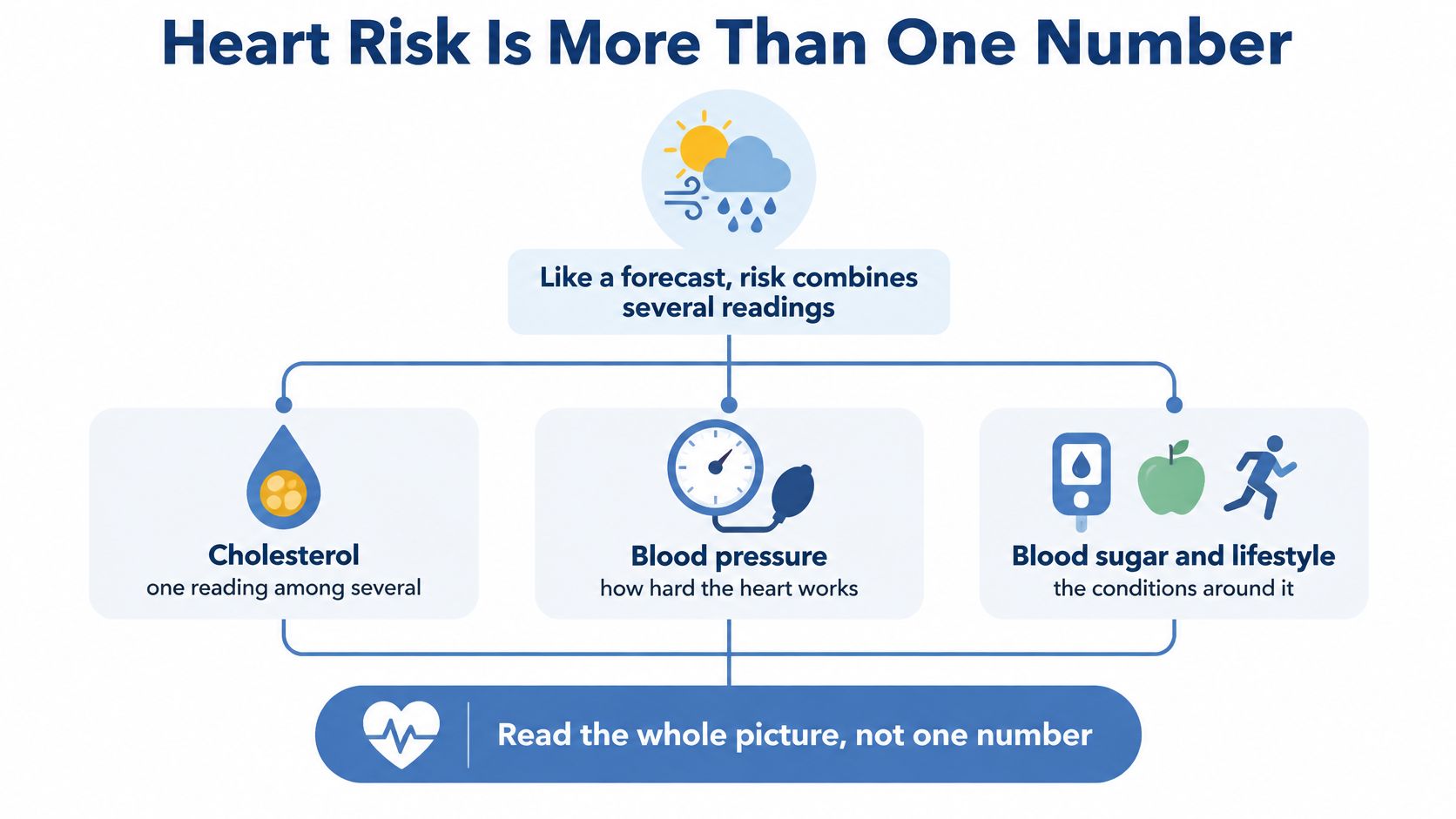
A forecast doesn't read one thermometer. It combines temperature, wind and humidity into a single statement about the day, which is why "18 degrees" tells you less than "18 degrees, windy, with a late shower". Heart risk works the same way.
A Heart Health Check assesses your five-year risk of a heart attack or stroke using medical and family history, lifestyle factors, blood pressure, cholesterol and blood glucose, as the Australian Government's review of health assessment services describes it.
Why One Number Isn't a Verdict
A modestly raised single marker can sit alongside low overall risk, and that combination is common in a man who is otherwise healthy. Read the other way, the combined effect of hypertension, dyslipidaemia, diabetes, smoking, age and family history can produce materially higher risk than any one of those numbers suggests on its own. Neither reading is possible from a cholesterol figure by itself.
What the GP Records Beside the Bloods
For the estimate to mean anything, the panel has to be paired with documented blood pressure, smoking status, diabetes status, kidney disease, ethnicity and family history. Those inputs are interpreted through a validated Australian absolute-risk framework rather than against one universal cholesterol cutoff that treats every man identically.
That's why a cholesterol result on its own is a starting point rather than an answer. The companion guide to cholesterol levels and what LDL, HDL and triglycerides mean takes the fractions apart separately.
How Often Results Get Repeated
Repeat testing is more frequent when results are abnormal or when overall risk is higher. Lower-risk men may need reassessment only every several years, and that interval should be written down at the visit rather than left to memory or to the next reminder text.
Two questions worth asking: what is my five-year risk, and which single factor would change it most if I moved it?
Those two answers turn a page of numbers into a plan, and they're worth more than the individual results feeding them.
Who Needs Different or Earlier Checks
A longer test list feels safer. It usually isn't. A broad panel can turn up an incidental abnormality that leads to repeat testing, imaging or a referral without ever changing what happens to you, and that's before the bill and the weeks of not knowing.
Risk isn't spread evenly, and screening has to reflect that. Recent Australian prostate guidance identifies higher-risk groups, including men with relevant family-history patterns, Black men of sub-Saharan African ancestry, and men with confirmed BRCA2 mutations, as the Prostate Cancer Foundation of Australia public consultation report sets out. For those men, the standard timetable is the wrong starting point, because their baseline risk sits where the average-risk schedule assumes it never will.

Sort Yourself Onto the Right Path
Six questions decide which tests get ordered and when. The size of the panel comes last.
- Ancestry. Some groups carry higher prostate cancer risk, which changes when and how testing is discussed.
- Family history. A first-degree relative with prostate, breast, ovarian or bowel cancer can pull testing earlier, and the ages at diagnosis matter as much as the cancers themselves. A father diagnosed in his early fifties is a different conversation from one diagnosed in his late seventies.
- Symptoms. Urinary change, erectile dysfunction or pain warrants a GP review at any age, rather than waiting for a routine check to come around.
- Age. The bands in the schedule set the default, not the rule.
- Other conditions. Kidney disease, diabetes and heart disease change which markers matter and how often to repeat them.
- Life expectancy. A test only helps if treatment could realistically follow it in a meaningful timeframe.
Get those six answers down first, and the right tests largely choose themselves.
Where a Standard Path Already Exists
Bowel screening shows what a settled pathway looks like. Eligible Australians with no bowel-cancer symptoms are sent a free home test kit through the National Bowel Cancer Screening Program on a regular cycle. It's built for people without symptoms, and it doesn't replace assessment when something is wrong. Prostate testing follows different rules entirely.
The review isn't only blood. A check that counts is judged by the decisions it supports: blood pressure measured at the visit, smoking and alcohol history taken properly, a mental-health screen, immunisation status, and bowel-screening eligibility confirmed. Each one maps to a concrete next step. A panel that skips all five hasn't done the job, however many markers it reports.
How to Act on a Raised PSA Result
Prostate testing is the part of a men's health check where the decision matters more than the test itself. Australian guidance doesn't support blanket population screening. Men aged 50 to 69 at average risk may be offered PSA testing every two years, but only after an informed discussion of benefits and harms, as the RACGP Preventive Activities in General Practice guidance sets out.
A PSA number works more like a smoke alarm than a verdict. It says something may need a look. It doesn't say what, or how serious, or whether anything needs doing about it. That gap between signal and answer is why the pathway below exists.
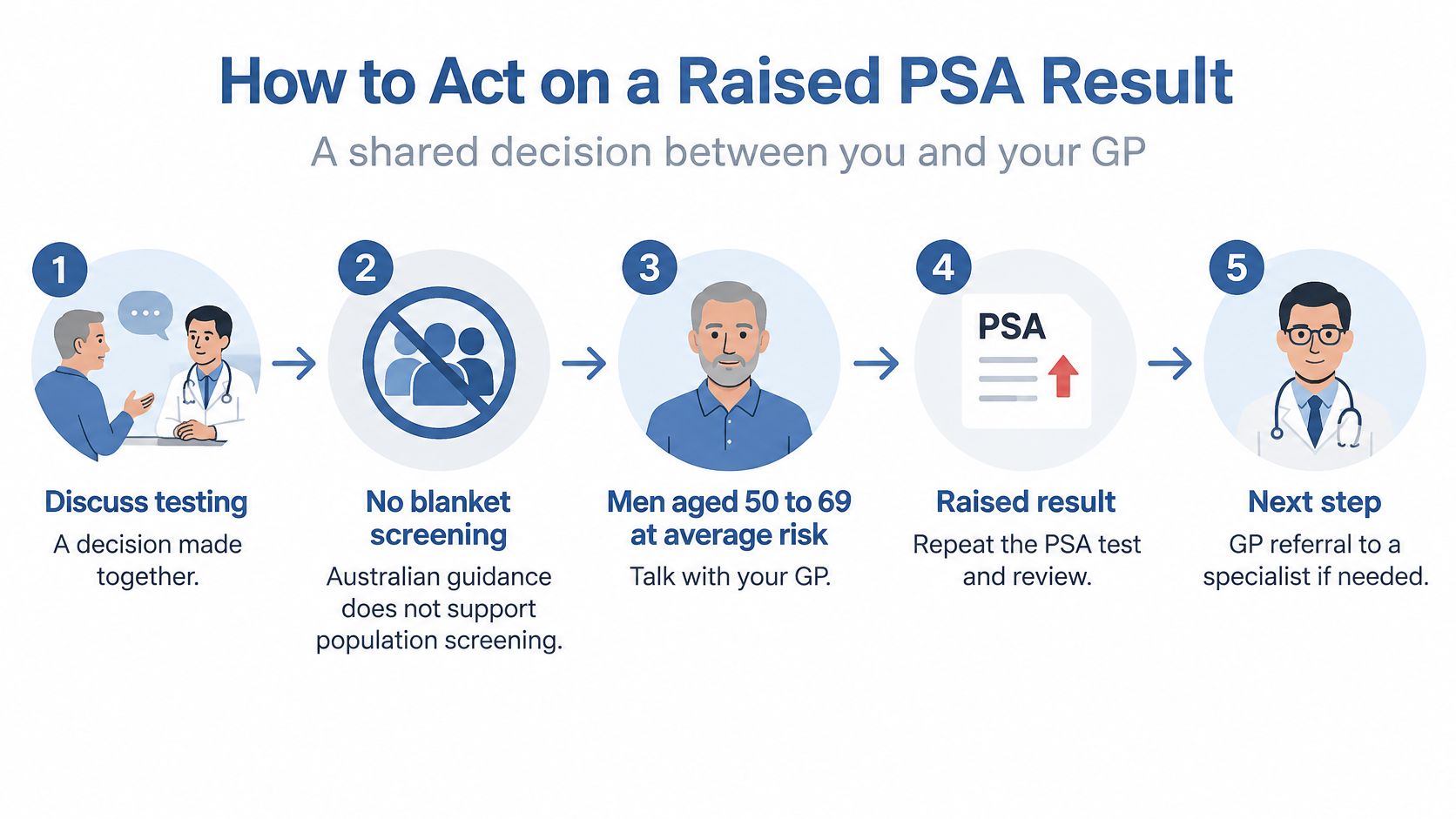
The Pathway From Result to Decision
- The discussion comes first. Informed choice covers what the test might catch and what a raised result would set in motion.
- A raised result gets repeated, not escalated. When total PSA sits above 3.0 ng/mL, RACGP guidance recommends repeating the test within 1 to 3 months. Infection, recent cycling, ejaculation and ordinary laboratory variation can all shift a single reading.
- Persistent elevation moves to specialist review. If the repeat confirms the rise, the GP weighs urology review and a prostate MRI.
- Biopsy is the only definitive diagnosis. A PSA number, however high, can't diagnose prostate cancer on its own.
- Some cancers are watched rather than treated. Low-risk cancers can be managed with active surveillance, which means monitoring on a schedule instead of operating immediately.
The arithmetic behind step two deserves a closer look. A false positive is a raised result that turns out to be nothing, yet it has still cost a repeat test, often a scan, sometimes a biopsy and a stretch of worry. Overdiagnosis is the quieter version: a cancer found that would never have caused harm, but which pulls a man into treatment anyway. Both are reasons the decision is shared rather than automatic, and both explain why adding more markers to a panel doesn't automatically improve prevention. Every extra test is another chance of a result that needs chasing.
What a Normal Result Doesn't Mean
A normal PSA lowers risk for the moment the sample was taken. It doesn't remove risk, and it doesn't rule out a cancer that isn't producing much PSA. Symptoms that appear later still need assessment regardless of an earlier normal result.
Family history shifts the timing rather than the logic. Men with a first-degree relative, such as a father or brother, diagnosed with prostate cancer are advised to start the conversation earlier, and the RACGP guidance linked above sets out how a higher baseline risk changes that discussion. What stays the same is the structure: talk first, test second, repeat before acting.
The alternative is not "no decision". Deciding not to test, with a plan to reassess if symptoms appear, is a legitimate choice. Deciding by default isn't.
If you'd rather hear the trade-offs spoken through than read them, this short video walks the same conversation.
Before any PSA test, take three questions to the GP: what's my baseline risk, what would a raised result trigger, and what changes if we don't test now? The companion piece on PSA screening in Australia covers how the guidance applies in more detail. Together, those answers turn a test into a decision.
Follow-Up Visits That Turn Results Into Action
A result only helps when someone acts on it, and that's where the pattern gets uneven. In 2025, around 78% of Australian male patients had seen a general practitioner during the previous year, compared with 87% of female patients, according to the Royal Australian College of General Practitioners. When follow-up is needed, many men are starting from further back.
Symptoms That Don't Wait for a Routine Check
A screening kit or a panel doesn't cover these. They need a GP appointment now:
- Rectal bleeding. Any bleeding, at any age, gets examined rather than watched.
- A persistent change in bowel habit. Looser stools, narrowing or increased frequency lasting more than a few weeks.
- Unexplained anaemia or weight loss. Both point to something worth investigating directly.
- Abdominal pain or bloating that persists. Especially when it's new and not settling.
A faecal occult blood test is a screening tool for people without symptoms and doesn't substitute for assessment when one of these appears.
What to Bring to the Review
- The results with their reference ranges. Ranges differ between laboratories, and the trend across reports matters more than one number.
- Every medicine and supplement. Including anything bought online, because supplements affect liver and kidney results.
- Family history with ages at diagnosis. "Father had a heart attack at 52" is more useful than "family history of heart trouble".
Making the Follow-Up Count
A telehealth GP consultation can interpret results and answer questions without a trip to the clinic. It should still end with a named next step and a date: repeat bloods in three months, a referral to a urologist, or a blood pressure review in six months. If it ends with "keep an eye on it", ask what that means in practice and who is doing what.
A normal result means the marker was in range on the day of collection. It doesn't rule out a condition, and it doesn't reset the clock permanently. The repeat interval depends on your risk and on what the last few results have done, and it belongs in the calendar rather than in a drawer.
Book Your Check and Confirm the Next Step
A check succeeds or fails on two decisions made before any blood is drawn: which tests go on the request form, and who reviews what comes back. If your age band and risk factors put you on the standard path, book a base panel and a GP review of the results. If family history, symptoms or another condition moves you earlier, book a GP-led risk assessment first and let it set the test list.

Five steps turn that decision into a booking:
- Decide what kind of check you need. A GP-led Heart Health Check combines history and risk factors with the blood results. A laboratory panel on its own doesn't do that, which is why the two belong together.
- Choose only the tests that match your band and risk. Take the core table from this guide and ask the GP to note why each test is included, so nothing sits on the list by habit.
- Arrange the tests through a referral or a provider that issues a standard pathology request. Ordering private blood tests online without a GP referral is one route: you choose from 41 pathology panels, attend a NATA-accredited collection centre near you, and receive results within 24 to 72 hours.
- Attend the collection centre and keep the ranges. Our collection centres are NATA accredited, and the printed reference ranges are part of the result rather than an optional extra.
- Book the review before you leave, and set the repeat date then. A next step with an owner and a deadline gets done. One left open rarely does.
If travel is the sticking point, our telehealth GP consultations let partnered GPs review results, answer questions and recommend next steps from home. The Men's Health Panel covers hormones, heart health, liver function, kidney function and general wellbeing, which overlaps with the lipid, kidney and liver tests in the core table above.
The same reasoning applies in the other direction. Ordering every marker on the catalogue is not the same as ordering the right ones. A longer list adds cost and interpretation time without adding protection, unless each test earned its place for a reason. A panel supports a check. It doesn't replace a GP-led risk assessment, and it doesn't make the screening decisions in this guide for you. The tests are the easy part; the decisions and the follow-up are where the value sits.
Vital iQ Health offers private blood testing and pathology panels across Australia, ordered online and collected at NATA-accredited centres, with results typically within 24 to 72 hours and a telehealth GP available to talk through what they mean. If this guide has left you clear on which markers matter for your age band, you can book the matching panel or build a custom profile from more than 300 individual biomarkers. Visit Vital iQ Health to see the panels and choose the one that fits the schedule above.