Blood Test Without Referral Australia: How It Works
Learn how a blood test without referral Australia works: ordering, collection, checking the request, reading results and sharing them with your GP.
Most pages explaining how to order a blood test without a referral stop in the same place. Pay online, get a request form, walk into a collection centre, results land in your inbox. That's the easy half. The harder question sits after it.
When a marker comes back outside its range on a test you chose yourself, who is meant to notice? Who interprets it against your symptoms, your medications and the time of day the sample was drawn? Who acts?
A blood test without referral in Australia is available, and it doesn't require a GP visit to arrange. It's also not a self-contained piece of healthcare. It's one step in a sequence that only closes when someone qualified reads the result. Here's how each step works, and what it does and doesn't guarantee.
Blood Tests Without a GP Referral Compared
You can order a private blood test in Australia without a GP referral. What you can't skip is the paperwork that makes the test legal to run: a pathology request issued by an authorised health professional, which the laboratory keeps on file.
The GP route works like this. You describe your symptoms, a doctor decides which markers to check, writes the request, and the test usually runs through Medicare-funded pathology. The private route swaps the order of operations. You pick the test, pay, receive a request form by email, and attend a collection centre.
Why do people bother? In 2023–24, 28% of Australians aged 15 years and over reported waiting longer than they considered acceptable for a GP appointment, according to the Australian Bureau of Statistics.
Six features separate the routes.
| Feature | GP-referred test | Private test without referral |
|---|---|---|
| Who starts the request | Your GP, after a consultation | You, through an online ordering provider |
| Initial consultation | Usually required | Not required |
| Medicare rebate | Available for eligible tests | Usually not claimable |
| Who chooses the tests | Your doctor, based on your symptoms | You, from a panel or individual biomarkers |
| Who sets the cost | Medicare schedule for eligible tests, otherwise the provider | The provider, shown before payment |
| Who interprets results | Your GP at a follow-up appointment | Your GP, or a telehealth doctor if you book one |
Read those rows as a shift in responsibility rather than a shift in convenience. A GP-referred test begins with a clinical conversation and ends with the same doctor holding the result. A private test begins with your choice and ends with a review you have to arrange.
The middle rows catch people out. A doctor choosing tests filters for what's clinically useful; a catalogue filters for what's available. And the cost sits with you, which is why it pays to understand which blood tests aren't covered by Medicare in Australia before you assume a rebate will soften the bill.
The last row is the one that matters most. Your private result is only clinically complete once a doctor has looked at it. Everything that follows explains how to get to that point properly.
Checking Lab Accreditation Before You Test
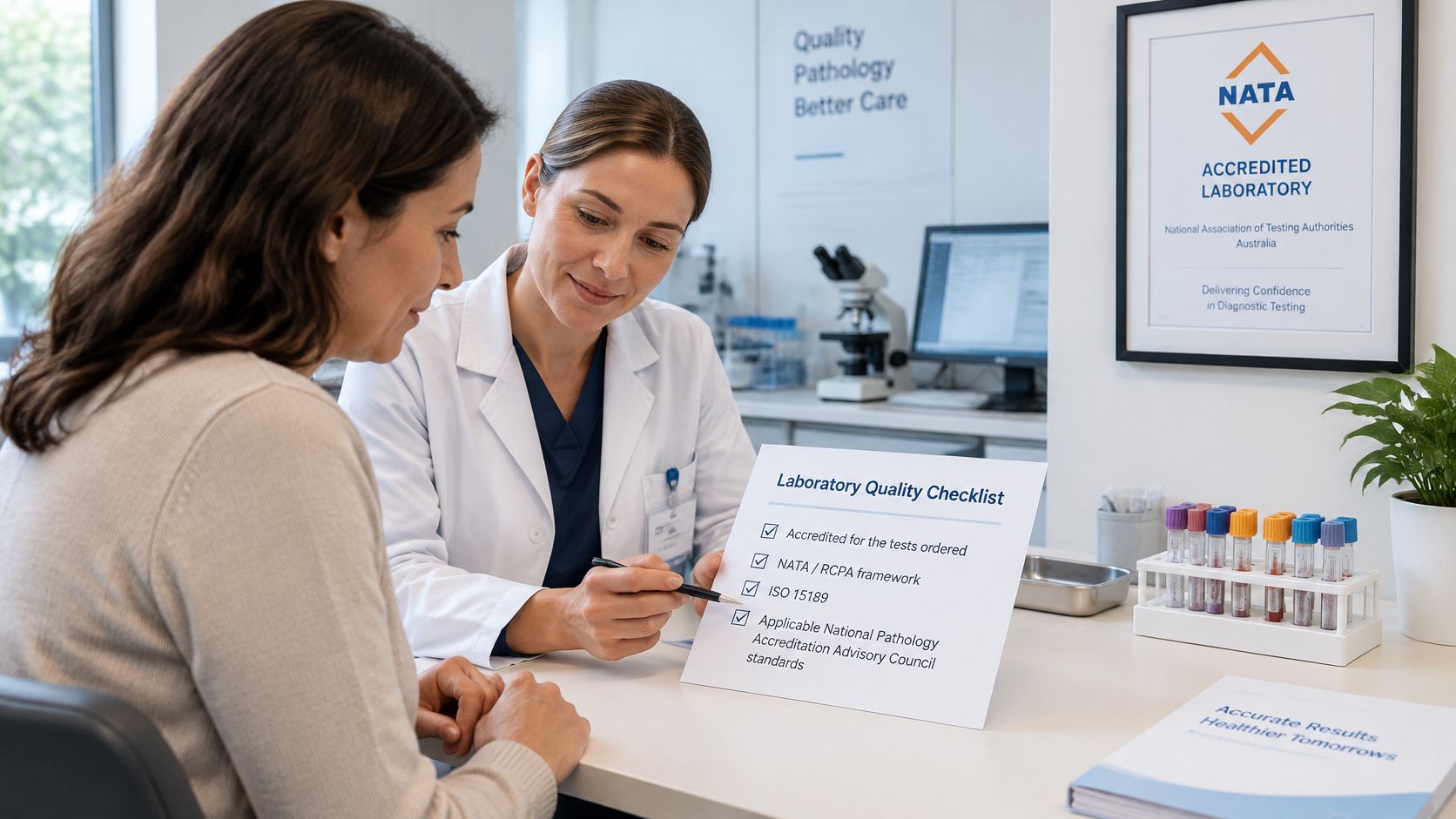
Accreditation is the check most buyers skip and the one that decides whether the number on your report came out of a verified quality system.
Australia's laboratory framework runs through the NATA/RCPA accreditation pathway, which incorporates ISO 15189 and the applicable National Pathology Accreditation Advisory Council standards. NATA's medical laboratory accreditation program describes accreditation as mandatory for laboratories seeking Medicare payment for pathology, and its scope covers both conventional laboratories and point-of-care testing.
Why "accredited" alone isn't enough
Accreditation is test-scope specific. NATA records show accredited scopes covering full blood examinations, biochemical profiles, thyroid testing, electrolytes, liver and renal markers, glucose, inflammatory markers and hormones. A laboratory can hold accreditation and still not be accredited for the particular assay you ordered.
So check the scope, not the badge. If your panel includes a hormone assay and the laboratory's scope lists haematology and biochemistry only, that's worth a question before you book.
Our own network reflects the same principle. Vital iQ Health partners with five pathology networks covering every Australian state and territory: QML Pathology, Laverty Pathology, Dorevitch Pathology, Western Diagnostic Pathology and TML Pathology. All collection centres we work with are NATA accredited, and the laboratories running the assays are NATA accredited too.
Keep to one laboratory over time
Reference intervals, analysers, calibration and reporting units differ between laboratories. A ferritin of 40 in one lab's units and a ferritin of 40 in another's aren't automatically the same measurement of the same thing, and your trend line can wobble for reasons that have nothing to do with your body.
Three things to record once the report arrives:
- The laboratory name, printed on the report itself.
- The accredited scope covering each test you ordered.
- The exact test names on the report, so a repeat matches like for like.
How to Order and Collect a Private Blood Test
The mechanics are simpler than the anxiety around them suggests. Here's the sequence, with the reason each step exists.
The infographic below maps the same flow from order to review.
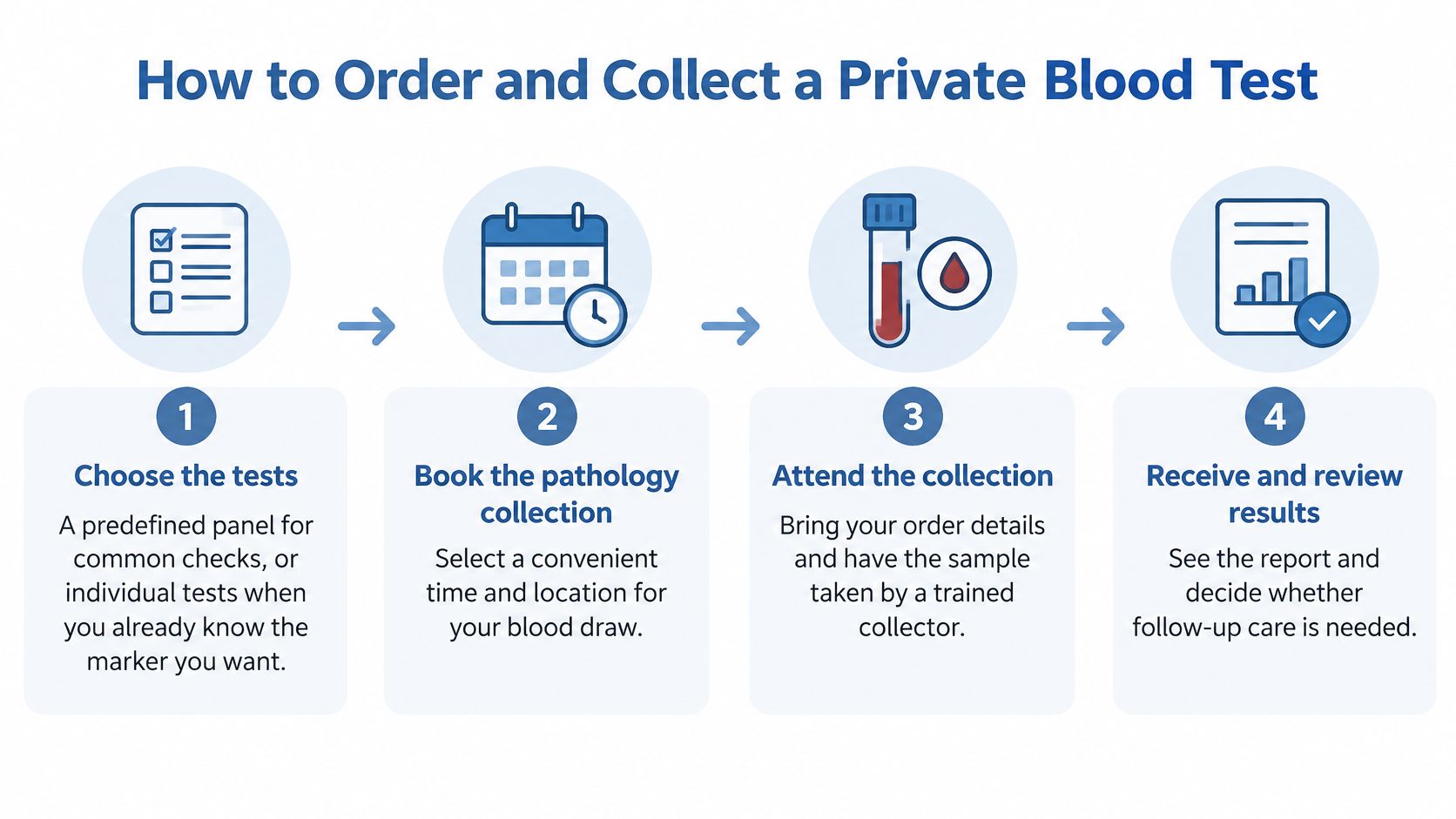
- Choose the tests. A predefined panel covers common checks in one order, or you pick individual markers when you already know what you're tracking. Panels group markers that are commonly ordered together; individual selection lets you choose specific markers.
- Order and pay online. Results usually return within 24 to 72 hours of collection, so the gap between payment and answers is short.
- Read the request form that arrives by email. This document is not a general referral. Services Australia's guidance on referring and requesting Medicare services sets out what a pathology request must identify: the patient, the requesting health professional, the provider number, the practice address, the requested services and the request date. If any of those fields is missing, the laboratory can't process the sample.
- Find a collection centre. Select your lab network and locate the nearest accredited centre. Where no specific laboratory is clinically required, you're free to choose your own approved collection centre.
- Check fasting instructions. Glucose and lipid tests often need an overnight fast of roughly 10 to 12 hours, so confirm before you travel rather than after you've had breakfast.
- Attend with the form and photo identification. A trained collector draws the blood in a few minutes.
- Keep copies. Retain the request and the receipt, and note the expected result date.
The distinction in step three is the one that trips up first-time buyers. Paying online gives you access to a request form; it doesn't make the test self-ordered in the eyes of the laboratory. An authorised health professional still issues the request, which preserves the laboratory's chain of accountability.
That separation also sets a boundary. Choosing a broad panel isn't a diagnosis. Abnormal or borderline values need clinical correlation, a review of your symptoms and medications, and often a repeat test. If you're tracking something specific, such as cortisol testing and what time of day does to the reading, a telehealth consultation turns an isolated number into an actual assessment.
Here's a short walkthrough of what to expect at the collection itself.
Before you pay, read the total at checkout. Private tests aren't billed through Medicare, so the full amount is yours to plan for. You should leave the centre holding three things: a copy of the request form, a receipt, and a note of when results are expected.
Practical rule: If the provider can't show you a compliant request form before payment, stop. Convenience without that document isn't a shortcut, it's a dead end at the collection desk.
Reading Results and What Each Range Means
People scan their report for their own number first, so start with the categories rather than the definitions.
| Result category | What it usually means | What to do next |
|---|---|---|
| Within the reference range | The result sits inside the laboratory's normal interval | Keep the report and follow your doctor's advice on repeat testing |
| Borderline or slightly outside the range | May reflect timing, fasting, hydration or a one-off reading | Book a doctor review; a repeat test may be requested |
| Clearly outside the range | Usually needs clinical assessment to find the cause | Book a prompt GP or telehealth review |
| Flagged as urgent by the laboratory | The lab notifies the ordering practitioner for immediate review | Seek urgent medical care now; do not wait for an appointment |
| Sample problem or delay | A specimen issue or analysis delay | Ask the laboratory or provider about a repeat collection |
Every laboratory sets its own reference range, which is why the laboratory name belongs on your report and why two labs can flag the same value differently.
Scale gives some comfort here. Australia's pathology system processes approximately 500 million tests a year, and the Australian Government's pathology guidance reports that more than 97% of specimens are analysed without incident. About 2% involve a minor issue that may need clarification or delay the result, and fewer than 1% have a problem preventing a safe result or requiring a new sample.
A sample problem usually means a repeat collection, not a diagnosis. Borderline values often come down to a single reading taken under particular conditions, and the sensible response is a conversation, sometimes with a repeat test. A clearly out-of-range value needs a clinician to work out why, not a search engine to name a disease. Inflammatory markers make the point well: what a high C-reactive protein result means depends entirely on the context a doctor supplies, because the number alone doesn't identify the cause.
An urgent flag is different from all of them. The laboratory contacts the ordering practitioner so the result gets immediate attention. If that happens to you, seek care now rather than waiting for a routine booking.
Three habits protect you. Keep the report with its laboratory name and collection date. Discuss any borderline or out-of-range finding with a qualified health professional. And if you feel unwell, get medical care first and interpret the numbers afterwards.
Where Your Results Go and Who Can See Them
A privately ordered test doesn't become visible in one fixed way. Upload obligations, provider systems, exceptions and your own settings all interact.
Australian Government guidance on My Health Record confirms pathology reports may be uploaded to My Health Record, and that from 1 July 2026 pathology and diagnostic-imaging information is shared by default, subject to exceptions and existing access controls. Some pathology categories become visible to healthcare providers only after a delay, while other reports can be viewed immediately after upload.
You're not without controls. The same guidance sets out options to restrict access, manage specific documents, receive notifications when your record is accessed, and ask a provider not to upload a report where that applies. Access requests for health information held about you are generally answered within 30 calendar days.
So the honest answer to "will my GP see this?" is: probably, depending on the provider, the document type, the timing and your settings. That's a reason to check, not a reason to worry.
A sequence that keeps you in control:
- Ask the provider whether reports are uploaded to My Health Record and on what timeframe.
- Set your controls before the collection, not after the result arrives.
- Download the report yourself so you hold the original.
- Send it to your regular GP directly, which is faster than waiting for a default share.
Digital delivery isn't the end of the process. It's the point where you decide who needs to see the result.
Follow-Up Care After an Unexpected Result
An out-of-range number from a test nobody referred you for feels like an answer. It's closer to a question with a good prompt.
One value is a starting point for a conversation, not a diagnosis. A clinician reading it will ask about current symptoms, medications and supplements, fasting status before the draw, the time of day the sample was taken, recent illness or a heavy training block, and whether that marker naturally fluctuates from day to day.
Timing matters more than often realised. Thyroid, hormone and cortisol markers shift with time of day and, for some markers, with the menstrual cycle. A single reading taken at an awkward hour can point in the wrong direction entirely.
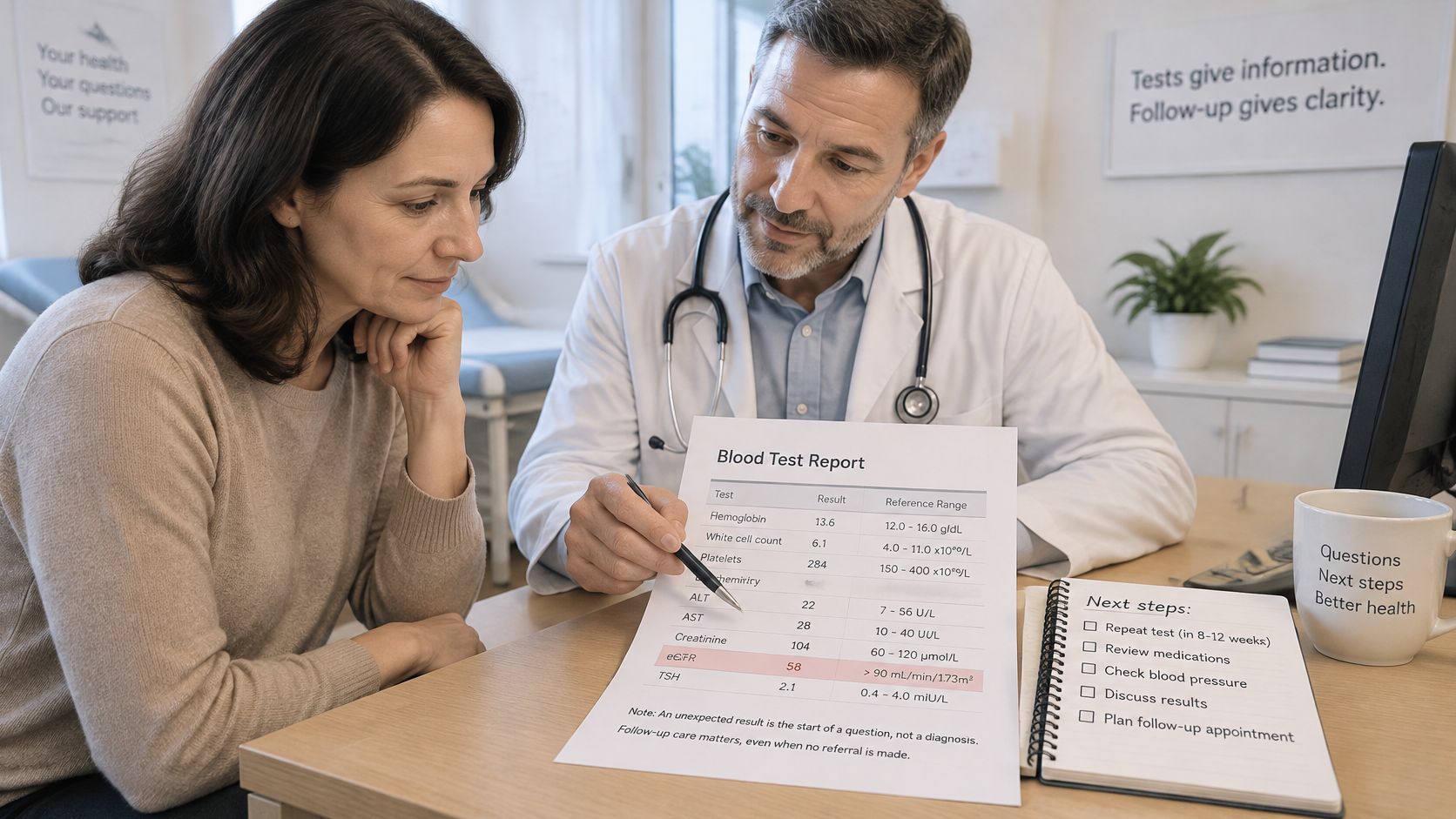
Usual next steps are unglamorous. A GP review, a repeat test at the same laboratory, or a targeted follow-up test that narrows the question. A telehealth consultation can turn one value into a short assessment and a written plan, and a GP can order any follow-up through a standard pathology request.
A normal result does not rule out every condition. An abnormal result does not confirm one.
Both errors are common, and both cause real harm. The first breeds false reassurance, the second unnecessary fear.
Bring four things to the appointment: the report, the laboratory name, the collection date, and a list of current medications and supplements. That's enough for a doctor to work with quickly rather than spending the first ten minutes reconstructing context.
Deciding If a Private Blood Test Fits Your Needs
A private blood test without a referral is available across Australia, and it fits a specific set of situations: routine screening, tracking a marker you already know about, monitoring nutrition or training load, or getting answers without waiting for an appointment.
Go ahead if you have no new or worsening symptoms, you know which markers you want or choose a panel that includes them, you have a plan for who reviews the result, and your request form and laboratory both meet the criteria outlined above.
See a doctor first if you have chest pain, unexplained weight loss, fainting, or symptoms that are getting worse. Those need clinical assessment, not a panel. Ordering a test ahead of that assessment delays the care that matters.
The range of choice is wider than many expect. Vital iQ Health offers 41 pathology panels and more than 300 individual biomarkers, so you can pick a predefined profile or build a custom test around the markers you're tracking. Telehealth GP consultations with partnered doctors let you review results and decide next steps from home, including evenings and weekends.
What the private route doesn't do is replace clinical judgement. It moves the ordering decision to you and leaves the interpretation where it belongs, with a doctor who can see the whole picture.
So take the next step in order. Choose your test, check the request form, book collection at a NATA accredited centre, and line up who will review the results before you walk into the collection room. That single decision, made early, is what separates a useful test from an unread PDF.
Vital iQ Health makes private pathology straightforward for Australians who'd rather not wait weeks for a GP appointment to order a routine blood test. You can choose from 41 pathology panels or build a custom profile from more than 300 biomarkers, attend a NATA accredited collection centre near you, and typically have results within 24 to 72 hours, with telehealth GP consultations available if you want the numbers explained properly. Visit Vital iQ Health to choose your test and arrange a review of the results before your collection.