Cortisol Testing Australia: Which Test to Order and Why
Cortisol Testing Australia explained: which test answers which question, how timing and sample type change results, and when to see a GP.
If a cortisol test measures your stress hormone, why can't the result tell you how stressed you are? Because the clinical question, sample type and collection time are part of the test, not background details added after the number arrives.
Cortisol testing in Australia is best understood as a staged investigation of hormone function. Before choosing a test or reading a result, you need to know whether the clinician is checking for cortisol excess, investigating insufficient cortisol, or assessing how the adrenal glands respond to a hormone signal.
Which Cortisol Test Answers Your Question
The right test depends on the question being asked, not on the word cortisol. Blood, saliva and urine tests aren't interchangeable ways of getting the same answer.
Cortisol tests by the question they answer
| Test | What it answers | Usual timing | Limit |
|---|---|---|---|
| Morning serum cortisol with ACTH | Whether morning cortisol and the pituitary signal help identify suspected adrenal insufficiency and its cause | Early morning blood draw | A single value needs symptoms and the laboratory reference interval |
| Random serum cortisol | Limited assessment for initial exclusion of pituitary insufficiency or confirmation of an Addisonian crisis | Any time of day | Not a stress or burnout measure |
| Midnight salivary cortisol, collected on separate occasions | Screening for cortisol excess in suspected Cushing syndrome | Around midnight, following the requested collection schedule | Doesn't help diagnose adrenal insufficiency |
| 24-hour urinary free cortisol | Screening for cortisol excess in suspected Cushing syndrome | Complete collection across the prescribed day and night | Doesn't help diagnose adrenal insufficiency |
| Overnight dexamethasone suppression test | Whether cortisol suppresses appropriately after dexamethasone in suspected Cushing syndrome | Medicine at night, blood sample the following morning | Requires clinician-directed preparation and medication review |
| Short Synacthen test | Whether the adrenal response supports or confirms suspected adrenal insufficiency | Blood samples before and after a synthetic ACTH injection | A confirmatory investigation rather than a general screening test |
Choose the question before the sample
Morning cortisol with ACTH assesses the hormone alongside the signal that tells the adrenal glands to produce it. The pairing helps a clinician interpret whether a low cortisol result might involve the adrenal glands or their control system.
A random cortisol sample has much narrower uses. Being able to collect blood at any time doesn't mean the resulting number answers a general question about tiredness or wellbeing.
Late-night saliva and urinary free cortisol belong mainly to the cortisol-excess pathway. They assess different aspects of production, so convenience alone shouldn't decide between them.
Dexamethasone suppression and Synacthen testing ask response questions. One checks suppression; the other checks stimulation. They are not just more detailed versions of an ordinary cortisol blood test.
Practical rule: Write down the condition being investigated before choosing the test.
Don't turn a hormone measurement into a wellbeing score
Most clinical cortisol investigations concern suspected Cushing syndrome, involving cortisol excess, or adrenal insufficiency, which includes Addison's disease. No single cortisol number works as a reliable stress or burnout score.
If you're comparing broader hormone testing options in Australia, check what question each included marker can answer. A panel containing cortisol doesn't automatically provide a complete adrenal assessment.
Take your written question to the requesting clinician and ask which specimen and testing pathway it needs. Choosing the wrong format can waste a sample and leave you with a result that's difficult to use.
Why Cortisol Results Depend on Sample and Timing
Say you receive a morning blood result and later see a midnight saliva result from another laboratory. Both reports say cortisol, but comparing their numbers directly would be like comparing a photograph of the tide at sunrise with another taken at night, without checking the location or scale.
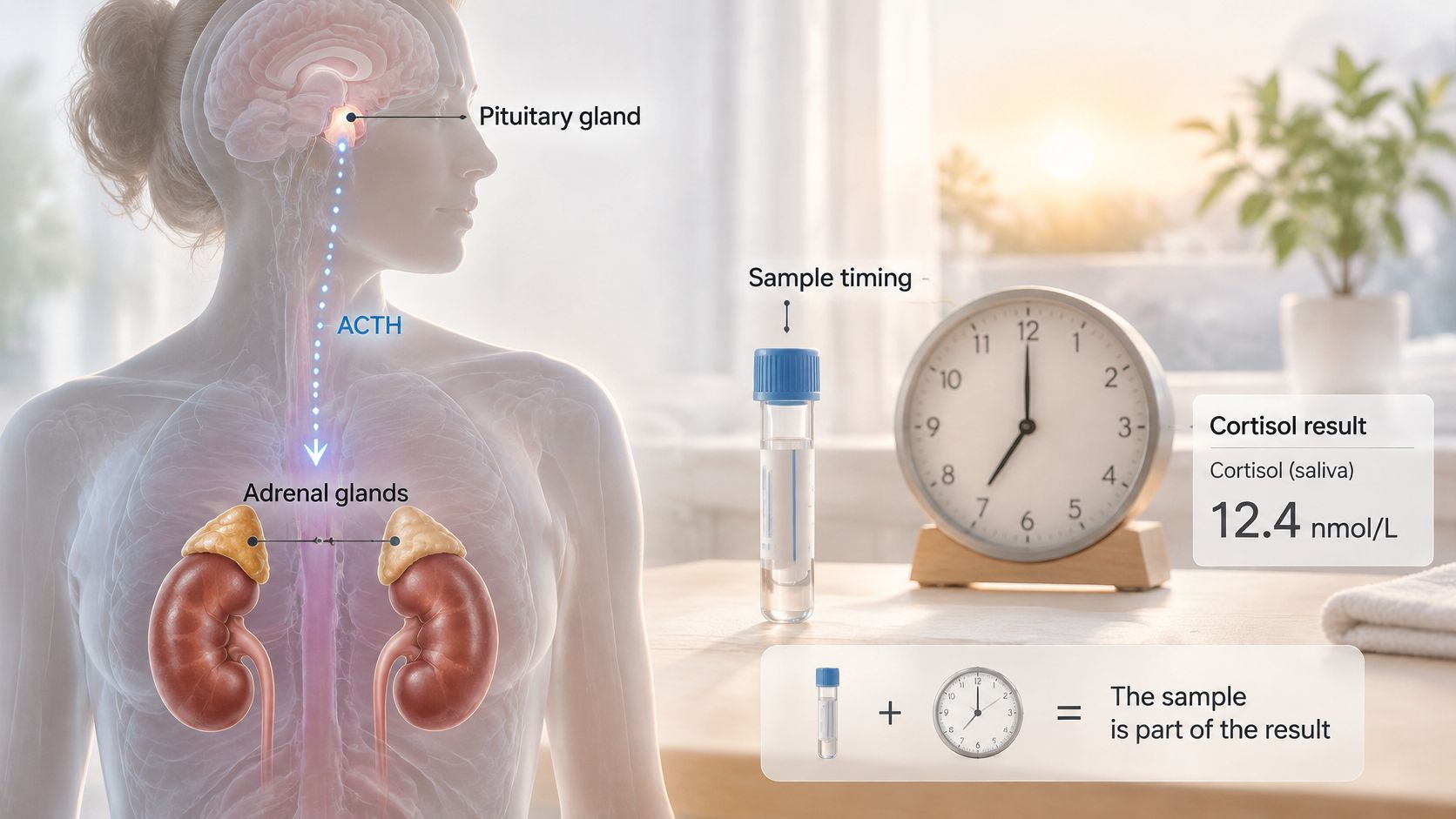
The specimen is part of the result. So are the collection time, measurement method and reference interval.
According to Healthdirect's explanation of cortisol, cortisol is produced by the two adrenal glands and regulated by adrenocorticotropic hormone, or ACTH, from the pituitary gland. It's essential for survival, supports the stress response and helps maintain normal physiological function.
The diagram below places the hormone signal alongside the collection and reporting process.
A snapshot needs a clock
Cortisol rises and falls through the day. A clinician therefore interprets a sample against what's expected at that collection time, rather than against a universal cortisol target.
The tide analogy helps here. A photograph can show where the water was at that moment, but it can't establish the whole day's pattern. Similarly, an isolated reading can't tell you whether cortisol production remains excessive or whether the glands respond adequately when stimulated.
Cortisol sample types, timing and reference examples
| Sample | Typical collection | Reference example | Main factor that changes the result |
|---|---|---|---|
| Serum, or blood | Early morning draw | The Royal College of Pathologists of Australasia cortisol manual describes a morning peak of approximately 200–650 nmol/L | Time of draw and assay-specific reference interval |
| Saliva | The collection window specified on the request | Separate reference intervals apply to morning and late-night specimens | Collection conditions and assay-specific salivary cut-offs |
| 24-hour urine | Full collection over the prescribed period | The laboratory's urinary free cortisol reference interval for a complete collection | Missing urine can produce a misleading total |
That blood reference example isn't a personal diagnostic threshold. Nor should it be applied to saliva or urine. The laboratory's own interval is the relevant comparison for its method and specimen.
Compare like with like
Consider a hypothetical pair of reports: one sample was taken in the morning, the other around midnight. Even if the displayed values look similar, their clinical meaning may differ because the expected concentrations at those times aren't the same.
An assay is the laboratory method used to measure a substance. Different assays can have different reference intervals or cut-offs, which is another reason not to judge a report against a number found online.
Diet, medicines and collection conditions also need attention. A clinician may need another sample or a different investigation rather than treating a flagged result as proof of disease.
Before comparing reports, check:
- Specimen: Was each sample blood, saliva or urine?
- Timing: Was collection completed at the requested time?
- Medicines: What were you taking when each sample was collected?
- Reference interval: What interval does each laboratory print beside the result?
Understanding how hormone levels are tested starts with these collection details. Without them, a number can look precise while answering very little.
How to Prepare for a Midnight Saliva Test
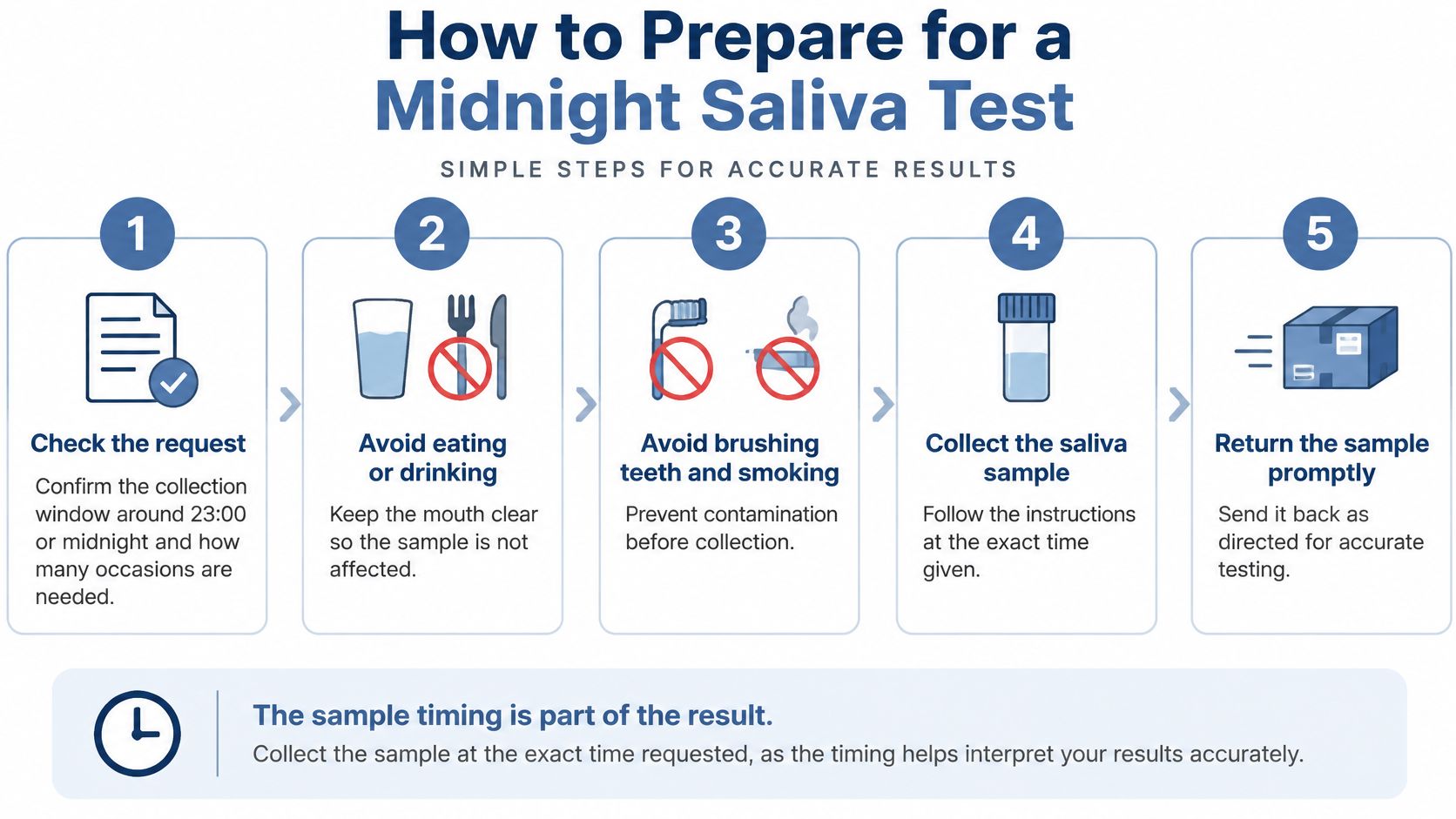
For a clinician-requested late-night saliva test, preparation protects the usefulness of the sample. Read the laboratory's instructions before collection night so you have time to resolve anything unclear.
Use this infographic as a preparation reminder, while following the instructions supplied with your own kit.
Prepare and collect carefully
Check the request first. Confirm the collection window and whether separate collection nights are required. Don't substitute a convenient daytime sample for the requested late-night specimen.
Keep the mouth clear beforehand. Follow the laboratory's food and drink restriction for the full instructed interval. Eating or drinking too close to collection can affect the sample.
Avoid brushing your teeth immediately beforehand. Follow any additional directions about smoking or other mouth-related activities. These precautions help prevent contamination.
Record anything unusual. Note recent stress, unusual activity, illness, shift work and your medication list, especially oral corticosteroids. Give that information to the clinician rather than trying to decide yourself which details matter.
Use the supplied collection device. Follow its instructions at the scheduled time. Don't substitute another container or change the collection technique.
Label, store and return the sample correctly. Record the actual collection time and follow the laboratory's storage and return directions. If another night is requested, repeat the preparation rather than assuming the first sample is enough.
Don't stop prescribed medication to improve a result. Ask the clinician who manages the medicine whether any change is needed for testing.
The following video provides additional context for cortisol testing.
If you're collecting urine instead
A urinary cortisol collection needs a different routine. The priority is collecting the complete requested period, not preparing your mouth.
- Confirm the start and finish procedure: Read the laboratory's directions before beginning, including which urine sample starts the collection.
- Collect every required sample: Use the supplied container and follow the instructions throughout the collection period.
- Store as directed: Follow the container's storage requirements rather than assuming room temperature is suitable.
- Document completeness: Record the requested timing and total volume if instructed, and tell the laboratory if any urine was missed.
Tell the laboratory about a missed step before anyone interprets the result. A collection problem shouldn't be mistaken for a hormone abnormality.
Don't try to compensate for a missed urine sample by extending the collection yourself. The laboratory can advise whether the specimen is usable or needs repeating.
Cushing Syndrome and Adrenal Insufficiency Pathways
Someone taking oral corticosteroid tablets develops changes that raise concern about cortisol excess. They arrange testing and receive a flagged report, then assume their adrenal glands must be overproducing cortisol.
That conclusion skips an important clinical step: medication review. Steroid exposure and the body's own hormone overproduction are different explanations, and a clinician needs to distinguish them before deciding what the result means.
When cortisol excess is suspected
Healthdirect's Cushing syndrome guidance describes persistently excessive cortisol, overlapping symptoms, and possible causes including adrenal tumours, abnormal adrenal growth and substantial exposure to oral corticosteroid medicines. It also explains that confirmed high cortisol may lead to CT or MRI investigation of an adrenal or pituitary cause.
For the person taking steroid tablets, the useful next step isn't choosing a scan independently. It's bringing the prescription history, dose changes and test report to the treating clinician.
A medication-related explanation doesn't make the symptoms unimportant. It changes how the clinician investigates and manages them. The person shouldn't stop the tablets abruptly or use the report to adjust treatment without medical advice.
An ordinary temporary rise during stress isn't the same as the sustained abnormality being investigated in Cushing syndrome. Because symptoms overlap with other conditions, the clinician must weigh the whole presentation rather than attach a diagnosis to a single flag.
When insufficient cortisol is suspected
Now consider someone with unexplained tiredness, weight loss and dizziness. These symptoms prompt a consultation, but they don't establish Addison's disease by themselves.
The clinician considers the history and examination, then chooses early-morning cortisol and ACTH if adrenal insufficiency is a concern. A short Synacthen test may be needed to establish how the adrenal glands respond to stimulation.
This person needs a different investigation from the person being assessed for cortisol excess. Ordering a late-night saliva test because it's easy to collect wouldn't answer the clinician's main question.
Follow the clinical question: Similar symptoms don't necessarily call for the same specimen or the same next test.
The staged pathway connects clinical assessment, timed sampling, medication review and confirmation. Imaging follows when the biochemical findings and clinical circumstances justify looking for a structural cause; it isn't an automatic response to every out-of-range result.
Follow-up also has a purpose. After treatment or recovery from Cushing syndrome, regular cortisol checks may be needed to monitor for recurrence. Those checks belong to an agreed care plan, with the test format selected for the condition and treatment history.
Reading Morning Cortisol and ACTH Results
An abnormal screening result isn't a diagnosis by itself. The better question is what the combination of cortisol, ACTH, symptoms and collection conditions suggests the clinician should do next.
For suspected adrenal insufficiency, early-morning thresholds can help guide that decision. They're clinical decision aids, not universal labels for every cortisol specimen.
Read the pattern rather than the flag
The RACGP adrenal disease update reports that early-morning cortisol below 140 nmol/L with markedly raised ACTH strongly supports primary adrenal insufficiency, whereas a level above 365 nmol/L makes adrenal insufficiency unlikely. The same guidance distinguishes early-morning assessment and Synacthen confirmation from cortisol-excess screening, for which late-night saliva is commonly collected on two occasions, with collection instructions commonly requiring no food or drink for at least 30 minutes beforehand.
Early-morning cortisol and ACTH patterns
| Early-morning cortisol | Other findings | What it suggests |
|---|---|---|
| Below the lower decision threshold described above | Markedly raised ACTH | Strongly supports primary adrenal insufficiency |
| Between the decision thresholds described above | Any ACTH result | Not settled by cortisol alone; a clinician may request a Synacthen test |
| Above the upper decision threshold described above | Any ACTH result | Makes adrenal insufficiency unlikely in the appropriate clinical context; assess other explanations for symptoms |
| Consistently high on appropriate screening | Symptoms suggesting cortisol excess | Abnormal screening, not a diagnosis; confirmation and imaging if indicated |
The low-cortisol pattern matters because ACTH provides context about the signal reaching the adrenal glands. A markedly raised signal alongside insufficient cortisol supports a different interpretation from cortisol considered alone.
A result between the decision thresholds isn't automatically normal or abnormal. It means the clinician may need a response test, additional context or repeat assessment rather than a firm conclusion from that value.
Likewise, a reassuring morning result doesn't explain every symptom. It may make adrenal insufficiency less likely while leaving the original tiredness or dizziness in need of assessment.
Don't confuse reference intervals with diagnostic decisions
A laboratory reference interval and a clinical decision threshold serve different purposes. A report can therefore require interpretation beyond whether its software has marked the value high or low.
One morning or untimed cortisol result can't establish burnout, adrenal fatigue, Cushing syndrome or adrenal insufficiency on its own. Don't translate a laboratory flag into a diagnosis or begin treatment intended to correct the number without medical review.
Bring these questions to the clinician:
- Which specimen and timing were used? Confirm that collection matched the question being investigated.
- Which laboratory interval applies? Use the interval for that specimen and assay, not a range from another report.
- What would resolve uncertainty? Ask whether repeat sampling, a Synacthen test or another investigation would change the next decision.
The useful outcome is a clear plan, not a result labelled normal or abnormal.
Confirm the Test Before You Order
See a GP first if your symptoms suggest a cortisol disorder, you take medicines that affect cortisol, or you may need specialist investigation. Clinical assessment is especially useful when you don't yet know whether the question concerns excess production, insufficient production or another explanation for your symptoms.
Private testing offers a different access route, but it doesn't remove the need for interpretation. A privately obtained report can start a conversation with a GP; it shouldn't become the endpoint when symptoms remain unexplained.
Compare the routes by what you need
| Route | When it may fit | What to establish before proceeding |
|---|---|---|
| GP-led assessment | New or unexplained symptoms, steroid exposure, suspected adrenal or pituitary disease | Which condition is being investigated and which test can address it |
| Direct-access private testing | You want access to blood measurements and have a clear purpose for testing | Whether the chosen sample and collection schedule match that purpose |
| Clinical review of an existing report | You already have results but don't know what they mean | Whether the report is sufficient or further investigation is needed |
The distinction is access versus diagnostic planning. Being able to buy a test answers how to obtain a measurement, not whether that measurement is the right next investigation.
At Vital iQ Health, customers can order private blood tests online without a GP referral, choose from 41 pathology panels, attend a NATA-accredited collection centre, and receive results within 24 to 72 hours. We also offer telehealth GP consultations, where partnered GPs review findings, answer questions and recommend next steps from home.
If you're considering private blood testing, choose the route around the decision you need to make. Don't assume a routine blood collection replaces a clinician-directed saliva, urine, suppression or stimulation investigation.
Complete a pre-order checklist
Before placing an order or attending collection, prepare a short written record:
- The question: State what you're trying to investigate, rather than writing only cortisol.
- The specimen: Confirm whether the request requires blood, saliva, urine or a supervised response test.
- The schedule: Check the collection window and whether repeat samples are required.
- The medication list: Include prescribed medicines and other preparations, especially steroid medicines.
- The interpretation plan: Identify who will review the report and confirm which laboratory reference interval applies.
Bring any previous reports in full, including their reference intervals and collection details. A screenshot showing only the cortisol value can leave out information the clinician needs.
Take the report and completed checklist to a clinician who can decide whether further testing, specialist review or imaging is warranted. The aim is to answer a health question accurately, not collect a hormone number without a plan.
Vital iQ Health offers private blood testing through NATA-accredited collection centres, with partnered telehealth GPs available to explain results and recommend next steps. Visit Vital iQ Health to explore testing options, and confirm that the specimen and timing match your cortisol question before ordering.