Low Zinc Levels: Causes, Risks and Whether to Test
Low zinc levels can come from diet, gut conditions, illness or medicines. See the main causes, who is most at risk, and when a test helps.
Almost 29.7% of Australians aged 2 years and over, about 7.3 million people, had usual zinc intakes below the estimated average requirement in 2023, up from 22.7% in 2011-12, according to the Australian Bureau of Statistics usual nutrient intakes release. In those same estimates, 47.7% of males fell short, against 11.2% of females, and 25% of adult males usually ate under 9.5 mg a day. For men aged 30 and over the relevant requirement is 12.0 mg, so that intake sits about 2.5 mg, at least 20%, below it.
Those figures describe what people eat, not a diagnosed deficiency. A low number on a blood report is a different question again. It can be useful, but only after you know who is short, what caused it, and what else was going on the day the sample was taken.
What Low Zinc Levels Actually Tell You
Treat dietary zinc as the delivery, the body's zinc store as the stock on the shelf, and a blood test as a single photo of that shelf taken on one day. A thin delivery over months can drain the shelf. A photo taken during a fever can look bare even when the usual deliveries have been fine.
Say a 62-year-old man eats toast, pasta and a small serve of chicken most days, then feels flat and is told to "just get a zinc test". The photo might come back low. That still leaves three questions open: what arrived in the food, what the gut absorbed, and what was circulating at the moment of the draw.
Zinc's everyday job is concrete. It supports immunity, wound healing, growth, taste and smell, and it sits inside hundreds of enzymes that help build and repair tissue. The body doesn't keep a large spare pile, so a long run of low-zinc meals matters more than a single skipped dinner.
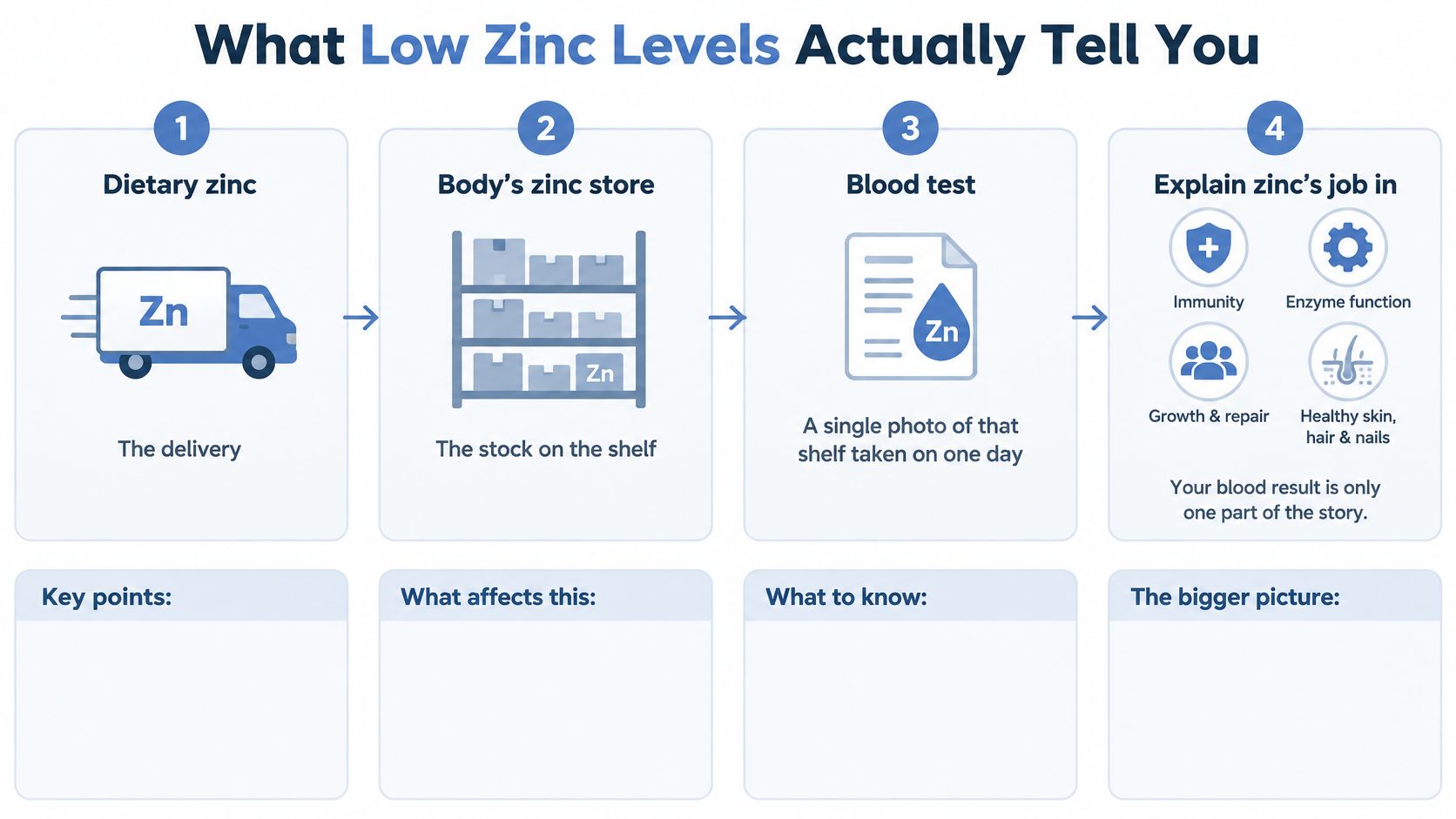
Low zinc levels on a report answer only the photo question: how much zinc was in serum or plasma in that tube. National intake figures answer the delivery question. Children aged 2 to 4 and 5 to 11 were comparatively less affected, with inadequacy below 5%, while shortfalls were higher in older groups. Population intake risk is not a personal diagnosis.
A three-question check before you book
- Higher-risk group: Are you an older man, feeding an infant, living with gut disease, or eating a restrictive diet?
- Symptoms: Has poor appetite, skin change, slow healing or mental lethargy lasted beyond a short illness?
- Absorption: Has surgery, diarrhoea, alcohol, kidney or liver disease, or a long-term medicine changed how you handle minerals?
Match yourself against the causes before you book anything. A matching cause tells the GP what to ask about, not which bottle to buy.
Common Causes and Early Warning Signs
Low zinc usually comes from one of four directions: too little in the food, too little absorbed, too much lost, or a period when the body needs more. The same person can sit in more than one row.
| Cause | How it lowers zinc | Who it tends to affect |
|---|---|---|
| Low-meat or plant-heavy diet | Less absorbable zinc from meat and seafood; phytates in grains and legumes bind zinc | Vegetarians, vegans and people eating few animal proteins |
| Malabsorption from gut disease | The gut lining absorbs zinc less efficiently | People with coeliac disease or Crohn's disease |
| Bariatric or other gut surgery | Smaller absorptive surface and altered digestion | People after weight-loss surgery |
| Chronic diarrhoea or vomiting | Zinc is lost through stool and fluids | Children and adults with prolonged gastrointestinal illness |
| Chronic kidney disease | Altered zinc handling and higher urinary loss | People with reduced kidney function |
| Chronic liver disease | Impaired zinc storage and lower circulating protein carrying zinc | People with liver disease or heavy alcohol use |
| Regular heavy alcohol use | Lower intake, poorer absorption and increased urinary loss | Regular heavy drinkers |
| Reduced appetite or older age | Less total food eaten, so less zinc overall | Older adults, people with illness or depression |
| Higher demand | Growth, pregnancy, breastfeeding and wound healing raise needs | Infants, teenagers and pregnant or breastfeeding people |
| Long-term medicines | Some treatments increase zinc loss or reduce absorption | People on long-term treatment; check with the prescriber |
Why the diet pattern matters
A person who eats wholegrain bread and legumes at most meals takes in real zinc, then absorbs less of it than someone eating red meat or seafood most days. Phytates in grains and legumes bind zinc in the gut. That doesn't make bread or lentils a problem. It means a fully plant-based pattern needs more attention to total intake and to food preparation than a mixed diet does.
The benchmark intakes show why men feel this first. The NHMRC Australia–New Zealand Nutrient Reference Values set the recommended dietary intake at 14 mg a day for adult men and 8 mg for adult women, with estimated average requirements of 12 mg and 6.5 mg. In the 2011-12 survey, more than one in three males (37%) and about one in ten females (9%) had inadequate usual intakes. From age 14, male requirements are nearly twice those of females in the same age groups, even though men generally ate more zinc in absolute terms.
Signs that overlap with other illnesses
Australian guidance links nutritional zinc deficiency with impaired growth, appetite loss, mental lethargy, skin changes and night blindness. Those signs also appear with iron problems, depression, coeliac disease and ordinary ageing. They justify a conversation with a doctor. They don't justify a high-dose capsule chosen from a shop shelf.
Practical step: Keep a food diary for three typical days and mark whether meat, seafood, dairy or a fortified food shows up. Then list the two or three causes in the table that match you, and take that list to your GP. Dietary inadequacy alone doesn't diagnose deficiency.
Who Is Most at Risk in Australia
Risk concentrates at both ends of life in Australia: in older men and in infants. Men carry a higher requirement from adolescence, and the share who fall short climbs steeply with age.
| Group | Recommended intake (mg/day) | Estimated average requirement (mg/day) | Share below requirement |
|---|---|---|---|
| Men 19–30 | 14 | 12 | 37.4% (2011-12) |
| Men 31–50 | 14 | 12 | 39.3% (2011-12) |
| Men 71 and over | 14 | 12 | 66% (2011-12) |
| Women 19–30 | 8 | 6.5 | 13.5% (2011-12) |
| Women 31–50 | 8 | 6.5 | 10.1% (2011-12) |
| Infants 7–12 months | 3 | 2.5 | About 20% below the EAR (OzFITS, 2021) |
Read the table as a ladder. Male inadequacy sits near two in five through the working years, then jumps to two in three after seventy. Female inadequacy stays near one in ten. A 2024 review in Frontiers in Nutrition reported that 24.2% to 52% of men in Australia and New Zealand didn't meet the estimated average requirement across the groups studied.
From older men to infants
Blood results follow the same slope the diet data does. In the open-access Tasmanian serum zinc paper, low serum zinc occurred in 18% of men aged 50 and older and 30% of men aged 70 and older, and no man younger than 40 sat below the study cut-off. A result reads differently at each point on that slope: an older man with poor appetite, gut disease, several medicines or a narrow diet faces a different question from a healthy man in his thirties. Healthdirect advises that adults use zinc supplements only with medical advice, with repeat blood testing after about two months when a supplement is prescribed.
Infants are the other concentrated group. About 20% of Australian infants didn't meet the zinc EAR in the 2021 OzFITS study, summarised in an Australian Government consultation paper on foods for infants. Requirements run particularly high in infancy, so late or low-zinc complementary foods matter. That figure describes intake risk rather than a blood diagnosis, and serum zinc in a baby is hard to read anyway: inflammation, fasting, time of day, albumin and a recent feed all move it.
One marker rarely settles a health question on its own. A cortisol test in Australia has the same limitation: the number needs the person in front of it.
Watch older men, infants, people with gut disease, pregnant people, and anyone on a restrictive diet. Note which of those groups you belong to before you book a blood test.
Zinc-Rich Foods and Simple Diet Changes
The most absorbable zinc sits in a short list of foods. Animal sources generally beat plant sources for the share that crosses the gut wall.
| Food group | Zinc contribution | Absorption note |
|---|---|---|
| Oysters and shellfish | Among the richest sources | Absorbed well |
| Red meat and poultry | Substantial source | Absorbed well |
| Fish and seafood | Useful source | Absorbed well |
| Dairy foods | Moderate source | Good absorption |
| Legumes and wholegrains | Good zinc content | Phytates reduce absorption |
| Fortified foods | Only when zinc is listed | Read the nutrition information panel |
A lunch that looks better on paper
Someone who eats wholegrain bread and lentils at lunch and dinner gets genuine zinc from both meals. Phytates in the bread and the lentils bind a share of it, so the same milligram count is absorbed less well than from a meal built around beef, oysters, chicken or fish. Dairy changes that picture. Milk, yoghurt and cheese add a moderate amount of zinc that is absorbed well, and they fit easily next to a plant-based main.
Small swaps that change absorption
- Soak, sprout or ferment legumes and grains. Those steps lower phytate, so more of the zinc in the same food becomes available.
- Add an animal protein or a dairy food to a plant-heavy plate. Eggs, yoghurt or a small serve of meat or fish beside beans lifts absorption without throwing out the meal.
- Use fortified foods only when the label lists zinc. A cereal or milk drink that doesn't name it isn't doing this job.
- Spread zinc foods across the week, not into one seafood dinner. Oysters are rich, but a regular pattern of meat, fish and dairy matters more than a single large serve.
Note which of these foods show up in a typical week. That note is what you take into the appointment, not a supplement dose guessed from a headline.
When a Zinc Blood Test Helps and When It Does Not
A serum or plasma zinc test measures zinc in the liquid part of the blood. People often treat that number as a verdict. It behaves more like a bathroom scale that jumps when you hold your breath: one reading only makes sense with the circumstances around it.
Australian pathology guidance, in the Second Clinical Committee report for chemical pathology, finds serum zinc testing particularly useful for people with malnutrition or those receiving total parenteral nutrition, and notes limited evidence for broad trace-element testing in other settings. Deficiency can impair protein synthesis, epithelial repair, immune function and appetite. Plasma zinc still has a narrow window. During acute inflammation, zinc shifts from plasma into tissues, so the reading falls for a while even when stores aren't the actual issue.
A low result taken in the middle of an infection can look like deficiency and be something else. Wait until you are well, or at least tell the doctor you weren't.
| Factor | Effect on the result | What to do |
|---|---|---|
| Recent meal or fasting status | Zinc levels shift after eating, so timing changes the number | Ask whether a fasting morning sample is required |
| Infection or inflammation | Zinc moves into tissues, lowering the plasma reading | Consider repeating after recovery and check inflammatory markers |
| Low albumin | Albumin carries much of the zinc, so low albumin lowers total serum zinc | Ask for albumin on the same panel |
| Time of day | Concentrations vary across the day | Keep the collection time consistent for any repeat test |
| Recent high-dose zinc supplements | Can raise the result and mask the true status | Tell the doctor and lab exactly what you take and when |
What a low result should trigger
An apparently low concentration should send you back to context, not straight to a bottle. The confounders to weigh up include infection, low albumin, liver disease, kidney disease, poor intake, malabsorption and too much zinc already on board. Each one changes what the same number means.
Useful follow-up is a look at dietary sources, a check for gut or nutritional causes, and a copper check if high-dose zinc has been used for a long time, because excess zinc can induce copper deficiency. A laboratory result doesn't set the dose or the duration. That is a clinical decision.
Zinc also isn't bundled into routine bloods the way people hope. Ordering it works like requesting a targeted test such as a B12 blood test: there is a specific clinical reason behind it, rather than a habit of ticking every mineral "just in case". Screening people with no risk factors and no symptoms adds confusion more often than it adds an answer.
Preparing for Your Doctor and Choosing Your Next Step
A zinc consultation runs on specifics. Arriving with dates, doses and a short food record gives the doctor something to interpret, rather than a vague worry about feeling run down.
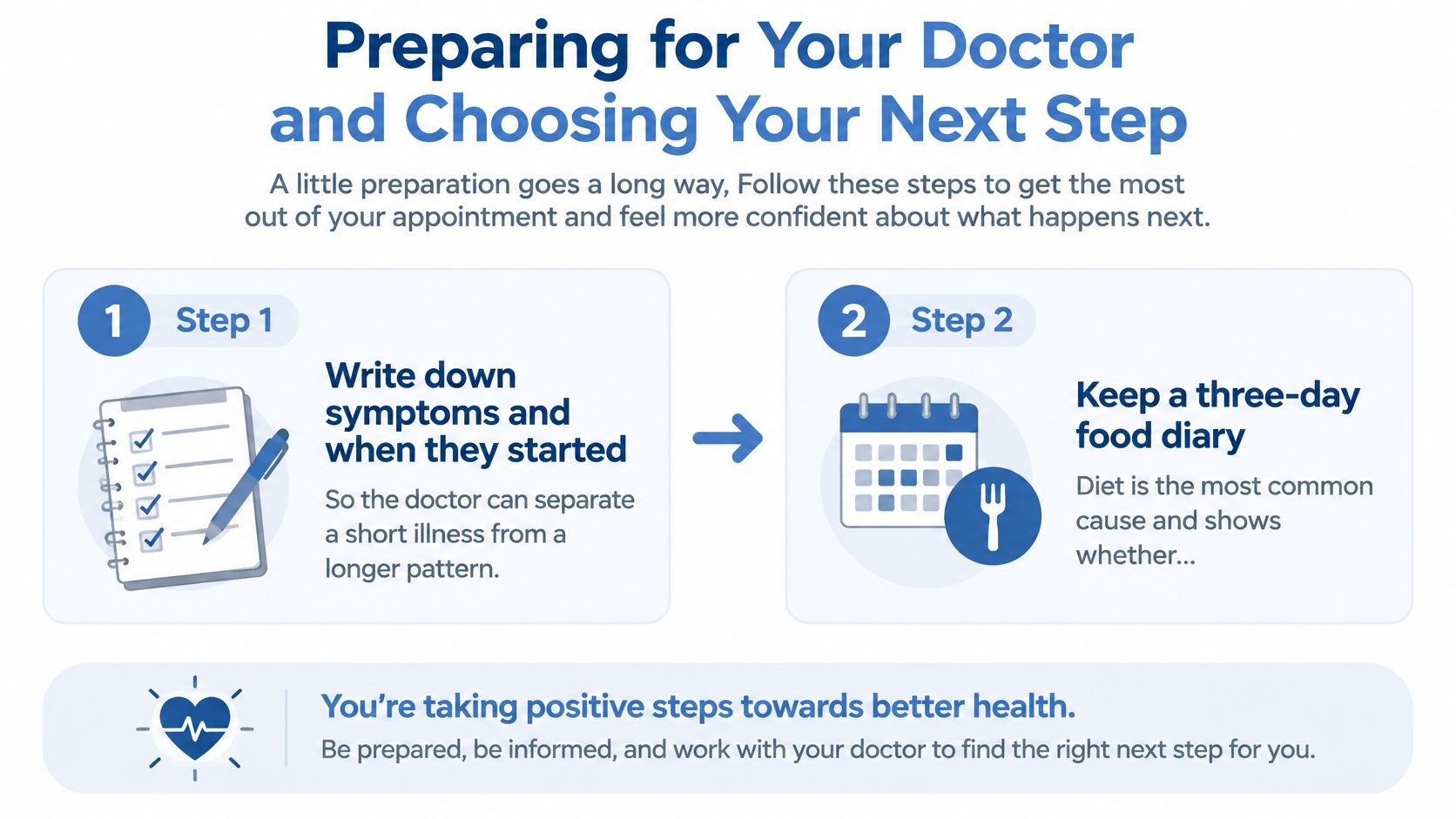
- Write down symptoms and when they started. A fortnight of poor appetite during a cold is a different story from three months of skin change and slow healing.
- Keep a three-day food diary. Diet is the most common lever, and the diary shows whether oysters, meat, fish or dairy appear.
- List every medicine, supplement and multivitamin, with doses. Long-term medicines and high-dose zinc both change how a result should be read.
- Note gut conditions, past surgery, alcohol use, kidney or liver problems, and any recent infection. These are the confounders a form won't ask you about.
- Ask whether a serum zinc test suits your risks, rather than requesting a broad screen because a friend had one.
- If a test is ordered, ask about timing. Fasting, time of day, and whether you are unwell today all move the number.
- Ask what a low result would change, and whether albumin and an inflammation marker will be checked beside it.
- If a supplement is prescribed, ask for the dose, how long, and when to retest. Don't start high-dose zinc on your own. Long-term excess can cause copper deficiency.
A short walk-through of how a zinc sample is collected and read sits well beside those questions.
How to choose the next step
Book a GP first if you have symptoms, a relevant condition, or you sit in a higher-risk group such as older men, or you care for an infant whose intake or growth is in question. The doctor chooses the tests, reads them against your history, and sets the follow-up. That order matters, because a zinc number means little until someone checks it against albumin, inflammation and what you eat.
If you want a result ready before that conversation, ordering a private blood test online is an option. At Vital iQ Health you order without a GP referral, choose from 41 pathology panels or build a custom profile from more than 300 individual biomarkers, then visit a NATA-accredited collection centre near you. Results come back within 24 to 72 hours, and testing runs through five pathology networks covering every Australian state and territory: QML Pathology, Laverty Pathology, Dorevitch Pathology, Western Diagnostic Pathology and TML Pathology. A partnered GP can then review the result by telehealth and talk through what, if anything, should change.
One zinc result starts a conversation. It isn't a diagnosis, and a supplement should follow medical advice only.
If you want zinc considered with the rest of your nutrition picture, we can arrange private testing through NATA-accredited collection centres and a telehealth GP who explains the result from home. That keeps a possible shortfall tied to your diet, symptoms and other markers instead of a single unchecked number. Visit Vital iQ Health to order a panel and plan the next step.