Methylation Testing Australia: What Each Test Shows
Methylation testing Australia explained: which tests exist, what the evidence supports, MTHFR limits, privacy risks and how to choose a provider.
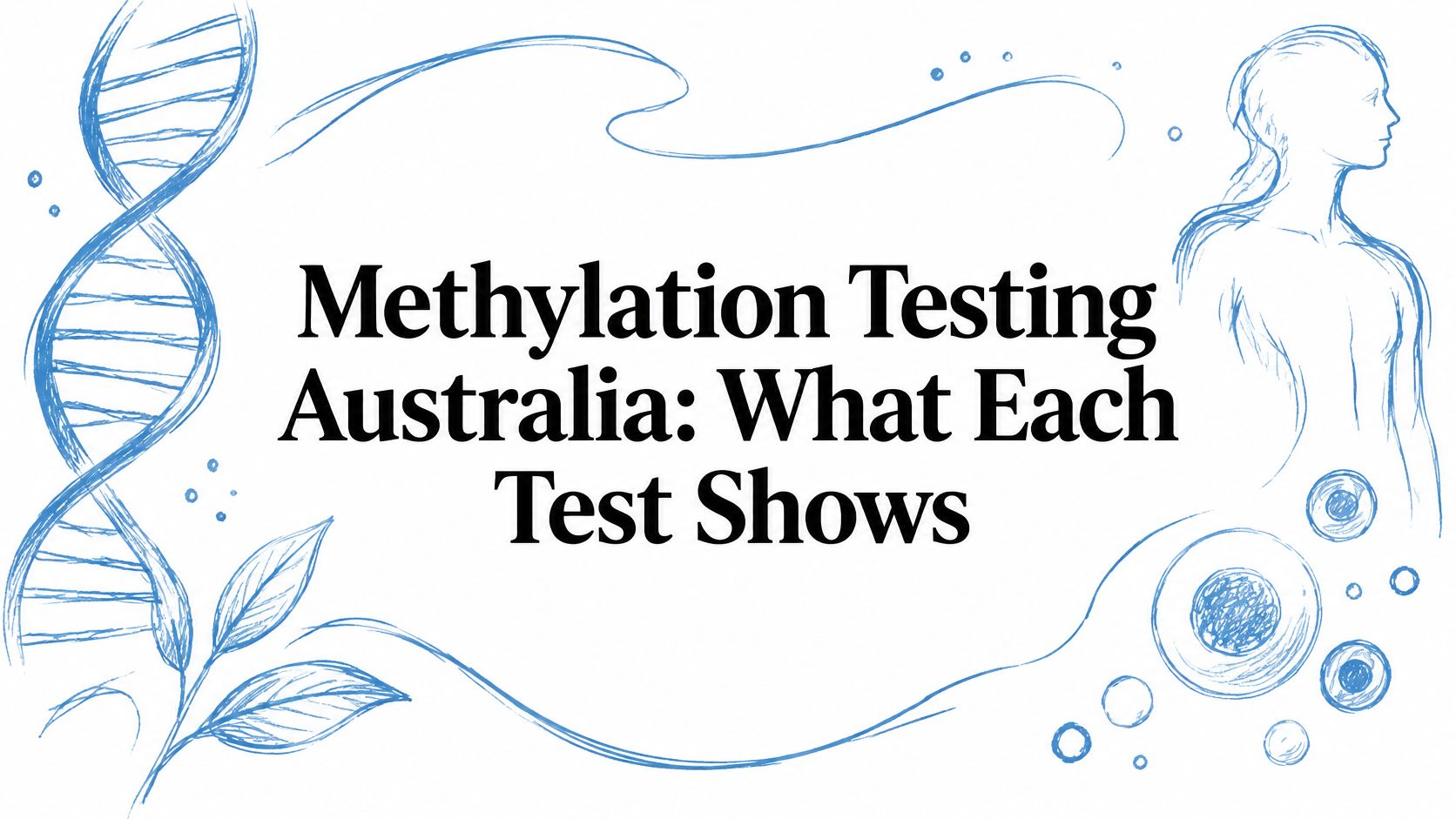
The popular advice treats a methylation test as a single answer for fatigue, low mood and fertility, then points you toward a supplement stack. That advice collapses four different measurements into one word. In Australia, methylation testing can mean an epigenetic assay, a biological-age panel, an MTHFR genotype, or blood markers of one-carbon metabolism. A gene variant is not the same thing as impaired methylation, and an abnormal genotype often changes nothing a clinician would do. What can change management is a result tied to a defined disorder, or a biochemical marker that can be checked against symptoms, diet and medicines. The rest mostly adds anxiety.
Methylation Tests Compared at a Glance
| Test type | What it measures | Typical use in Australia | Evidence status |
|---|---|---|---|
| Epigenetic DNA-methylation assay | Methylation at defined genomic sites | Research, newborn screening programs, targeted diagnostics | Established for defined imprinting disorders |
| Methylation-age (biological age) panel | Estimated age from blood methylation patterns | Consumer wellness panels and research | Not a standalone diagnostic test |
| MTHFR genotyping | Common gene variants in the MTHFR gene | Ordered by some clinicians and consumer services | Routine testing not recommended by RACGP |
| Homocysteine with folate and vitamin B12 | Functional one-carbon metabolism markers | Clinically indicated work-up | Useful when clinically indicated |
Epigenetic DNA-methylation assays read chemical marks at named places in the genome. Specialist laboratories and research groups use them when the question is a defined condition, including some imprinting disorders, rather than general wellness. A screening program or a clinician usually orders the test. The result is strongest when the laboratory names the sites and the method.
Methylation-age panels turn blood methylation patterns into an estimated biological age. Wellness companies sell them, and research groups use related scores. The number is not a diagnosis. It does not tell you which supplement to start, and it does not replace a clinical assessment.
MTHFR genotyping reports common variants in one gene rather than methylation itself, and Australian professional guidance summarised for consumers says those variants have not shown a sufficiently actionable link with diseases such as thrombophilia or recurrent pregnancy loss, so the test commonly does not change management.
Homocysteine with folate and vitamin B12 is the functional check. When one-carbon metabolism is in question, these blood markers show how the pathway is running. They do not infer a fault from a genotype alone.
The single word methylation covers different biological layers, so a result from one row cannot be read as a result from another. The same trap appears with hormone panels: a cortisol test in Australia only makes sense once you know the assay and the clinical question.
Practical rule: Name the row your test belongs to, and check that the laboratory names the assay, before you interpret any number.
What Methylation Means and How to Read a Result
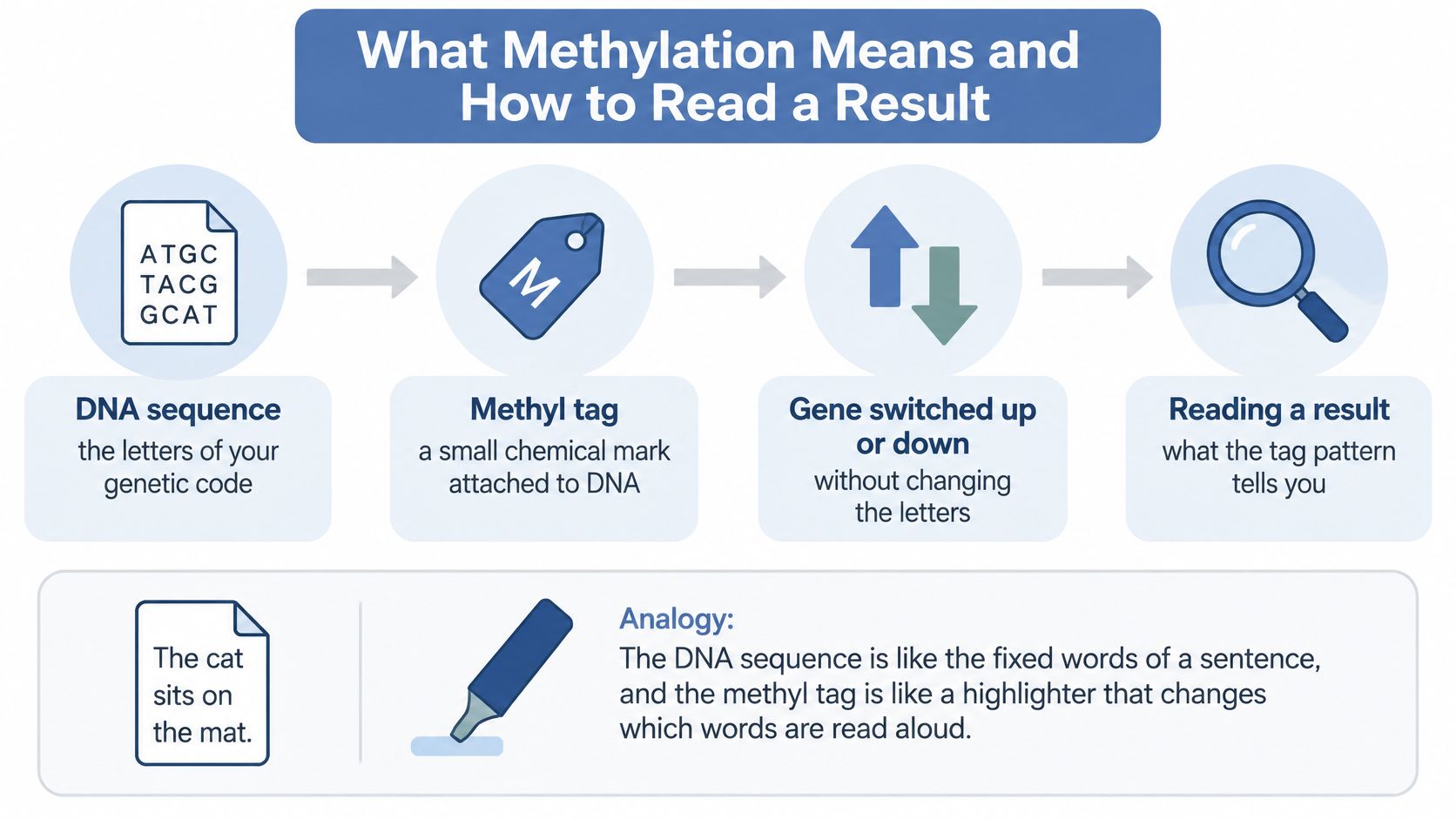
DNA methylation is a small chemical tag, a methyl group, attached to DNA. The tag can turn nearby gene activity up or down without changing the letters of the genetic code. Think of the DNA sequence as the fixed words of a sentence, and the methyl tag as a highlighter that changes which words are read aloud.
Labs are usually measuring one of two things, and they are not interchangeable.
- Site-level marks: Methylation at specific genomic positions. A 2024 Australian-linked study assayed more than 850,000 methylation sites on the Illumina MethylationEPIC array, as the study authors reported.
- Gene variants: Inherited spelling differences in enzymes such as MTHFR. That is genotyping. It does not measure whether methylation is impaired today.
There is no single universal methylation score for overall health. One number rarely signals a fault, because the value depends on the tissue, the platform, the reference group and the life the person has lived.
A biological age that did not separate future cases
An Edith Cowan University study followed 50 late-onset Alzheimer's disease cases and 51 matched controls for up to 16 years. Commonly used epigenetic-age-acceleration measures did not significantly distinguish future cases from controls during follow-up (p > 0.05). Three newly identified methylation biomarkers showed in-sample associations about eight years before clinical onset, but only nominal replication in an external cohort of 146 cases and 324 controls.
A reported biological age may help research or broad risk stratification. It does not establish disease, forecast one person's outcome reliably, or replace validated clinical assessments. If a wellness report prints a single age, ask which platform produced it and whether anyone has validated that marker outside the original sample.
The context a number needs
A reading also reflects the world around the person, not only their genes. In a twin-and-family study of 479 Australian women aged 40 to 78, floods were associated with altered methylation at 164 CpG sites, according to the open analysis of that cohort. An association at that scale is not a personal diagnosis.
Before anyone treats a figure as clinical, the report should state:
- Tissue source: Blood, saliva or another sample, named explicitly.
- Assay platform: The array, PCR method or sequencing approach.
- Reference population: Who the result is compared with.
- Leukocyte correction: Whether blood-cell mix was accounted for.
- Independent validation: Australian or external, not only the discovery sample.
- Clinical picture: Symptoms, medicines, diet and pregnancy status.
Say in one sentence whether your test measures a site-level mark, a gene variant or a metabolic marker, then ask the clinician what this result would change.
Where Australian Methylation Testing Is Heading
The serious end of methylation testing in Australia is a population screen for defined disorders, not a consumer age score. The Victorian Epi-Genomic Newborn Screening program, EpiGNs, is designed to assess approximately 100,000 infants for methylation-associated conditions including fragile X syndrome, Prader-Willi syndrome, Angelman syndrome, Dup15q syndrome and sex-chromosome aneuploidies, as described in the program report.

How a heel-prick sample moves through the lab
The workflow is built for scale and for confirmation, not for a wellness dashboard.
- Two punches from the blood spot: Each punch is 3.2 millimetres, taken from the newborn screening card already used for biochemical tests.
- A first-stage screen: Methylation-specific quantitative melt analysis, MS-QMA, looks for abnormal methylation patterns.
- Targeted confirmation: Follow-up uses methods including droplet digital PCR, EpiTYPER and low-coverage whole-genome sequencing, covering both methylation and copy number.
A 2014 demonstration showed MS-QMA could detect abnormally methylated alleles present in only 1% of cells. That sensitivity matters for people whose standard genetic testing was negative, because a low-level methylation change can be missed when a lab only reads the DNA letters.
The program is not only checking whether the machines work. It is meant to set clinically actionable screening thresholds and to estimate how common these disorders are in Victorian newborns. Parents do not buy this as a private kit. It sits inside a screening pathway with defined conditions and a second test before anyone treats a first-pass signal as final.
Targeted methylation testing is also moving into cancer genetics. A 2024 Australian molecular-diagnostics study built a BRCA1 and RAD51C promoter-methylation test designed for single-day library preparation and sequencing on any next-generation sequencing platform, as the test-validation authors reported.
That video is a plain-language walk-through of methylation as a biological process. It is not a product demonstration, and it does not replace the clinical threshold a screening program still has to set.
Australian laboratory work is concentrated on inherited and imprinting disorders, and on research that can name a decision. The consumer market, selling broad biological-age and wellness claims, is running well ahead of that evidence.
Why an MTHFR Result Rarely Changes Your Treatment
Say you pay for a consumer gene panel after months of tiredness. The report flags an MTHFR variant and a supplement list arrives with it: methylated folate, a B-vitamin stack, sometimes products you have never discussed with a doctor. The variant is doing the explaining, and the shopping list is doing the treatment.

The Royal Australian College of General Practitioners advises against routine MTHFR testing. There is no established causal link between common variants and particular diseases. No evidence-based treatment has been shown to improve outcomes based solely on variant status. There is little likelihood the result will change clinical management.
Where the test is specifically discouraged
The same guidance tells GPs not to use MTHFR testing for thrombophilia or recurrent pregnancy loss. Those are exactly the worries that push many people to order the test online. A variant in this gene is not a clotting diagnosis, and it is not an explanation for pregnancy loss.
Women of childbearing age are still advised to take standard folic acid, regardless of MTHFR status. The supplement advice does not flip because a genotype came back "abnormal" or "normal". Dose changes in pregnancy, when they are needed, come from obstetric risk, not from this variant.
What would actually change management
If the result is abnormal, the usual answer is that nothing in the treatment plan changes because of the genotype alone. Decisions sit with:
- Homocysteine, folate and vitamin B12: Measured in blood when the pathway is in question.
- Symptoms and medicines: Some drugs and illnesses move these markers without any gene test.
- Diet and pregnancy status: Folate intake and pregnancy planning already have their own advice.
A normal variant is not proof that methylation is fine. An abnormal variant is not proof that methylation is impaired. Repeat genetic testing adds another copy of the same unhelpful fact. A clinician-led blood check is the useful next step when there is a real biochemical question, because it can be high, low or normal in a way that alters diet advice, further investigation or reassurance.
Ordering the genotype to settle anxiety usually does the opposite. You leave with a permanent label and no new action.
Costs, Referrals and Turnaround
Price pages for methylation-style tests are often incomplete until checkout. Before you pay, write down the total listed price, whether that figure is shown before payment, and whether collection, consultation or a written report is billed separately. If a line is missing, treat it as unpaid only after you have asked. Do not assume it is included.
Referral, rebate and the clock
Referral rules differ by seller. Some online services accept an order with no GP referral. Others will not collect a sample until a doctor has requested it. Private blood tests in Australia can be ordered without a GP referral, including through our online pathology requests, but that does not mean every methylation or genomics seller works the same way. Read the checkout rule for the test you are buying.
Rebates are test-specific. Ask whether any Medicare benefit or private-cover payment applies to that item. If the provider does not say, record the answer as not disclosed. A wellness gene panel and a pathology biochemical test are not billed alike, which is why people comparing blood tests not covered by Medicare need the item name, not a category label.
Turnaround needs a start point. Note the stated reporting time in days, and whether the clock starts at collection or when the laboratory receives the sample. A "five-day" promise that begins at receipt can still mean more than a week if the kit sits in transit.
Ask for a written quote that lists each fee, the referral requirement, the turnaround and the refund rule when a sample fails quality control. Newborn screening and research programs are not sold to consumers, so these questions apply only to tests you order yourself.
Two quotes are comparable only when they name the same assay, the same turnaround start point, the same referral rule and the same total price.
Privacy and Provider Checks Before You Order
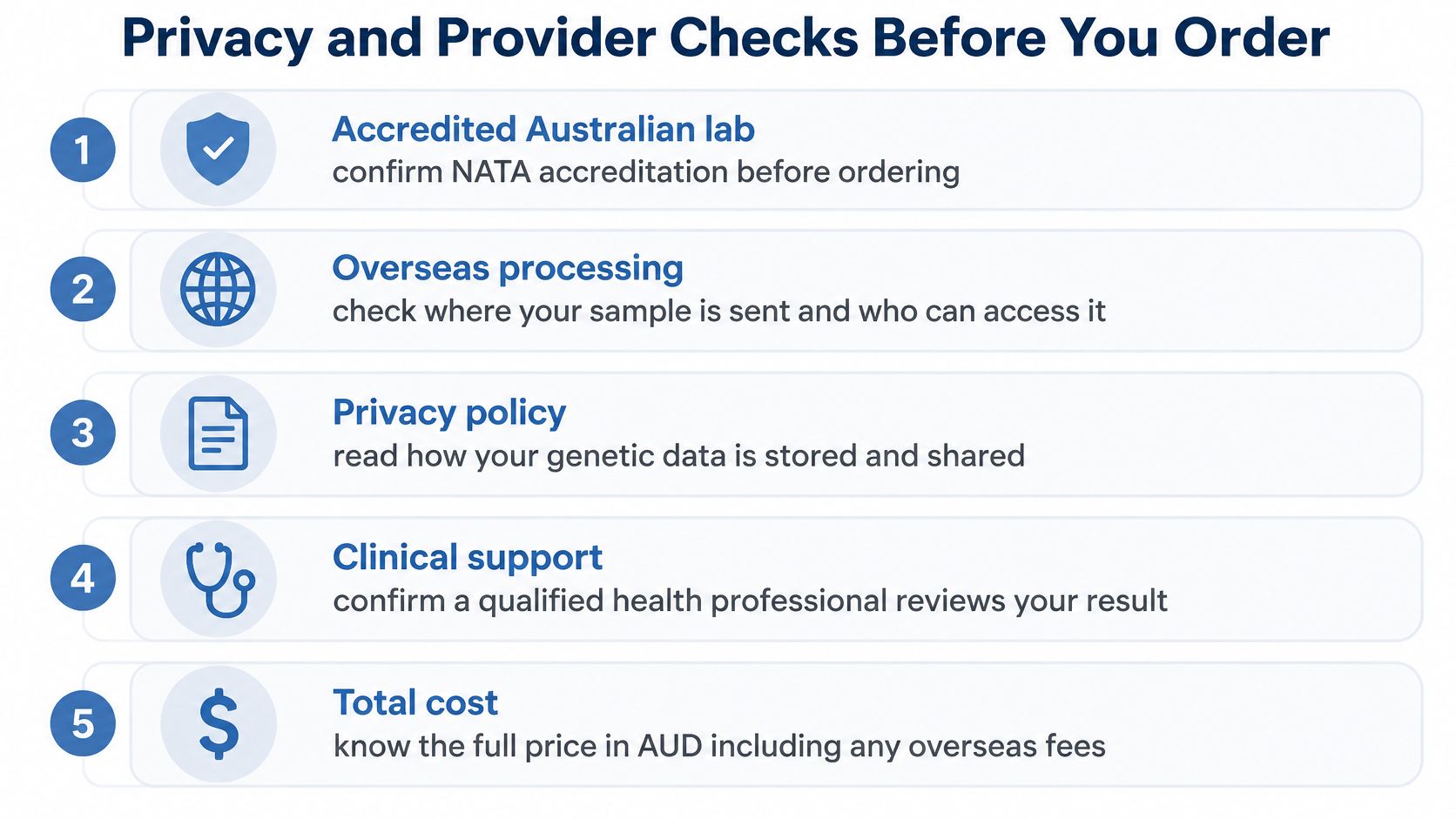
Accuracy is the question most buyers ask. The harder question is who keeps the sample and the genotype afterwards. Direct-to-consumer genomic testing can involve laboratories and companies in different countries, with different regulation. The Human Genetics Society of Australasia position statement warns that overseas providers may fall outside Australian regulatory oversight, and that genomic data may be shared or sold to third parties.
An accredited Australian laboratory is not the same thing as an offshore consumer platform that posts you a kit. Privacy protections may not travel with a sample or a dataset once it crosses a border.
Four questions to answer before you pay
Where is the sample stored and processed, and in which country? Oversight follows the laboratory, not the website you ordered from. If the location is blank, you cannot tell which rules apply.
How long are the sample and the genetic data kept? A short testing window and indefinite research storage are different products. The retention period should be a number of months or years, not "as required".
Can the data be shared or sold? Marketing language about "de-identified research" can still move data to partners. You want a yes or no, and the names of the recipient types.
Is fresh consent required for any reuse? A tick box buried in terms and conditions is a weak basis for a second project you never heard of.
Australian privacy guidance treats genetic information as sensitive health information. It can reveal information about biological relatives. Disclosure to those relatives without consent is allowed only in narrowly defined circumstances, where it is necessary to lessen or prevent a serious threat to their health or safety. Perceived anonymity is a poor comfort when a result is about a family, not only about you. People who order pathology without a referral still need the same clarity on who holds the record.
Five checks any provider can be tested against
| Criterion | Good sign | Red flag |
|---|---|---|
| Laboratory accreditation | NATA-accredited testing confirmed in the lab's own documents | No accreditation stated |
| Named assay | Platform and method named for the test | Vague methylation score with no method |
| Clinician review | Qualified doctor explains the result and next steps | Results sent with no clinical discussion |
| Reference population | Population the result is compared against is stated | No reference population given |
| Collection access | Named pathology network with centres in your state | Collection location unclear until after payment |
We use NATA-accredited laboratories, and our collection centres are NATA accredited. Collection runs through five pathology networks covering every state and territory: QML Pathology, Laverty Pathology, Dorevitch Pathology, Western Diagnostic Pathology and TML Pathology. That is a collection fact you can verify. It does not make a consumer gene score into a diagnosis.
Red flags are blunt. No named laboratory. Storage country missing. Research reuse tucked into terms. No route to request deletion. No clinician who will say what, if anything, should change.
Request two documents before you pay: a written data statement covering storage, retention, sharing and consent, and a written pass or fail against the five checks above.
If you want blood markers a clinician can act on, rather than a genotype sold as methylation, Vital iQ Health provides private pathology panels across Australia, with online ordering, collection at NATA-accredited centres, and telehealth GP review of the results. That is the layer that can sit beside symptoms, diet and medicines. See the panels and collection options at Vital iQ Health.